
Hosted on Acast. See acast.com/privacy for more information.
[00:00:22] Hello, this is Garlic and Pearls, the podcast which looks in great detail at what makes the French so French and the British so British. The French case is presented by Muriel Zagha and I, Suzanne Raine, try and explain the unique properties to these remote distant islands that we inhabit.
[00:00:44] So, today Muriel you're going to explain something that is distinctly French and why it is so French. Yes, well I'm going to attempt to at any rate. Today, Suzanne, I'd like to tell you about Toile de Jouy which is a French fabric.
[00:01:08] It's a place, it's a place name. Do you know the sort of thing I mean? Do you know the sort of fabric I mean? I do know the sort of fabric. Does that mean anything to you? I absolutely do know because it goes through phases of being incredibly fashionable in interior design. And then… And indeed fashion. And fashion. Oh, right. And fashion. Yeah. Less so than in interior design I'd say where that's where I've come across it most.
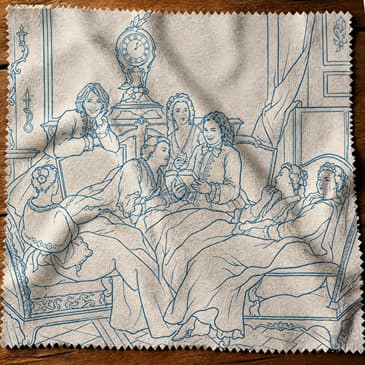
[00:01:36] Or there may be Vivienne Westwood. Exactly. That's what I know. If you try to describe it, how would you describe Toile de Jouy? What do you see when you visualize it? So it's a fabric which is usually two colors, usually a sort of cream background and then tones of blue, red, ochre, sort of mustardy colors printed on with pastoral scenes.
[00:02:00] Often a sort of shepherdess lady sitting down, some kind of nymphs. I don't know whether they are nymphs actually. There can be nymphs. Yeah. I have to say, actually, I bought some fabric which was like next generation Toile de Jouy a long time ago now, which had kind of elephants on and things like that. So it was in the style but not the same pictures as what I think of as being traditional.
[00:02:29] But you're going to tell me that elephants have always been in it. And that's fine too. Well, elephants are not forbidden. There's no, I mean, that's the interesting thing about it is it's actually a lot more diverse than I realized when I went into it. So my way into this is in childhood.
[00:02:46] So maybe when I was four or five years old, Toile de Jouy, I would say, is the first textile, the first fabric that I remember becoming aware of, noticing, you know, as a small child and liking and commenting upon. So when you're little, unless you're born to be a textile designer, which I didn't think I was, you don't ordinarily notice fabrics very much. But this one, of course, had pictures on it. So this was in my great aunt's house. And there was a bedroom.
[00:03:14] And I mean, this is all transfigured by memory. But what I remember was that there was a bedroom with a bed that was upholstered in Toile de Jouy and had maybe a canopy or some curtains to it as well, which were also matching Toile de Jouy and possibly also the curtains in the room. So there was a sort of maximalist effect of this print. And maybe Toile de Jouy wallpaper as well. That would be my dream. And on the ceiling.
[00:03:42] Yeah, I would ideally live in that space. But I was I remember being completely dazzled by it. And the pattern was exactly as you described, sort of bucolic scene with shepherdesses and sheep and the little cottage. I mean, just absolutely charming. And when you're a little girl, this is very appealing. You know, anything featuring animals and women is great. So you can project yourself into it. And I suppose I loved how much of it there was in the room.
[00:04:07] This fabric, instead of just a cushion with a print, the whole room appeared to be upholstered in this fabric. So I remember saying, this is beautiful, you know, and my mother said, well, that's called Toile de Jouy. And I remembered it. So this is how children are educated in France. And I suppose, you know, in the same way that you grew up with tartan or you grew up with tweed or you grew up indeed with the blue willow pattern plate.
[00:04:31] There are these textures or pictures, sometimes both, that really accompany us through our lives and they're part of our collective identity. So that's why I think it's very French and associated with France. I don't mean by that that all French people have Toile de Jouy in their house, but a lot of people have a bit. So if you have a chateau, you will have some Toile de Jouy in one of the bedrooms or more.
[00:04:56] If you have an ordinary French home, it's very likely that there will be maybe a tray or a cup or something that has a little bit of Toile de Jouy pattern because we do like it. We cleave to it. So it's a bit like the blue willow, the spode thing in a way. So what is it really? Toile de Jouy, literally, it means fabric from Jouy. So the fabric in question is cotton or linen. Does Toile just mean fabric or is it a specific type of fabric?
[00:05:26] So Toile is a word that I think we use in English to mean, you know, when you're having a dress made by a dressmaker, the sort of calico stage where the dressmaker makes a sort of mock up of the shape of the dress or whatever in cotton, usually a light cotton, is called a Toile. And that, I think, tells you a little bit of what the fabric is like. It's a light cotton or linen. I think it could be linen as well. Fabric light as opposed to, you know, heavy wool or as opposed to silk. It's not silk.
[00:05:56] It's cotton. And it's originally the inspiration for it was the Indian cotton fabrics, which in France we called indienne. Because of the East India Company's very enterprising trading, they started bringing those Indian cottons, printed cottons, crucially printed with colors and images from India in the 1600s.
[00:06:21] And in France, certainly we started calling them indienne, these cottons. And then we started making our own, but largely inspired by Indian cottons and by Indian techniques of printing, although we then developed our own ways of printing those fabrics. And so that's the Toile bit.
[00:06:41] And then the Jouy bit is a reference to the place, Jouy-en-Josasse, which is a village not very far from Paris, southwest of Paris, but it's really quite close to Versailles, into the chateau of Versailles.
[00:06:55] And this is where a manufacturer plant was created to make these fabrics or the most famous of those plants, because of course, as with a lot of other things, there was a man, there was the founder, and I'm going to tell you more about him in a moment. And he started it all, but other competitors started making similar fabrics in other parts of France and indeed elsewhere.
[00:07:20] But he was really the inventor, and I think that's because he was entirely excellent at it in every way. So I'll tell you a bit more about that. Jouy-en-Josasse is still there. The village still exists. There's a museum of Toile de Jouy there, as you would expect. But the factory is gone, long gone. There's almost nothing left of what was, once upon a time, almost the little empire of making these amazing fabrics, these very distinctive fabrics.
[00:07:50] What's left in the courtyard of the mairie in Jouy-en-Josasse today is the bell. You'll like this, Suzanne. You see, you like bells. Love a bell. It's the bell they used to have to summon the workers to work in the morning. Oh, the tolling bell. Well, workers, which of course in those days, which have included children because, you know, it was a long time ago.
[00:08:10] This Toile de Jouy is a light weave, cotton or light linen, and printed always, so never plain, always printed with pictures, either decorative flowers or sometimes sort of semi-geometrical things, or figurative. And it's the figurative one that I think has really taken hold of the imagination.
[00:08:30] But in fact, looking at the website of the museum, the Musée de la Toile de Jouy, I discovered that in the time that Toile de Jouy, the Fabrique Oberkamp, it was called. I'll tell you more about Monsieur Oberkampf in a moment.
[00:08:44] In the time that it existed, they produced about 30,000 different patterns, out of which only 200 are the sort of bucolic pastoral type that we all love, which feature swains and shepherdesses and cottages and maybe a little donkey or something like that. Swains. You see, only you could have used the word swains. I would never have thought about it, but that's what they are. They are swains. Lots of swains, lots of swains on Toile de Jouy.
[00:09:12] And so there are these figurative Toile de Jouy that show people doing things. And as you said, again, usually it's one colour only. So this is what we imagine, I think, a drawing in maybe red or purple or green or blue on a cream or maybe a sort of oatmeal background. Sometimes it can be reversed. Sometimes it can be the drawing is oatmeal, but on a maybe dark red background. You get that.
[00:09:39] And they also made a lot of polychrome designs, which are less somehow have not been remembered as clearly because I think they were less about storytelling. That's my take on it is that they made some beautiful polychromatic floral designs with garlands and so on, very intricate. I mean, not just as brilliant as, say, William Morris, you know, just as interesting.
[00:10:05] But the ones we remember are those couple of hundred ones that tell stories. And there are reasons for that, I think. The founder who invented Toile de Jouy at a time where, of course, a lot of people were making textile, were weaving and spinning and learning to print and dye and doing all these things. So he wasn't on his own, but he was a special man. He was so special that he gave his name to a street in Paris and a metro station, Oberkampf.
[00:10:34] And I've been down that street and got off at that metro station many, many times without ever asking myself who was behind the name. I always assume it's battles. But in this case, it's not a battle. It's the name of a man. And his name was Christoph Philipp Oberkampf. How do you spell Oberkampf with a... Yes, it's very Germanic, isn't it? That's because he was actually German. With an O at the beginning.
[00:10:57] Yeah, so O-B-E-R, Ober, and then Kampf as in, you know, K-A-M-P-F. But that's entirely German. So it's a very, very German name. He was born, this man, he was born Christoph Philipp Oberkampf in 1738 in Wiesenbach in Germany. He died in Jouy-en-Josasse, the place where the factory was, in 1815.
[00:11:27] And he died at his home, which was next to the factory. So that's the arc of his life. He comes from Germany. He ends up in France, having built this amazing heritage brand. He came from a family of dyers, of professional dyers, a family line. I think several generations of people who were very good at it. And he learned the trade from his father, who was a manufacturer of printed cottons in Switzerland.
[00:11:54] So Germany, Switzerland, it's that kind of axis. And then in 1756, when he was 18 years old, Christoph Philipp decided to spread his wings. And he left his father's business. And he moved to Mulhouse, which is a town in Alsace. Alsace being one of those French provinces that was sometimes German, sometimes French. It's changed so many times that at the moment it's French. And, you know, we're clinging to it.
[00:12:23] And he was hired as an engraver at a textile printing work in Mulhouse. And then two years later, when he was 20 years old in 1758, he went to Paris. So, you know, in French, when you move from a provincial town to, for a provincial city, even to Paris, you always say monter à Paris, to go up to Paris. We always go up. Even if we come from the north and we go literally south to Paris, we go downwards, but actually on a map, I mean.
[00:12:52] But actually, you always go up to Paris in the collective imagination, much to a lot of people's annoyance, because it's very arrogant of Paris, of course. But we do the same, actually. We do the same. There are places you go up to. And that's just how it is. Can I offer a reflection that it's interesting to me that he was an engraver, because we've had quite a lot of characters as we've gone on our Garlic and Pearls Odyssey,
[00:13:20] who have started off as engravers, certainly as apprentices. And because engraving was fundamental to literature and art, basically, they've then gone on to, do you remember the one on Jigsaw Puzzles, where he started off as an engraver and he engraved maps, which, of course, then takes you in a whole other direction. Where cut up and turned into Jigsaw Puzzles, yeah.
[00:13:47] And then, obviously, the willow pattern thing is all about engraving and transferring of patterns as well. But it's quite striking that it was such a sort of critical element of industrial development that those people who learn that craft gave themselves all sorts of opportunities in different directions. And Mr., or should I say Herr Oberkampf, Herr Oberkampf at this stage,
[00:14:15] was acquiring life-transforming skills by becoming an engraver. He was. Yeah. He was. He was. And you're quite right. I had remembered that. I remembered the Jigsaw Puzzle and the sort of engraver scene in London that you evoked so well in our episode on Jigsaws. When he starts working in Paris, he's working as an engraver and also as a colorist. Interestingly, he was very curious about color.
[00:14:41] And that reminded me of our episode on the four-color big pen. So the baron, you know, the dastardly baron beak. He had started in inks. He'd learned about inks and ink colors and the inks that were very fast and so on. And then he moved on to pens and the sort of mechanics of a complicated pen, like the four-color pen. And again, the baron beak, he was Italian. I think we ascertained. And so you get these people from elsewhere who bring with them a different tradition.
[00:15:12] You said that really interesting thing about skills and people who bring skills, you know, and give themselves all kinds of opportunities because they learn this one skill of engraving. So in that context, it's interesting to make a quick leap in time at this point. You know, I told you that these Indian cottons with vivid prints on them began to be imported to Europe in the 1600s. And people loved them.
[00:15:38] And especially, you know, if you've been wearing a sort of scratchy, woolly cagoule all your life, essentially, or hood, you're seduced by these lovely light fabrics. People loved them. And the silk and wool industries in France were alarmed by the arrival of these competing fabrics. So there was a little bit of a defensive panic against them in France.
[00:15:59] So much so that in 1686, Louis XIV, so this is the Sun King who often recurs in our podcasts, he announced a ban on Indien, on these Indian cotton fabrics, which was enforced until 1759. So a long time, a long time without these cottons. Although when I say without these cottons, because they were lovely and the aristocracy loved them, people could still find ways of getting hold of them.
[00:16:28] So for example, Madame de Pompadour, who was the mistress of Louis XV, and very fashionable, as you know, she had her entire house upholstered in these Indian print cottons, and she wore them as well. So that's the thing about being the favourite is you don't have to follow the rules. And a lot of other people a bit like her. So they were illegal, but... They were illegal, but the elite could get hold of the forbidden toile
[00:16:53] and have them in their house and wear them at court and nobody said anything. But ordinary people were not allowed to have them. There was a similar reaction in the UK at that time to the foreign imports of beautiful Indian cottons for exactly the same reason, because it threatened our own textile industries. And that's entirely understanding. You can see how you had groups of textile workers in the UK sort of lobbying government
[00:17:23] to impose import duties, all sorts of things to sort of... And you're making me reflect. Do you remember the episode we did on bobble hats and berets, where because of the threat of foreign imports to the British wool industry... There was an act of parliament. Act of parliament making it illegal not to wear a woolly hat for a long time. Exactly. So it's a similar thing, because I think in the case of... Sort of state intervention.
[00:17:52] In the case of those threatening cottons from elsewhere, there wasn't an outright ban in Britain. There was in France. And as a result of that, so that's protectionism, you know, as a result of that, France fell behind in terms of technique, because in Britain, in Germany, in Holland, in Switzerland, and other places, there was a little bit of protectionism. But I think the industry was allowed to continue apace.
[00:18:22] And so when the ban lifts in 1759, and our friend Christophe Philippe Oberkopf? is employed in Paris at a printer's plant, textile sort of little manufacturer workshop, it's the time when you can start again to explore these techniques. And he has a lot of savoir-faire, to use a French word, not a German word, from his family, because he is German, that he can then apply.
[00:18:51] So he was away for France to catch up very quickly in an area where we had lagged behind because we were protecting the silk weavers of Lyon or whatever, which, you know, again, you can understand the reasoning behind all these things. But there is a little bit of a price to pay in terms of competitiveness. And then Oberkampff brilliantly was there. And he knew how to use the color blue for printing, which was incredibly difficult, but he had a special technique to do that.
[00:19:17] And he had been taught from infancy all kinds of skills that in engraving, but also his sense of color, manners of printing fabric durably to make the print really fast, you know, all these things he knew a lot about. That's ever so interesting because it also shows, not to get too political about it,
[00:19:38] but what happens when you do accept immigrants who bring new skills and perspectives into an industry or a working environment? And they say, well, actually, how do you think of doing it like this? It's absolutely that story. It's a fantastic illustration of that. And at this point, Suzanne, I think we need to take a little bit of a break and maybe go and drape ourselves in a little bit of Toile de Jouy and walk up and down a path in our garden
[00:20:06] and then come back into our little chateau and continue our conversation. And we're back. Oberkampff by this stage has accrued enough experience in 1759. And he wants to set up his own business. And so he goes into partnerships. I found different versions of this. I know that he partners with his brother, who's called Frederick Oberkampff, and he's also got an investor who helps him.
[00:20:35] And in one of the sources I read, the investor is a man who was also a member of the Swiss Guard of Louis XVI. He'd honestly set some money aside. It's a strange story. And also you can imagine what sort of person he would be, like a sort of heavy, you know, big, strong guy, but who had an interest in going in with Oberkampff with this German, this random German guy to build a textile empire from nothing.
[00:21:04] So they found a location. It makes you want to go and read novels, doesn't it? Or indeed write them if they don't exist. It's all very Three Musketeers. It's wonderful. So he found a site in Jouy-en-Josasse. So this is the village just a few miles from Paris and Versailles. So near the center of power, always a good idea. With a river nearby, you need a lot of water for dyeing fabrics, for washing fabrics and so on. You need access to flowing water.
[00:21:33] There's a wood so you can cut down wood and you use it for firewood to power your machines. Plenty of meadows for drying fabric in the sun and plenty of space for building because they start small, but then they go quite big towards the end. It's a massive enterprise. So he harnesses some of his skills, the process for printing the color blue, which was especially tricky. So other people didn't quite know how to do it, but he did. His father also helps by lending him
[00:22:02] some skilled workers of his own. So you start, you know, you're way ahead and also sending him extra wide bits of toile that are not readily available in France. You know, little things like that that actually make an enormous amount of difference in terms of your production. So he has all this advantage of know-how, of savoir-faire. They start manufacturing in 1760. So as soon as they are able, it goes very well. And demand grows and grows. And so in 1764,
[00:22:31] they expand the scale of the business. They acquire more land. They add more buildings. By 1774, they're employing 900 workmen. So that's quite a lot. And then in terms of his migrant story, in 1770, so after residing in France for 10 years, Oberkampf becomes naturalized. So he becomes a French subject of the king, as was still the case then. He was partnered with his brother, Frederick.
[00:23:00] He also had a very clever nephew. Again, your jigsaw story, I think, had a lot of family. Oberkampf has a very useful family also. So he had a brilliant nephew called Samuel Widmer, or Widmer, I guess, who was brilliant at printing techniques and engraving. And so in the beginning, when they start making their toile in Jouyens-Josasse, they're using a technique really borrowed from India, which is using wood blocks. So you print using wood blocks.
[00:23:30] You know, you go sort of all over the fabric like that. Samuel came up with the notion that you could use engraved copper plaques, but not just that, because of course he didn't invent that, but he devised a way of curling these copper engraved sheets onto cylinders so that you can roll a pattern on and on, onto the fabric. So it's the beginning of a more industrialized,
[00:23:59] we're still in a very artisanal setup, but it's the beginning of mechanization, isn't it? And again, that's something they had ahead of competitors that allowed them to produce more things more quickly. The arc of this story is similar to the willow pattern, the sort of spode-wedgewood thing, because it was that question of, how do you develop the technique to take the pattern from one form, a copper plate, and to put it on another form, in the case of willow pattern, a real plate,
[00:24:28] in the case of the fabric? Yes. And that, it sounds easy where you say, where they just, they engraved it onto the copper and then they made it into a roll and then they rolled it on. But actually when you have a piece of hard copper, bending it over without distorting, for example, you know, you have to put effort into that. So you can imagine there was someone saying, how can I do this? What's the best way? And that's creative invention. Yeah. It's very Vorsprung durch Technique, isn't it? Not terribly French at all. It really is the German mindset.
[00:24:58] Yeah. Well, we benefited from it immensely, but it is a very Germanic approach, I think. Really interesting. So Technique, very important. Of course, technical skills. Also artistry. Artistry and taste. And that's where, again, he was, Oberkampf was a little bit above the competition because he had a wonderful visual sense. So he was really into Rococo art, you know, all this very ornate style of architecture
[00:25:27] and interior designs and indeed fabric and portraiture that we associate with the 18th century. So if you go to the Wallace Collection in London, for example, it's just kind of Rococo paradise. And Madame de Pompadour, again, is the queen of Rococo. And he had a really good sense for that. He understood ornamentation and refinement. And he also hired some proper artists to draw the cartoons,
[00:25:55] which were then used for the designs. So in particular, there are several, but in particular, a painter called Jean-Baptiste Huet, H-U-E-T, who was, you know, his paintings are in the Louvre. There are, he was famous. Fragonard, another famous French painter, also contributed designs. So he really understood that you have to get the best on board. Maybe, you know, maybe you're making fabric to upholster a chair, but it matters that the designs should be really beautiful
[00:26:24] to appeal to your clientele, which is the elite clientele. We have a lot of money and are very happy to buy all your designs. So they're the people you're sending your books of patterns to out to your good clients, you know, in this select. And of course, this is before the revolution. Money was no object. People were spending very, very lavishly. If you watch Dangerous Liaisons, you know, the Stephen Frears movie, which is just a riot of fabrics. I mean, I know there's a story there as well, but if you are a bit of a fetishist
[00:26:52] for fabrics and patterns, it's a joy. There's some Troil de Jouines there as well. So it's all going really, really well. The fabric is expensive. So it's not a cheap thing for the people, but it's very popular. And the aristocracy, the court, are buying loads of it. So Queen Marie Antoinette, wife of Louis XVI, she loved it. She visited the factory in 1781. She had a lot of Troil de Jouy on her person
[00:27:21] and in her home. In 1783, Louis XVI, who also loved the fabrics and the prints and was aware of what good exports they were, because all this brings in revenue, of course, with great success. He granted Oberkamp's business the status of a manufacture royale. So that's like by royal appointment. It's a very prestigious sort of branding. And then in 1787, Oberkamp himself is granted
[00:27:50] a coat of arms and a motto. So not only is he French, he's also a minor noble, but it's still a massive, massive step. What is his motto? The motto of Christophe Philippe Oberkamp was recte et vigilante, which translates from Latin to mean uprightness and vigilance. Oh, that's such a good motto. Which, of course, we should all adopt that motto. So it's a good motto.
[00:28:20] And it's also important when you're at the head of a place with a lot of machinery, you know, you have to be vigilant all the time, but also upright. So there we are. That's a Germanic motto, actually. Very. Yeah, yeah, yeah. You can hear it in German somehow. So we talked about the artistry in terms of his hiring of, you know, high profile artists, very distinguished artists. What's also interesting is how,
[00:28:47] and I think that's partly why we remember and people at the time were attracted to and we are still attracted to, the scenes that show people doing things rather than just lovely garlands of flowers, which can be very beautiful. But what's most interesting about Toile de Jouy, I think, is that in its designs, it reflected the times, the changing times. So in the 18th century, when things began, really,
[00:29:18] you can see from some of the patterns, some of the ideas of the Enlightenment. So an interest in science, for example, the first hot air balloon flight, there's a pattern of that. You get brilliantly a pattern which is called les travaux de la manufacture, the works of the manufacture. And that is a meta design about Toile de Jouy, about the making of Toile de Jouy. Because the Enlightenment was also all about
[00:29:47] working out how to do things, progress, you know, and industrial progress. So there's a beautiful pattern, which is still very popular, which shows the 14 stages of making Toile de Jouy. So you see women washing the fabric in the river and then children pinning the lengths of fabric in the fields. You see the engraving process. Those patterns are repeated on the fabric. I think that's quite interesting.
[00:30:16] That's gorgeous. The interest in industry, it is gorgeous. Then there's a lovely one called the Coronation of the Rose Queen, le Croonnement de la Rosière, which shows a young woman receiving a crown of roses at the hands of a sort of a lord of the manor. And this is harking back to a custom dating from the 5th century, where the seigneur de Salancy, who was also a bishop, he was the bishop of Noyon, he introduced a custom,
[00:30:46] which, I mean, there are many versions of this custom in his fiefdom, where he would reward the most virtuous girl, the most virtuous local girl living on his land with a gift of money and the crown of roses. And then there was a pageant, you know. And so, actually, these kinds of traditions still survive in France today. It's interesting. Do you have anything like that still? Like the May Queen, you know? Yes. Those kinds of very bucolic celebrations of beautiful young women. I think, though, I suspect that
[00:31:16] we do them, but we do them as a kind of enthusiastic rediscovering of traditions that we accidentally lost when we had the Industrial Revolution, rather than as a serious crowning of the, I mean, I had this sense... As a continuous thing. Well, I think you showed me some stuff. I don't know whether it still is a serious thing in France, actually, or whether it's similarly a kind of... It's certainly serious. You know, my parents have a
[00:31:45] house near the Swiss border, in fact, and in the village where they are, there is still a tradition for crowning a girl, maybe not every year. I think they do it every few years and she's called la reine de l'oiseau, the bird queen. I don't know why, l'oiseau, but she's the same thing as she's supposed to... I mean, nowadays, there's less emphasis on virtue, you know, explicitly, but certainly it's a young maiden, a young woman from the village who is perhaps perceived
[00:32:14] as a really nice member of the community, a lovely person and also beautiful and then she's crowned and there's a bit of a procession. Maybe that's Catholicism as well, you know, you remain attached to these kinds of displays. Anyway, other exciting patterns of 12 de Jouy, I think, exciting. There's, fascinatingly, there's one which is called La Liberté Americaine, American Liberty, and it celebrates victory at the Battle of Yorktown
[00:32:44] in 1781 where French and American troops defeated the British General Charles Cornwallis. Of course, we have to celebrate that in the 12 de Jouy that we can put on our walls and furniture. Yeah, well, you have to have something to celebrate because let's do it. There's that. So this is all pre-revolutionary. So then what happens, of course, the French Revolution happens. No. And oh, what's going to become of 12 de Jouy at the hands
[00:33:14] of the revolutionaries? I don't think it's a very revolutionary fabric. Eric. Let's take a break now and we'll come back and I'll tell you if you're right. Okay. And we're back. So, French Revolution, Liberté, Égalité, Fraternité, all of that, chopping off the head of the king, poor Marie Antoinette is also done for. What happens to 12 de Jouy, do you think? Do you think it's the end? I think Napoleon wraps himself in it and his horse
[00:33:43] and maybe it's why if he'd been less obsessed with 12 de Jouy, he might have done better at the Battle of Waterloo. Who knows? So you're right about Napoleon but even before we get to him during the revolutionary period, it's fine and Oberkampf negotiates this quite cleverly. There's a kind of revolutionary compatible adaptation of the designs there's one for example again designed by Jean-Baptiste Huet
[00:34:13] the same artist as before there's one called La Fête de la Fédération the Feast of Federation which commemorates the big national unity celebration in 1790 on the Champ de Mars following King Louis XVI swearing an oath so this is before before the king is killed obviously and Lafayette is on the horseback in that design as well. It's all the nice things and this this is very pleasing to the revolutionaries they don't mind he also
[00:34:42] Oberkampf gets himself elected as the first mayor of Jouillon-Josers because the revolutionaries rearrange all the administrative districts the new departments we've talked about this before a little bit and the new localities and so suddenly Jouillon-Josers which is just a village has a mayor and this mayor is Oberkampf and you can see how that would happen because he's obviously created a lot of jobs he's a very important figure I think this requires quite a lot more investigation because
[00:35:12] is he still in league with the Swiss Guard guy? I think the Swiss Guard guy is we know very little about him I wish I could tell you his story but I don't know in my mind he's become a pirate because I think he's that sort of person but this is completely my own interpretation this is pure fiction I should say I don't know but it's interesting that Oberkampf who was protected by the king and very much on the inside of the Ancien Régime
[00:35:40] manages to sail pretty unperturbed through the revolutionary era I think there's one incident recorded where one of his workers denounced him to the authorities to say he's basically a royalist he hasn't really changed his opinions but the complaint was not upheld and nothing happened and Oberkampf in his mercy even kept this particular man in the team nothing terrible happened to that man they sorted it out
[00:36:10] among themselves so he was obviously a master diplomat as well as all the other things as well as being a master colorist and all the other things that he did then Napoleon so yes you're right Napoleon loved Toile de Jouy was a massive supporter of Toile de Jouy and Empress Josephine also really liked it and so again Oberkampf manages that transition when the empire begins he introduces lots of lovely neoclassical
[00:36:39] designs which the revolutionaries already liked actually if you remember our episode about the revolutionary calendar and all these sort of neo classical women dressed like Greek nymphs who impersonated the monks it's very much like that so we like sort of draperies and things that are reminiscent of the Greeks and the Romans and Napoleon is mad for it to the point where he awards Oberkampf the Légion d'Honneur in 1806
[00:37:08] so as a sort of ascending arc it's quite something you're a local politician you're a captain of industry you've invented something that has become absolutely crucial to French industry by 1793 so even before the revolution Toile de Jouy was the second most important factory in France after something called the Manufacture de Saint-Gobain where they made glass so glassware
[00:37:38] super important and then Toile de Jouy because of course people used this for all kinds of things this fabric and it was exported it was exported very successfully but I'm also thinking because in the in the UK context at exactly this time if you remember when we were talking about the mills in Yorkshire that there was this massive boost because they had to turn out enormous quantities of wool worsted to equip our army
[00:38:08] and navy for fighting the French and you had at that time this is so French because you were still very much focusing on qualities such as beauty and aesthetic whatever so your first biggest factory is making glass and your second biggest factory is making lovely cottons with pastoral scenes and swains there you are that's it in a nutshell that tells you absolutely everything about our two nations and two very different temperaments
[00:38:38] it's true I can't deny it so yeah it's interesting also that you know I said Oberkampf was a genius because he was so good at harnessing best artists he was also very good I think at understanding nostalgia even even before it was quite the time for things to become nostalgic in the beginning of the 19th century so he's doing all these sort of neoclassical patterns
[00:39:07] but he's also doing patterns that are inspired by the fables of La Fontaine so you know La Fontaine 17th century poet he wrote these fables that are lifted from Aesop's fables where animals represent people and their moral fables and so there are quite a few I think a dozen different patterns of Tuel de Jouy that represent these fables which are so familiar to the French still you know you'd say
[00:39:36] almost 200 years after so in the 1800s they're still very familiar and today they're still being taught in French schools and I could recite a fable now but I won't do it I'll save it for another episode because we want to talk about La Fontaine another time so there are these very attractive patterns which are already about French traditions cultural traditions that people have grown up with so that's where he's modern and he also understands about
[00:40:06] the appeal of nostalgia and tradition that's an interesting thing but also in a revolutionary context that's fascinating because particularly Napoleon who's actually earlier as well where they tear down the calendar tear down time tear down this but let's still have fabric with these nostalgic fable scenes that's right we can't tear down everything so he he adapts yeah he adapts it's like you know
[00:40:36] we did an episode about playing cards remember and how okay so we begin to have kings and queens and they're sometimes inspired by mythological figures or kings and queens from the revolution comes and card manufacturers revise their figures to become allegories of justice and liberty and equality it's the same sort of process isn't it if you have a business you go well people will still want
[00:41:06] the product so we just have to adapt to the new prevailing ideology and it will be fine and let's go for something timeless like the fables which are about animals so it's not very obviously associated with any particular regime you know we can continue to provide that to do with childhood it's completely unthreatening to the regime so okay so Napoleon embraces Oberkampf in the way that Louis XVI had embraced him that is quite something to be the darling of both I think
[00:41:34] and so he reaches the summit of his glory with the Légion d'honneur by then he is employing I mean by the sort of 1810s 1815 is when he dies but by the end of his reign shall we say he's employing 1300 workers and he's built and built and built in Jouy-en-Josesse there are 36 different buildings to the plant so it's absolutely massive and there are some lovely I'm just going to
[00:42:04] show you a couple of illustrations of what it was like because the thing to bear in mind is colour it's the importance of colour there are a couple of images for example there's a lovely engraving there that shows the way into the factory so there's a big entry gate a sort of portico and then entry gate and there's a carriage horse-drawn carriage and there's a boy with a
[00:42:34] wheelbarrow full of fabrics in the foreground and another worker is going about their business and you can see hanging from a sort of pole that is attached to the sides of the roof of the building all kinds of coloured fabrics hanging down so there's yellow there's red there's purple or a sort of magenta colour green brown and then in the background you can see some blue and some more yellow very bright blue and then there's an amazing painting wow
[00:43:03] yes of them all and initially I thought okay so these are crops but they're not crops they're very brightly coloured bands of fabric that have been pinned down there were little boys called the gamins épingleurs whose job was to pin down the fabric so that it could dry properly so you can see these bands of colour that's gorgeous like crops but in fact they are fabric drying in the sun so here
[00:43:33] what they're doing is they're dyeing the base fabric they're dyeing the toile yes yes and then they're going to take it back into the factory and print the pastoral scenes on it and print it so I haven't gone into the technical details of it because honestly it's not my area but as you can imagine you need to prepare the fabric so that it will take the dye properly and then probably prepare it again
[00:44:03] to take the print properly so that it is fast because that is of course the way you make a good business is if you sell a product where in the same way that again the four color bic had this excellent ink that was so fluid and nobody quite knows how they make their ink to this day it's the same sort
[00:44:47] built a spinning plant a weaving plant so he can have endless supplies of to to then print and color so there's a spot of bother in 1815 because what happens in 1815 he dies but before he dies even the Cossacks come and then the Prussians and they're all coming after Napoleon and so they wreak havoc in Jouillon Josace it's terrible and production has to
[00:45:16] halt while all this is going on but presumably for her Oberkamp that's less of a problem it's true that if you think of an alternate history where the Prussians win and settle in France and take it over he would have been fine he would have started printing these lovely Teutonic style stories on his toile he's the
[00:45:46] master of reinvention he says I've waited for you a long time maybe he's the sleeper agent the whole way through well if you look at things in a certain way there's almost a John Le Carré hiding in plain sight yeah absolutely he's the mole okay so the poor man dies in
[00:46:16] 1815 having built this stupendous M-Bar and then sadly as is the way of a lot of the companies and brands we've discussed on this podcast competition industrialization mechanization all these things get in the way they have very high standards at the Oberkampf manufacturer and they can't really compete with the young up-and-coming competitors and so
[00:46:45] the company changes hands a few times and then sadly his sort of artisanal high standards model has to give way in the face of proper industrialization and mechanization where we're not going to be too precious about the quality of the artists we hire and so on the company goes bankrupt and it's gone and actually it's gone in that the brand has not survived as a brand or as a company that makes
[00:47:15] those textiles what survives is a museum and the memory of these toiles and other people are making them so we now use the word toile de jouie is a generic term really you know like a biro for monsieur biro who was robbed of his invention but the toile de jouie now means for all of this kind of fabric it doesn't have to mean that it's been made in jouie en josace you know it doesn't have the kind of appellation d'origine
[00:47:45] controlée it's not protected because there's no factory there anymore so all there is is the bell so there's no factory at all was there only ever Herr Oberkampf factory in jouie or did others set themselves up nearby no I don't think they did but there were others in other parts of France so there were people making similar fabrics in other parts of France but the very specific so it's unusual actually because
[00:48:14] it is unusual terroir name which actually only attaches to one factory yeah and we're still calling it toile de jouie after all these years so that says something about the power of the product and the appeal of this product that we still really like yeah just say a word before I move on about another aspect of Oberkampf's identity which was not only was he German he was also Protestant he was a Lutheran and so he
[00:48:44] came to France not only not speaking French but also being the wrong religion very much the wrong religion because he came before 1787 which was the date of the Edict of Versailles which granted again to non Catholics their civil rights so he's a bit of a pariah from a religious point of view as well which makes it all the more remarkable his rise I mean so for example when he got married he was married twice his
[00:49:14] first wife died he remarried but he was married firstly to a lady called Marie-Louise Petineau in 1774 and they had to be married at the embassy of Sweden because he was married anyway and then later when his first wife had died he married again and this time the permission came
[00:49:44] in time but he still married at the embassy of Holland and was married by Calvinist chaplain so he was he dies he gave us this lovely lasting creation which a lot of people riff on I think partly because it's so traditional
[00:50:13] and perhaps a bit stuffy because it's associated with chateaus and things and the ancien regime you get things like you know one of the beastie boys the hip-hop group he created a Brooklyn toile in collaboration with a design agency in New York there's a designer based in Glasgow called Timorous Beasties and Timorous Beasties in the 90s they brought out a Glasgow toile which has skyscraper well you know high-rise buildings and then all kinds
[00:50:43] of people I mean essentially drug addicts and showing the sort of underbelly of Glasgow life there's an interesting lady called Sheila Bridges who is an American textile designer and she created a Harlem toile which has those pastoral scenes those bucolic scenes but they are all black characters engaged in pursuits that she says herself is a bit of a spoof of the things we associate with what black people like to do so it's lampooning things
[00:51:13] so they're in 18th century clothing her characters there's a couple dancing to boombox they're playing basketball girls playing double dutch but all in 18th century clothing so it unleashes all kinds of inspiration it's really interesting and there's even an app you can get there's even an app that the musée de toile de jouy has produced where you can have an app on your phone with lots of toile designs what would be great is if they design an app where you
[00:51:43] can put the things in that you want and you can create your own toile de jouy and order it that's what still love it in that it's an old in a way it's an old design very traditional sort of pattern for interior design it's evergreen because I think it's the storytelling aspect it's those scenes that show people doing things and in fact at the museum of
[00:52:13] toile de jouy they had only last year we've only just missed it annoyingly a brilliant exhibition that brought together toile de jouy and the French comic strips because those are two very French ways of telling stories so I'm going to end on that thought that it's about storytelling and the way the French like to tell themselves stories about being French there we are and the nostalgic pastoral idyll which we can never go back to and never really
[00:52:42] existed anyway that's the thing to tell yourself Muriel thank you very much that was just lovely it's about creativity but also about entrepreneurialism and invention and just inventing the thing that people want and about hybridization I think about as you said someone who comes from somewhere else and has completely different skills and who then adapts them to the they have integrated themselves into that new culture and they become
[00:53:12] the best at expressing what this new culture this other nation wants to see and hear and enjoy in their homes so if you've enjoyed this episode and how could you not really then please subscribe so then you never have to miss another episode because they come thick and fast they come every week and do join us on socials we are pretty much everywhere leave us comments leave us ratings we love to hear from you and
[00:53:42] I look forward to seeing you next time for something completely different thank you Muriel and au revoir au revoir Suzanne