
Hosted on Acast. See acast.com/privacy for more information.
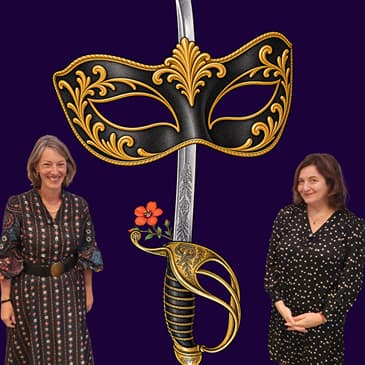
[00:00:22] Hello, this is Garlic & Pearls with me Muriel Zagha, the Frenchie, and my co-host, the excellent Suzanne Raine, who is British. On this podcast, we talk about the differences between the British and the French. We explore all angles of difference between Frenchness and Britishness, and we take turns doing this. And so today, Suzanne, it's your turn to tell me about something quintessentially British that I might not know about, although I suspect there might be some Frenchies.
[00:00:52] I have a Frenchess in there as well today. Is that right? You know what it is, because unusually, it's a book that I've asked you to read before we meet now, so that we can have a different kind of conversation rather than just me telling you all about the book. So we're starting with a level playing for us. I mean, not level, because obviously you'll know so much more about it, but I have read the book and so at least I will be able to follow and perhaps interject with naive questions of my own.
[00:01:18] Well, I'm just very interested to get your take on it. So the book, listeners, is The Scarlet Pimpernel by Baroness Otzi, about whom more later.
[00:01:29] And this is a book, which was published in 1905, about the first masked superhero. And guess what? He was a member of the British aristocracy, and he saved the poor French nobles from the savage revolutionaries by a mixture of nonchalant bravado and extreme cunning and wit.
[00:01:49] He is the original mild-mannered fop with a secret identity. He's Colin Firth and Hugh Grant and Sean Bean and Jason Statham all rolled into more. Formidable theory. He outwits the bloodthirsty guillotinas and rescues poor French nobility from insane crowds. So, but tell us what you really think. You've read it. Yes.
[00:02:19] You're French. Yes. I think we shouldn't say now who the Scarlet Pimpernel is. No. But did you guess immediately? I did, but that's partly because I'm familiar with this trope of the masked hero, and I have read a lot of books about that, and I've seen a lot of films about that. And so it's part of the joy of it is, in a way, that the audience or the reader, it's signaled quite early on who the person might be.
[00:02:48] And then it's about the fun of whether they're going to get away with it, because you know, but a lot of people in the story don't know, even though it seems pretty obvious. They don't see it. They're very obtuse. That's very amusing. And that adds to the suspense, I think. So there's nothing wrong with it being pretty obvious. It's just, it's delightful because you're in on it with the author. You are. And I have to say, it's one of those things, the Scarlet Pimpernel. It's a phrase that I think we all know.
[00:03:18] Yeah. But I'd never read the book, and now I've read the book, I actually have a lot more questions, some of which we're not going to answer today because I don't know the answers to them. But it's made me really want to know the answers of them. Let's start with what's a Pimpernel. So I'm going to show you a picture of a Pimpernel, and I see that you're going to shrink back with fear because… Well, obviously, it's blown up. Presumably, it's not the real size of the flower. No, it's a tiny little flower.
[00:03:46] Yeah, so you've blown up this tiny little flower, so it looks almost like a sunflower. It looks sort of orangey-red, five petals, and then some sort of purpley-pink stamens with yellow pollen. That's extraordinarily good. Well, is it really? Botanical description. I'm not a botanist, but… And so I don't think I've ever consciously seen this flower. I think in French it would be called Pimpernel. Yes. We do have that word. I think it's a French word. Right.
[00:04:16] Which is interesting. It is interesting. But do you grow them? Do people grow them in their gardens? It's a sort of weed. So it does grow… It's wild, which is what he is as well. It creeps a lot. Yeah, okay. It's a Latin name, Lysimachia arvensis or Anagalis arvensis. Okay. And it's also known as red chickweed, poor man's barometer, probably because it droops in hot weather or something. Okay. Poor man's weather glass, shepherd's weather glass or shepherd's clock.
[00:04:46] Okay. And it's low-growing. I think where I've seen it most is in… This is embarrassing. In my vegetable garden where all sorts of things take advantage of my lack of attention. It is a sort of orangey, pinkly red. But it's not a horrible weed that kills things. No. It's just… It's quite a pretty useless weed, as it were. I think so. Yeah. And it's from old French, Pimpernel. And possibly it was a medicinal plant. Possibly.
[00:05:14] They're saying maybe it came from the words for pepper in some way. But nobody really knows. But it is a French name. That's the flower. That's the Pimpernel. That's what it is. Because I thought, I don't know what a Pimpernel is. So now I'm visualizing him with petals all around his head like Peter Gabriel, you know, when he… Yes. …he wears the daisy thing. Yeah. Anyway. Shall we start by telling the story for those who don't? Yes, please.
[00:05:42] It's set in 1792. And it starts in Paris in September at the West Barricade, where a savage crowd is lustful for the violence of the guillotine. And the man at the West Barricade in charge of it all is Sergeant Bibaud. And he's super zealous and he's proud of his great skill at catching French aristocrats as they're trying to flee the reign of terror, which was being unleashed.
[00:06:08] And the first chapter is full of descriptions of the French crowds and their sort of desire to just kill all the aristocrats. Would you like to tell you anything more about that in your defense? I think it's not wrong in terms of the bloodlust. And I will just say we can talk a bit more about this later. But I was educated in… I grew up in France. I am French. I was educated in France.
[00:06:36] And we didn't really study the French Revolution as much as you'd think. You'd think that would be a foundational event that would be really taught extensively in schools. But what I got, the impression I got from the little we did study at school was that it had been a really good thing because it had established the republic and got rid of the monarchy. And it was only literally years and years later, decades later, listeners, that I thought to myself, hmm, they call it the terror. That doesn't sound…
[00:07:05] La terreur. That doesn't sound very nice. I wonder why they call it that. And looking into it a little bit more, you realize that there were literally rivers of blood on the… what is now the Place de la Concorde. I think it was called the Place de l'égalité at the time where they guillotine people. And that it was a monstrous, monstrous period of violence. But it's sort of… There's a sort of collective amnesia, I think, about the visceral horror of it. You know, this takes the gloves off immediately and tells you what it was really. It really does.
[00:07:34] And hopefully so, really. So you've set a scene which is… It is really awful. And this Sergeant Bibaud, you know, he is… He's determined to stop any French nobility. He also toys with them horribly, doesn't he? Because sometimes he allows them to think that they have got away and then he catches them when they begin to relax. Oh, awful. He's also really scathing about one of the other guards and one of the other gates,
[00:08:04] Citoyenne Gros-Pierre. Gros-Pierre? How do you say it? Gros-Pierre, I think. Citoyenne Gros-Pierre, who had idiotically, he'd let through a cart driven by an old man with a boy and he looked into these casks that were on the cart and he didn't find anything. So he let them go through. And then half an hour later, up came a captain of the guard with a squad of a dozen soldiers and they asked Gros-Pierre, has the cart gone through?
[00:08:32] And Gros-Pierre said, yes, not half an hour ago. And you've let them escape, shouts the captain furiously. You'll go to the guillotine for this. And then all the soldiers rush off through the gate following the cart. And then the problem is, of course, that it wasn't the cart that was the Scarlet Pimpernel and all the French aristocrats, but the captain and the soldiers. So he's so cunning. That's the thing.
[00:09:01] And so introduces at the very beginning, the idea of this is the quote, this band of meddlesome Englishmen. And they leave a calling card behind. This is the description of it. They say in Paris, every time a royalist escapes to England, that devil, the public prosecutor, receives a paper with a little flower designated in red upon it. So that's the kind of thing that the elusive Scarlet Pimpernel gets.
[00:09:30] And of course, by the end of the chapter, Sergeant Bibbo has himself been fooled by an old hag who turns up and says, my grandson has the smallpox and he's in the cart. And some say it might be the plague. And I've got to escape. And everyone says, oh, my God, get away from us, you poxy old hag. And of course, it's not. It's not. A poxy old hag.
[00:09:56] You know what the old hag reminded me of was a toad of Toad Hall escaping from prison dressed as a washerwoman. Do you remember that? I wonder if that's in a way a sort of echo of the Pimpernel. It's fantastic, isn't it? This is the scene. So it's French nobles escaping with the help of the band of meddlesome Englishmen. The next chapter is set in a pub called the Fisherman's Rest in Dover.
[00:10:26] And we get a load of local scene setting with people in the pub, including a little bit of introduction to political debate about the rights and wrongs of helping the French refugees. Yeah, so the pub is almost a sort of coffee house as well, isn't it? Yes. Where people are debating ideas. Exactly. And it's clear that in 1792, and we can talk a bit more about this as well, there was a debate going on in British politics about the extent to which they should get involved.
[00:10:53] So that I found really fascinating because it hadn't really occurred to me until I read the book and, you know, I was thinking about it because I knew we were going to talk about it. Because again, we are so siloed, aren't we, in our own national histories? I mean, less so now than, say, when I was taught at school. But you think of the French Revolution as something that happened in France to the French. You don't really think about how it was being looked at from far away, especially when it wasn't entirely clear to begin with what was going on.
[00:11:24] So that is very interesting. And you had, so you'd even get, so just from the pub chatter, you get these two guys saying, you know, Mr. Fox and Mr. Pitt and Mr. Burke are fighting and are wrangling between them if we Englishmen should allow them to go on in their ungodly way. Let them murder, says Mr. Pitt. Stop them, says Mr. Burke. So that's just, you know, and also from the beginning now in the pub, in the Fisherman's Rest, there were two strangers, aren't there? Yes. Sitting at the table. Yes.
[00:11:54] It's probably nothing. You know, they're just sitting there. It probably won't lead to anything. And we shouldn't particularly keep an eye on them, I don't think. They're just two innocent strangers who are keeping themselves to themselves. But their ears are pivoting and taking in everything that's been discussed. I was suspicious of them from the very beginning. Yeah, so was I. But again, that's fun because you, you, you, you know, you bookmark them and you think, I know something's going to happen, they're going to do something, but what and when,
[00:12:23] and you're waiting. It creates suspense. It's great. And then, of course, you have the introduction of the main characters. I'm not going to go blow by blow through the whole book, but we're now going to talk about the main characters. And again, chapter three starts with a little bit more. The unspeakable brutality in France made every honest Englishman's blood boil, but no one dared to interfere. Burke had exhausted all his eloquence, but Pitt felt that the country was not ready to
[00:12:50] embark on another arduous and costly war, and it was for Austria to intervene because of Marie Antoinette. Because of Marie Antoinette, of course. And Mr Fox argued it was not for England to take up arms just because one set of Frenchmen decided to murder another. Yeah. So, then into that come Sir Andrew Fuchs, with a double F. Brilliant. And Lord Anthony Dewhurst, one of the sons of the Duke of Exeter. And the description of him thus,
[00:13:18] A perfect type of young English gentleman, tall, well set up, broad of shoulders and merry of face. A good sportsman, a lovely companion, a courteous, well-bred man of the world with not too much brains to spoil his temper. That's a very English idea, that merriness, merriment, and not too much brains. That's what makes the perfect man. Well, that's one of the reasons why I found this book so revealing, was because of this
[00:13:46] idea where you can talk about what is the perfect man, the masked stranger, all this. But, you know, that's the perfect Englishman. They have rescued the, you have to say her name because it's French. The Comtesse. The Comtesse de Tournai de Basse Rive. And her daughter. And her daughter, the ingénie, Suzanne. I know. So excited. And her son, the Vicomte. Yes. Okay. And they rescued them and they brought them in.
[00:14:14] And, but the Comtes has been left behind. I know. So they're deeply anxious. And at that point, in the corner, the two suspicious strangers, one of them gets up and adjusts his large triple caped coat while his companion slides under the oak table. Again, I think nothing to see, probably just completely innocent, picking up something that he dropped. Not in any way concealing himself. The better to listen to the others and then later on.
[00:14:44] And reveal himself. It's great though. You can really see it. I mean, it's very theatrical and very cinematic. Can we come on to that a little bit? And then there's, there's a few themes in the book. And one of the ones I wanted to draw out is a lovely exchange where the Comtesse asks Lord Anthony Dewhurst why they are prepared to risk their lives for French aristocrats who mean nothing to them. And you would expect, I think being, possibly being French, you would expect that it would
[00:15:14] be for some philosophical cause, some reason that is about a belief system or something. And I suppose it is belief system. But the answer that Lord Anthony gives, this is all quoted to it, sport, Madame la Contesse, sport, asserted Lord Anthony with his jovial, loud and pleasant voice. We are a nation of sportsmen, you know, and just now it is the fashion to pull the hair from the teeth of the hound.
[00:15:44] That's right. And she says, you have a more noble motive, I am sure, for the good work that you do. Well, she'd say that in a French accent. She would. And he says, faith, Madame, I would like you to find it then. As for me, I vow I love the game. For this is the finest sport I have yet encountered. Hair breadth escapes, the devil's own risks. Tally ho and away we go. Sounds just like Hugh Laurie in Blackadder, doesn't it?
[00:16:14] I mean, all of Blackadder, I think, came out pretty much of this look. Yeah. And she reflects, it says, you know, to the Countess, it seems preposterous that these young men and their great leader, the Scarlet Pimpernel, all of them rich, probably well-born and young, should for no other motive than sport run the terrible risks which she knew they were constantly doing. And I think, although this is, you know, obviously slightly exaggerated, I think that you could
[00:16:43] argue that most of the 18th and 19th century world exploration that happened, happened in this spirit. And was motivated by the desire for japes and adventure. Yeah. And I remember your episode about pirates. Yeah. You know, I mean, it all coalesces, I think. And I think that's, that is uniquely of these islands. Yes.
[00:17:08] Then, we're still only in the pub at the very beginning, the two main characters emerge, Sir Percy Blakeney and his wife, Lady Blakeney, who is of course also, please can you say her name? So she is Marguerite Saint-Just. And she is, may I say? Yeah. Oh, she is a, formerly a leading French actress of the Comédie Française, no less. Which is a big thing, presumably. It's a big thing.
[00:17:38] So the Comédie Française is the, is the theatre where Sarah Bernhardt, you know, it's the, it's the big French theatre, a repertoire theatre. It's in the centre of Paris near the Palais Royal. It's the, the old French theatre where, that produced all the great stars. So that gives you an idea of how glamorous she is. I think the fact that she's an actress is also interesting, isn't it? So she's, she's good at dissembling, we might think.
[00:18:04] We might think also it's, because this book is an observation about Englishmen, English people in particular, but also about the French. Yes. So the Comtesse and Suzanne, her, her lovely daughter, and Lady Véguine, Marguerite. Are all French women. All French women. And they're different, they are quite different, because the Comtesse is a bit of a stick, isn't she? She's very humourless. I think the word haughty recurs. Yeah.
[00:18:33] She's haughty. Yeah. And Suzanne is lovely, of course, a charming, charming girl. There's nothing particularly French about Suzanne. She might easily be an English girl of the same background. I don't think she's as... Oh, I see her as being a kind of, before it all went wrong, one of the, like a bonjour tricesse girl, you know, just sort of insouciant, propping around. Yes. No, no, no. Okay. No, no, I do. I see that.
[00:18:58] But Marguerite is the more sophisticated French woman, and also she's... Super brainy. She's very brainy, but she's also incredibly beautiful. Yeah. And also childlike. Yeah. She has all these strands. Yeah. So she's very French. Very French. She's very French. She's femme enfant, isn't she? She's like a woman, child. Child woman. This is wonderful. So Percy, this is the description of him from the book. Tall, above the average, even for an Englishman.
[00:19:28] Broad shoulders and massively built. He would have been called unusually good looking, but for a certain lazy expression in his deep set blue eyes and that perpetual inane laugh which seemed to disfigure his strong, clearly cut mouth. One of the richest men in England, leader of all the fashions, intimate friend of the Prince of Wales. We know he wears red trousers, basically.
[00:19:57] As befits. Well, yeah. Absolutely. Yeah. Oh. Well, he is the very type of the British aristocrat. Yeah. And the true gentleman. Yeah. He's the true gentleman. And again, the reason I found it so interesting is because he's clearly blonde, blue-eyed. Tall. Tall, strong. Long.
[00:20:19] And then reducing that by being self-effacing and slightly idiotic, which is the way of things. It is the way of things. We have to introduce the baddie as well, Citoyen Chauvelin. Oh, terrible. What do you mean terrible? You're on his side. No, no. I mean, I would say the book is not very even-handed.
[00:20:45] You'd have to be a real fanatic to say, no, no, Chauvelin is the actual hero of the story. He wears black, doesn't he? Yes, exactly. Who's the baddie? I can't really tell. Yeah. He's the French ambassador, actually, isn't he? But he's ambassador of the French Republic, which it's complicated politically. I'm going to massively concertina the plot because we want to encourage people to read it.
[00:21:11] But Marguerite has a brother, Armand, who has gone back to France to try and rescue the Comte. Chauvelin knows that he can use this to get Marguerite to help him. And there's going to be a big ball in London and she has to go and find the identity of the Pimpernel. And otherwise, her brother will die. Yeah. And that's the- What a terrible, terrible bind for Marguerite. It is. What would you do? I don't know. I don't know what I'd do. Honestly. Okay.
[00:21:40] We're going to stop at that point and have our break. And then you're going to tell me what happens next because we're dying to know. Well, you're going to think how you're going to get out of this fix, Marguerite. Okay. I'm going to try. I'm going to try and find a way out. Okay. We're back. We're back. Right. So, Marguerite. Well, I mean, I would, I think, just punch Chauvelin in the face, really, and then somehow get other people to help me. But I think I would try and disable him physically.
[00:22:09] But obviously, she's far too well-bred to do anything of the sort, Marguerite. She's in a fix, though. She is. Without giving too much away.
[00:22:18] Without giving too much away. Terrible mistake.
[00:22:47] But had led to the execution of that family. Yes, had led to their execution. And at that point, their relationship had cooled terribly. And so she now thinks he's a blundering fool with a silly laugh. He despises her. And so it is obviously a romance as well because they have to get their love back. Yes. And so at this point, we know. Can we tell the listeners? I think we can tell the listeners.
[00:23:17] I don't think it detracts from the pleasure of the book. So we know that Sir Percy is actually... Scarlet Pimpernel. Scarlet Pimpernel. Scarlet Pimbers. Scarlet Pimpernel. The least likely candidate. Yeah. But she doesn't... Her not knowing means that there are multiple missed opportunities for her to come to him and say, Chauvelin is blackmailing me. Can you help?
[00:23:44] And so she doesn't discover it until he's already gone to France to try and rescue everybody. And she goes into his study and finds the signet ring with Scarlet Pimbers on it. It's about marriage as well somehow, isn't it? It's about how well or how badly you can know each other. Exactly. So there's a wonderful bit here where she's discovered... She's done unwittingly an awful, terrible thing.
[00:24:13] The worst crime in her eyes that a woman ever committed. Her very blindness in not having guessed her husband's secret seemed now another deadly sin. She ought to have known. She ought to have known. And that said, how could she imagine that a man who could love with so much intensity as Percy Blakeney had loved her from the first? How could such a man be the brainless idiot he chose to appear? She, at least, ought to have known that he was wearing a mask.
[00:24:39] And having found that out, she should have torn it from his face whenever they were alone together. Yes. That's it. That's marriage. Yeah. Yeah. There's some other bits which I thought really show this as well. There's a bit where the Prince of Wales really describing things. Everyone's trying to work out who Pimpernel is. And he says to Chauvelin,
[00:25:27] So that's rather fun. It's about passion as well. There's a bit where he, because he's so English. He's so very English. He can't tell her what he feels for her. So, you know, he's this strong man. He's this wonderful Scarlet Pimpernel fellow. And they have their kind of parting thing where she's trying to make him love him again and she won't. And it says here,
[00:25:54] Had she but turned back then and looked her once more in the roselit garden, she would have seen that which could have made her own suffering seem but light and easy to bear. A strong man, overwhelmed with his own passion and his own despair. Pride would have given way at last. Obstinacy was gone. The will was powerless. He was but a man madly, blindly, passionately in love. And as soon as her light footsteps had died away within the house, he knelt down upon the terrace steps.
[00:26:21] And in the very madness of his love, he kissed one by one the places where her small foot had trodden and the stone balustrade there where her tiny hand had rested last. That's most un-British behaviour, really. Except it isn't because it's the repressed stuff. It's the repressed stuff that comes out. He's kissing the steps, not the wife. It's the return of the... Yes, exactly. Yeah, yeah, yeah. You know, he should have kissed her. He can't do any of those things in her presence. She has to be away. Yeah, no, I get it.
[00:26:51] I've got two final bits that I wanted to read which are just brilliantly British at the end. So, again, I mean, it is resolved at a point. But there is a bit where the Scarlet Pimpernel is in difficulty. They're both on a cliff somewhere. Oh, yeah. Oh, it's terribly dramatic. It's hard to quite... It got a bit difficult with all the cliffs and rocks and things like that. Anyway, it's on a cliff.
[00:27:18] And she's kind of slightly unconscious, but then she's gradually coming round. She hears through her half-sleeping senses a weird sound. It was the sound of a good, solid, absolutely British damn. And you think, again, it's so British. And he then says, odds life when the ropes are giving rain.
[00:27:42] But I marvel whether it has ever happened before that an Englishman allowed himself to be licked by a damned foreigner and made no attempt to give as good as he got. So that's almost Flashman, isn't it? Yeah, it is. It is. There are certainly elements of that. So that's the story. Is there anything else you'd like to say about the story? It's a cracking good yarn, isn't it? I mean, it really is something you'd read in one sitting, adventure story.
[00:28:07] Was the influence of this direct and conscious, that's to say, did a lot of people read this book and then it trickled into the culture so that nowadays we end up with so many huge cultural icons that are to do with double identity, like Batman, for example. Or is it just that there's something universally attractive about this idea and you can't necessarily trace it back to her? I don't know.
[00:28:37] No, I think it was direct. And indeed, the guy who co-created Marvel Comics, a man called Stan Lee, said he'd read Scarlet Pimpernel stories as a child and their protagonist was the first character who could be called a superhero. That idea of the secret identity then led to Zorro, the Shadow, the Spider-Man, the Phantom, Superman, Batman. You know, they all came out of this.
[00:29:01] We should say as well, probably at this stage, there are, we think, three films, don't we? So the first film was in 1934 with Leslie Howard as Sir Percy Blakeney, Merle Oberon as Lady Blakeney, Margaret Sustard, and Raymond Massey as Chauvin. Then you drew my attention to this, 1950. So this is a Michael Power and Emmerich Pressburger movie called The Elusive Pimpernel.
[00:29:28] It's got David Niven as the Pimpernel, which is also a very good choice, I think. Marguerite by Margaret Layton, who was a great sort of glamorous British star. And Chauvelin by Cyril Cusack, who is a Cusack, I believe. He must be related to other Cusacks. He is, so, yeah, Sinead Cusack is his daughter, for example. Yeah, that's great. It's not a great film.
[00:29:57] It's not the best Pimpernel, but it's still great because it's in Technicolor. It's very vivid. And David Niven, I think, is a brilliant bit of casting as the, you know, foppish. I mean, I'm not sure because I would say, isn't he too far on the fopp side? Possibly. And also the other issue is that Niven didn't want to do the film and his heart is not in it. So it doesn't quite work. So I think the 1930 version is probably better. And for me, I think the 1982 version. Ah.
[00:30:26] With Anthony Andrews as Sir Percy Blakely. Oh, brilliant. Jane Seymour as Marguerite St. Juste. And Ian McKellen. I assume that. Well, that does sound best. I haven't seen that one. But that's a rainy afternoon of bliss, isn't it? That. What's quite weird is none of them thought to cast a French actor. No, but that's often the way. I suppose we've talked about this in the context of French Bond villains who are often not played by, you know.
[00:30:53] If you're portraying a horrible French person, you probably think, well, we can do that better than the French. We can do it. Anyway, it's in works. Maybe a French person would not want to be horrible enough. I'm going to then very briefly tell you the story of who wrote it because it's quite interesting. And I think it, again, it draws something else. And then we're going to finish, fascinatingly, with what actually happened in real life.
[00:31:22] And was there a real Scarlet Pimper? So it was written by Baroness Otzi, who was a Hungarian émigré to the UK. And obviously that is relevant because she's describing something that happened 100 years before. So she was born in 1865 and she lived until 1947.
[00:31:47] But her parents left their estate for Budapest in 1868 because they were worried about a peasant revolution. And they lived in Budapest and Brussels and Paris. And then in 1880, when she was 14 years old, she was called Emma Magdalena Rosalia Maria Josefa Borbala Otzi di Orci was her name. Emma and her family moved to London.
[00:32:13] They lodged to begin with, with another Hungarian expat, Great Portland Street. She was a refugee, you know, kind of Baroness refugee. So this is a story about Baroness refugees, actually. And that makes sense. It does. So she was arty. She went to West London School of Art and then the Heatherly School of Fine Art.
[00:32:36] And at art school, she met a man called Henry George Montague Maclean Barstow, who sounds, I think, richer and posher than he was because he was a son of a clergyman. And they got married in Marylebone in 1894. And they had a wonderful, joyful, happy marriage that lasted for nearly 50 years until he died in Monte Carlo in 1942. I know. They had a house in Monte Carlo.
[00:33:02] But my observation on this would be kind of a bit like you as well, or like Conrad or a number of emigres, which I suppose you are. I am. I'm an emigre. But you settle in London and develop a particularly keen eye for how the British do things and also a very eloquent way of describing it.
[00:33:29] And so I think what she's done would have been harder for a British author. A British woman of the same background, especially perhaps, who would have been a bit more hemmed in and more class bound, would you say? I think so. I think so. I got that. I was really interested in her marriage because she, I mean, I'm sure he was a wonderful man, but he wasn't the obvious choice for someone of her background at all.
[00:33:56] She was clearly quite, I mean, it was 19, you know, 19, well, 1894. She was clearly a little bit bohemian. I mean, actually, Hungarian Park. But a little bit bohemian. They were at art school. They got married and they co-authored a stage play, The Scarlet Pimpernel, which opened in Nottingham, 1903. So imagine that again.
[00:34:19] Then it transferred to London and it opened at the New Theatre in the West End on the 5th of January, 1905. And it was massively popular. It played more than 2,000 performances. It ran for four years. And following this, as a result of the success of the play, they wrote the novel, which was an immediate success. And she became a famous romantic novelist, really.
[00:34:43] She wrote a series about The Scarlet Pimpernel, but I don't think any of them are quite as grabby as this one. So that's her story. And the other thing that's quite interesting about her is that, and again, it's probably linked to somebody who had had her background, is that you then often become more politically active because you've been through a political upheaval in some way.
[00:35:12] At the beginning of the First World War, she founded something called England's Active Service League. And she was a founding member of the White Feather Movement. And I didn't really understand enough about the White Feather Movement. But the White Feather Movement was an organization set up in August 1914 by Admiral Charles Penrose Fitzgerald, also known as the Order of the White Feather,
[00:35:38] which enlisted groups of young women to go and hand out white feathers to young men in civilian clothes because they weren't... To shame them, really. It's a social shaming measure. Yeah, exactly. And what's curious and surprising is that the suffragettes, you wouldn't really expect it somehow,
[00:36:00] but they transitioned from, you know, kind of militant campaigns for the votes to being wholeheartedly behind the war effort. Yeah. Partly to demonstrate, I think, to the government that the women are worth it. Yeah. So... Upstanding citizens. Yeah. So, Emmeline Pankhurst toured the country making recruiting speeches, handing out with her supporters white feathers to every young man in civilian dress.
[00:36:27] She took her eldest daughter Christabel Pankhurst around as well. Well, the government released all the suffragettes from prison in August 1914 to sort of strike a bargain that the suffragettes would do the white feather thing in order for... This is the word. Suffragettes must fight for their country as they fought for the vote. Yes. Said Emmeline Pankhurst. And they got a grant from the government to aid their campaigning.
[00:36:55] Baroness Ortsy was a part of that, the Order of the White Feather. And anyway, she ended up so successful. She bought a house in Monte Carlo, the Villa Bijoux. Oh, how lovely. I imagine it was huge. And her husband died in 1942, as I said. And she came back... She died in Henley in 1947. And she wrote a memoir called Links in the Chain of Life.
[00:37:23] So we can all go and read that if we like. Two things that struck me when I read the novel, which are to do with the fact that it's a historical novel. One is a really interesting little moment at the beginning where it's almost... You know, there's a kind of subgenre of historical novel, which is a time slippage thing where you actually... The heroine often, sometimes it's a hero, travels in time.
[00:37:47] And this isn't quite that, but in the beginning when we are being introduced to the pub environment... So this is Chapter 2, The Fisherman's Rest. It says, The coffee room of The Fisherman's Rest is a showplace now, at the beginning of the 20th century. At the end of the 18th, in the year of grace, 1792, it had not yet gained the notoriety and importance,
[00:38:12] which a hundred additional years and the craze of the age have since bestowed upon it. So, she's really telling you, here we are now, this is what it would be like now, and we are travelling in time. I'm taking you to the year of grace, 1792. It's almost... It's quite a modernist sort of little trick, that. And then the other thing that struck me, which is a lot of it is to do with Britishness, as you say,
[00:38:40] Englishness, the quintessence of Englishness, and also Frenchness. It's one thing that really lets her down a bit, especially towards the end with the climax of the disguise and peril and so on, is the typical of the times, but nevertheless, grotesque anti-Semitism that is displayed in the characterisation of a Jew who bears all the marks of the most repellent untermensch you can imagine.
[00:39:05] And that is also interesting, historically speaking, because it does give you a window into the mindset of a certain class that was very widespread at the time and is continuous with the Dreyfus Affair in France, you know. So, you can tie it up together with how people felt about Jews at the time. And it's shocking because it comes at the end of the story, which is about other things.
[00:39:31] And yet, there is this absolute other, which is the Jew. And it does, yeah, I mean, it does remind you again, it's another way of bringing you back to the time when the book was written. So those, and that's towards the end. So, beginning and end, it's sort of bookended by these very 1905 moments, if you want, if you like. Do you know, you have a really good point. One of the things I thought when I was reading the passage about the Jew is that, well, two things.
[00:40:00] One, it's slanted towards the prejudices in France, which, as we know at that time, were severe. But secondly, and more interestingly, of course, there's a brilliant trick with the Jew, isn't there? Yeah, there is, there is. So, in fact, what she's saying is actually... Yeah. No, it's always more complicated, of course.
[00:40:25] She also, I think, makes the point that the French Revolution, one of the benefits of the French Revolution has been to grant civil rights to the Jews in France. She's not very clear as to whether that's a good thing in her eyes, but she does mention that. So these are all little extra bits that make it perhaps thornier than you'd think for such a romp of a book. It's thorny in lots of ways. Now, it's time for our cliffhanger question.
[00:40:55] Yes. Was there really a Scarlet Pimpernel? I can't wait to find out after the break. Welcome back. So I think, before I answer, was there really a Scarlet Pimpernel? Which I think is quite hard to answer. Well, given the elusive nature of this character. I think there probably were more Scarlet Pimpernels than we know about. I was going to say, was there a whole army of them, actually? There probably were. I think there's more work to be done.
[00:41:23] Because when I started digging into this, there are some people who have dug into this, and you can find some examples. I mean, there must have been all sorts of things going on. But the story that's interesting is the extent to which the British were inspired to help the French aristocrats, and in what way.
[00:41:44] And it's a story about refugees and politics and British citizens helping people in need or mistrusting people in need. And so I thought we might just talk a little bit about that. So the French, wealthy French people had already started leaving France in the late 1780s because they could see the way the wind was blowing.
[00:42:10] It was in 1792 when the terror really began. Because, you know, passports were expensive and you couldn't have one, you know, there was a risk if you looked like you were about to flee. So people weren't. And then the terror began. Their possessions were confiscated. A law was passed that, you know, emigres who returned to France would be condemned to death, be guillotined within 24 hours of arrest.
[00:42:35] You know, so those who could flee could flee only with what they could carry. So they arrived on English shores with hardly any money, no possessions, no experience of having to earn a living because they're aristocrats. And their English relatives didn't necessarily have relatives, you know, goes back to the Normans, of course. But some of the British political classes were very suspicious.
[00:43:01] They recalled French support for America, you know, not OK. And they worried about importing the contagion of revolution. They worried about spies. They were arriving on Britain's southern shores. Yes. Because they were having to sail over. And this is where, I mean, it's nice that it starts in the Fisherman's Rest. So local people in coastal towns where the emigres first arrived, they did supply food and clothes and accommodation.
[00:43:31] So that's... To these bedraggled fugitives. Bedraggled people. And, for example, this is an account. Lord Sheffield heard of a French vessel that had been wrecked near New Haven. And he sent his Swiss servant to help and escort the survivors to his home. And this is the description. Madame de Balbeny, sister to...
[00:43:50] Madame de Balbeny, sister to Madame de Sais-Maison, I think, probably, with her three children from three to eight years old, as fine brats as ever were seen. Their parish priest and man and maid. What a group. Yeah. And they were coming over actually now in large numbers. And it was becoming something of a political problem.
[00:44:18] Several different movements emerged to try and help them. And one, which was led by a man called John Erdly Wilmot, who was Member of Parliament for Coventry. He was particularly worried about all the priests. Ah, of course. Because the French government had occupied or sold church lands.
[00:44:42] And the revolution had requested them that they all sign the oath to the civil constitution of the clergy. And it's been called one of the revolution's greatest mistakes because it forced the clergy to choose. Exactly. There was a missed opportunity. And the Pope rejected the civil constitution. It's tricky, of course, because it's one thing for the British population to help the Huguenots, who are Protestants. Right.
[00:45:10] Quite another to welcome all these Catholic priests. Exactly. Romans. Exactly. But one of the people who was very active in arranging support for emigrant groups was Edmund Burke, who was of Irish Catholic descent himself. And he urged assistants and he said, we've got to find ways to help all these people wandering around the streets with Catholic clerical robes. And I mean, it became... Smelling of incense.
[00:45:40] It became something of an issue. So you had John Erdly Wilmot call for a meeting in the Freemasons Tavern in Bloomsbury in September 1792. Tremendous. To take into consideration some means of affording relief to their Christian brethren. And that meeting was attended by a number of other notable figures who are British aristocrats. The Duke of Portland, the Marquess of Buckingham, the Bishops of London and Durham.
[00:46:07] And they set up, first of all, a fund for the relief of the suffering clergy of France in the British dominions. And it became known as the Wilmot Committee. That's not okay, though, because that's only helping clergy. But you've got all the... Women and children. Women and children and all the rest of it. I mean, there's another description here. In late 1792, they had, by this stage, a refugee crisis with thousands of French emigres arriving in British.
[00:46:35] So there's one of the papers called The Morning Chronicle said, priests and other emigres seen on the roads from Dover, Hastings, Eastbourne and Brightham Stone, all coming up to London in all possible ways on coaches, wagons, fish carts, etc. The streets of London are now swarmed with them. And as many of them are in absolute distress, subscriptions have been opened by our benevolent countrymen for their relief.
[00:47:00] So this is one of the first examples, actually, of mass mobilising of public support, because the politicians were behind, of humanitarian relief for refugees. And it was about, you know, the revolutionary and Napoleonic wars. But that idea of private donors, some kind of non-governmental organisations, processes for distributing support funds,
[00:47:26] didn't really become established until then, you know, after the Second World War with all the UN and everything. But this is a sort of prototype moment of it. Something else, though, happened at the same time, which was the flip side of that. So the suspicion. So firstly, all these Frenchies are turning up. They're aliens. They're aliens. Do we trust them?
[00:47:52] Spies could be lurking anywhere, ready to foment revolution and anarchy. They've got it over there. We don't want it here. They've dispossessed the aristocracy, whereas land is the critical thing of an Englishman's rights, you know. So what do you think we did? Put them in, sort of gathered them together, or some of them, and put them in some sort of detention centre until we knew what was actually going on with them. We passed the Aliens Act. The Aliens Act.
[00:48:21] And it went through the Lords on the 21st of December 1792, and the House of Commons on the 8th of January 1793. And it required all emigres to register the moment they arrived in Britain. The captain of the vessel that brought them was subject to a fine of £10, if we didn't furnish a list of the emigres, including names, quality and profession. Interesting. Profession lady, for example.
[00:48:49] Each individual emigre was required separately to make a declaration with his identity, former address for six months prior to coming to Britain. And if you lied, you had to get deported. And they then had to hand over any arms and munitions. You couldn't leave the port without a passport from the mayor or the magistrate to indicate the town that you're going. And once there, you have to report to local authorities, where you then get a new passport allowing you to reside in that area.
[00:49:18] So that's not ideal, really, if you're going through a difficult time. It's not. At the same time, it's better than just being deported back to France and to the guillotine, isn't it? So I suppose people might have thought, well, this is rather unpleasant, this suspicion and being treated like a criminal. But at least we are allowed to stay away from the guillotine. Yeah. And just being pragmatic. Eventually, the government, under Prime Minister William Pitt in February 1794,
[00:49:47] did agree, brackets, was persuaded to provide financial aid to emigres, many of whom were really struggling, really struggling because they didn't have anything. And so he allocated public funds of initially £1,000 a month. And that had allowances to be paid to each man under 16 years of age and over 50. Women and girls got the same amount.
[00:50:14] And then, complicatedly, men had to join the army. What I thought was fascinating was, as you said, what happened to the women and the children. So in 1795, Special Committee, under the patronage of the Duchess of York, was set up specifically to help the female emigres because she said, heart sick as we were at the sight of these scenes of distress in which so many persons
[00:50:41] of the same sex and rank as ourselves have been so innocently involved. So English aristocratic ladies in London and some other cities raised money so that items such as clothing, linens and medicines could be provided for impoverished French women. But they had to make a living. So they became language teachers. They taught dancing, fencing or chess. Interestingly. Fencing or chess. So wonderful. Open schools. French women did needlework.
[00:51:11] They designed and made dresses. Of course, that's the sort of thing they do, isn't it? So there's a lady called Madame de Sesseval who made straw hats. Lovely. And embroidered white linen dresses. They did painting. The Contes de Guerri discovered a talent for making ices. The Prince of Wales and the Royal Dukes went to her cafe. So actually, I think that what you're seeing here again, beautifully, is an example of what
[00:51:37] happens when, and it's particularly London that does this again and again and again, you take in refugees and then you assimilate. So the French women brought amazing ices. Yes. To a cafe. And straw hats. And straw hats. And the finest fashions. And gradually we forgot whose culture it was. And it just became another thing that was in London.
[00:52:03] Another fantastic example of that cultural assimilation is Isambard Kingdom Brunel, who is one of our greatest civil engineers. He built all our great bridges and roads. All the infrastructure. All the infrastructure and everything. His parents were part of this story. Were they? Brunel's father, Sir Mark Isambard Brunel. Mark with a C. Mark with a C. Was born in France. His father was a prosperous farmer in Normandy.
[00:52:32] He was born on the family farm. And he grew up there. He went at the age of 11 to a seminary in Rouen, where he learned carpentry. Didn't want to be a priest. He learned naval stuff and became a naval cadet on a French frigate in 1786. Served in the West Indies. During that time, the French Revolution began. And in 1792, he returned to live with his relatives in Rouen.
[00:53:01] And he was a royalist sympathizer, as were most of the inhabitants from Normandy, as you'd expect. And so in 1793, he visited Paris during the trial of Louis XVI. And he unwisely, publicly denounced Robespierre. Oh, dear. One of the leaders of the British Revolution. Oh, dear. Brave, but foolhardy. Yes. Well, he happily got out of Paris with his life and he went back to Rouen.
[00:53:26] And in Rouen, he met Sophia Kingdom, who was a young English woman who was an orphan working as a governess. And she was also, you know, I mean, it's amazing. And they were forced to flee. And they fled first to New York and then to England, where they lived the rest of their life. And Isambard Kingdom Brunel grew up.
[00:53:45] So that's an instance where, you know, something that seems very British, great sort of civil engineer, history of trains, all the rest of it, is directly connected to this terrible moment in French history. Of French emigres fleeing. French emigres fleeing. How extraordinary. There's an awful lot more that you could know about this that I don't have time to tell you.
[00:54:07] But I think what it made me really reflect on is this tension between welcoming the stranger in need and seeing that you've just got thousands of them. And how do you know which ones are deserving? And also that resources are finite and there's only so much to go around and so on.
[00:54:28] And then the worry about, which is very Scarlet Pimpernel, actually, the worry about spies, about someone who pretends to be something and then turns out to be something entirely different. And then very finally, was there a Scarlet Pimpernel? Presumably that's inconclusive. Presumably you're not going to say, well, it was actually the Marquis of what's it. Yeah. No. Well, there's a lady called Elizabeth Sparrow who's written a book called Phantom of the Guillotine, The Real Scarlet Pimpernel, Louis Bayard, Louis Duval.
[00:54:59] 1769, 1844. Yeah. And she says that Baroness Ortsy got the idea of the Scarlet Pimpernel from this man's life story. I mean, to me it's slightly boring because he's not Sir Percy Blakeney. No, of course. So was he... But it made him so much better. But he is Louis Bayard, the principal agent working for the British government to promote the restoration of the French monarchy from 1795 to 1815.
[00:55:28] And in 1796, the British government gave him a new identity as Louis Duval and he became a barrister at Lincoln's Inn. So what's great about Louis Bayard was that he was able to establish multiple alibis in France at will because he was one of four similar looking brothers.
[00:56:16] Oh! And he was the sole child of Louis XVI and Marie Antoinette, about whom I know hardly anything. But she's the only one who's known to have survived and he helped her do that. And Elizabeth Sparrow also says in the middle of the same year, he was zipping across the channel to visit London to take his English bar exam in his alter ego, Louis Duval. That's so much better than any Marvel movie. I know. Marvellous.
[00:56:47] So, Muriel, that's it. I leave you with four brothers running around France simultaneously rescuing aristocrats. Love it. I'll tell you what else I love about it. And maybe this is apocryphal, but I read that the Baroness got the idea for the Pimpernel. So, OK, maybe he was based on a real person. But the way she describes it, presumably in her autobiography, I don't know, is that she was at Temple Tube Station in London.
[00:57:17] And suddenly he appeared before her. She could see him. She could see him in his amazing sort of raffish getup. And she could see everything about him. It was a sort of premonition. He came to her in a vision, literally. And there is something there, I think, that will resonate with a lot of writers that I think sometimes a character just comes to you, appears before you, and then you have to put him down on paper. So that's what happens in the book.
[00:57:46] That's what I really I found very moving. Yeah. This idea. And again, in this modern London industrial setting. Yes. This man from the 18th century appears. It's beautiful. That's what the Scarlet Pimpernel does. He does. What a mysterious and beguiling episode. Thank you very much, Suzanne. One of your best, I think. Oh, don't overdo it.
[00:58:12] Well, one of your most revealing to me, certainly, and I think to a lot of our listeners, you really pulled together all these threads of things that a lot of people might know the phrase Scarlet Pimpernel. A lot of people might not have read the book, but also might not realize what the reality was on the ground at the time of this complicated response to the arrival of these French people and then the inheritance of that in the current culture. So that was brilliant. And listeners, if you enjoyed this episode, tell all your friends about it.
[00:58:41] Send them a link. Subscribe to the podcast. Follow us online. Send us messages of goodwill. We're always delighted to hear from you. And Suzanne, I look forward to seeing you next time for something different on Garlic and Pearls. Au revoir, Muriel. Au revoir, Suzanne.