
Hosted on Acast. See acast.com/privacy for more information.
[00:00:21] Hello, this is Garlic and Pearls with me Muriel Zagha. I'm French and my friend Suzanne Raine who is thoroughly British. And this is a podcast where we talk about the Frenchness of the French and the Britishness of the British and we give examples of what we discover and we take turns with this. And today Suzanne it's your turn to tell me about something to do with British culture.
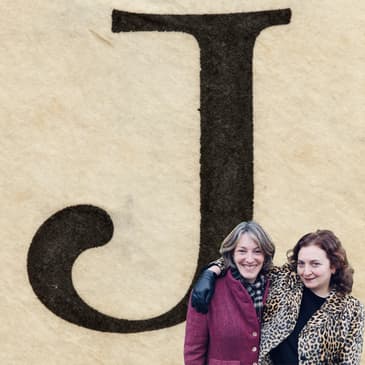
[00:00:52] Did you ever watch Sesame Street? Oh yes, of course. This episode is brought to you by the letter J. Oh, that's lovely. And so is the letter J a sort of furry purple monster thing? I think maybe because you're French you might want it to be because the point that I'm about to make that's going to, I hope, blow your mind is that you might think you have a letter J. Yeah. But actually you don't. What?
[00:01:21] No, you don't. You just don't. Say, well I'd like you now please to say the French alphabet. Okay. A-B-C-D-E-F-G-H-I-J-K-L-M-N-O-P-Q-R-S-T-U-V-W-X-Y-Z. So I did say J. This is how we pronounce it. But it's, it's spelled like the letter J.
[00:01:46] I think it's the letter J. Why is it not the letter J? What's going on? This is very anxious making.
[00:01:55] I hadn't really realised it. But Britain, for some reason, is one of the few countries in Europe that has a letter J that it pronounces J. And so I have been investigating that. And I haven't got all the answers. I should confess to you now that this may be hopefully an episode that simply leaves you wanting more. So it's a bigger mystery than even you realised.
[00:02:26] Yeah. I think so. This is exciting. But I do think that we should pause and reflect and be proud, if you're a British listener, that we have the letter J and that we celebrate and use it in its complete identity rather than having it and pronouncing it in some sludgy kind of J kind of a way. Oh, I see what you mean. I think it's lesser.
[00:02:53] Okay. We have all the English words we've imported, like jazz, for example, le jazz. We pronounce with that sound, that J sound. But only those. I mean, it's true that French words like jeudi, for example, which is the word for Thursday, which starts with a J, is that sort of soft sound. And je, je suis. Je, je suis. Yeah, je suis, exactly. So you're going to tell me all about it. I'm listening.
[00:03:20] Yes. So there's no I in J, you could say. Or is there? So I should just, I should. Explain yourself. Yes. I should reassure our audience that there's a whole load of stuff when you open a dictionary, which says how you pronounce words and letters and things. I am not going to engage with that because I've always found that quite difficult because it's this weird mix of symbols and funny letters.
[00:03:47] So the sort of phonetics of it. It's beyond me as well. I'm relieved. Yeah. But the thing that we do know and can agree on is that the letter J did get invented in a way that other letters really are in the midst of time invention. So the Latin alphabet or the Hebrew alphabet or the Greek alphabet don't have a letter J. Oh, I see.
[00:04:12] So how do people manage? What did they say? I don't know. I know. I've completely lost my bearings. I think that there was always, this is where we're different, of course, there was always a sound. There must have always been a sound, J. Yeah. But, and we have it in two different ways because we have it with a J, J, like Juliet. Yes.
[00:04:39] Of course, when Shakespeare wrote Romeo and Juliet, the letter J hadn't been invented yet. What? So, I know. I know. It's a cliffhanger. I'm going to leave that there. So did he, how did, how was it? Oh, was it spelled like a, was it like an I? Yeah. Something that lived like an I? Yeah. Ah.
[00:04:57] So it was always an I, like in the Roman numerals. So I was number one and an I. And people started doing a sort of curly bit on the end of it. And often at the end of a word, they would have a curly bit on the end of it. So it kind of existed as this flourish on the I. Yeah. But then there's also the sound that we had. So we have that sound as well in words like hedge. Oh, yes.
[00:05:26] Which is spelt D-G-E. So there's something about kind of Old English, Middle English, Old Scots, where we were using this sound, which I think, again, you may not have the sound. Not really. No. Only, again, in imported English words. Yeah. So it's a big lack on your part. We manage. It's like being without the metric system. We're fine. You know, you would say you're fine without that and we're fine without the J sound.
[00:05:54] The thing that gave me pause for thought is that quite a lot of European languages don't have the sound. So most of the Germanic languages, German, Dutch, Icelandic, Swedish, Danish, Norwegian, they pronounce the J as a J sound. Ah. Don't they? Okay. And then French, Polish, they write a J, but give it a different pronunciation to the one that we give it.
[00:06:21] There is a man who is not British, who I need to introduce for completeness, even though I don't really want to, who's a man called, interestingly, Jan Giorgio Drissino. That doesn't sound very British. No. And also, I'd reflect that Jan and Giorgio begin with G. So he, no wonder he was a bit obsessed with the idea.
[00:06:46] He was predestined to be the man who, did he invent the sound then? He was the first person explicitly to distinguish between the I and the J as representing separate sounds. He was born in 1478 and he died in 1550. And he was a Venetian, a kind of Renaissance poet, dramatist. You know how they were everything? They were, yeah. Humanists. He was a grammarian.
[00:07:13] And he said, there's two problems in the Italian alphabet or the Latin alphabet. And one is J and I, and one is V and U. And I propose that we distinguish between them. And he wrote, I'm not going to say it in the Italian, but it was called Trissino's Epistle about the Letters Recently Added in the Italian Language. Lovely. 1524. Yeah. So it was clear that there were people whose names were Jan Giorgio, who'd been thinking about this for a long time.
[00:07:44] And, you know, can I just interrupt? This is a very flippant comment, but I've realized how Italian the whole thing is. There's a song by Daft Punk, which incorporates a lot of talking about, by Giorgio Moroder, you know, the producer. And he says at one point, my name is Giovanni Giorgio, but everybody calls me Giorgio. And then the music starts.
[00:08:09] And so that sound, that is the propulsive sound which launches the song. It's so exciting. I'm sorry I interrupted. No, but it's interesting because obviously various languages had a need for a letter that enabled them to show that they were making that sound. Yes. And we in Britain had that need. And I think we had been making that sound for a long time.
[00:08:36] And I think in Scots as well, it's really, it does go back in the Scots language, which is distinct from the Gaelic. So who invented the J in Britain? By which we mean, I suppose, the sort of calligraphically, the way of writing it out as a distinctive letter. Who invented that? This is where it's going to get quite biblical. Oh. Were you not expecting that? No. Nothing, nothing in this episode is expected.
[00:09:05] Everything is unexpected to me. I'm just lurching from surprise to surprise. Really, you're like a boat that's been untethered from its moorings. I often feel that way in your company. So I'm just waiting. I'm waiting trustingly for you to explain. Well, I should start by another little preface to say that it is one of our less commonly used letters.
[00:09:33] So it is the fourth least frequently used letter in English words. And guess what the other letters are that we don't use very much? K, maybe? Well, I will use K quite a lot, actually, at the end of words, I suppose. Yeah. Yeah. It's the obvious ones. It's Z, Q and X. Q and X. So Scrabble tells you, doesn't it? Because J, there's only one J usually. And it's worth eight points. Yes.
[00:10:00] So if you manage to fit it somewhere, you're doing really well. But it's very commonly used in proper nouns, especially names. Yes. And that's the clue. I'm now going to ask you to guess whose name was instrumental in the introduction of the letter J. J. I'm going to take a wild guess because you said biblical.
[00:10:28] I'm going to say, is it the name Jesus? Oh, no. No. So more ancient. We're talking Old Testament. No, we're talking more egotistical. More egotistical. Than Jesus. Than Jesus. It's getting a bit theological now. Gosh, yes. So are we thinking of kind of supreme being type person or prophet? Why don't I just tell you?
[00:10:57] I think so, because I'm getting lost a little. But the very pleasing thing is that this enables us to connect, particularly for our listeners who are still familiarizing themselves with the Garlic and Pearls of, or back catalogue, with one of our earlier episodes on witchcraft. Oh, yes. Because the answer is King James, the first of England and sixth of Scotland. Really? Okay.
[00:11:25] Was instrumental in the story that ended up with the letter J. And I think a king whose name is James, rather like Gian Giorgio, who's probably spent his whole life sitting there thinking, I'm king of England and Scotland. I don't even have a letter to start my own name with. Will nobody sort this out for me? What I can't show you, I'm afraid, Muriel,
[00:11:53] is any evidence that shows that King James was motivated in this journey by a desire to spell his own name correctly. But he is a figure in the journey of the letter J, which we should jump at. Sorry, it's not brilliant. This proliferation of J sounds. I know, so much fun. It's great.
[00:12:20] So the story of the letter J is intrinsically linked with the story of the production of the King James Bible. Right. Do you know about that or should I tell you some stuff? Tell me some stuff because I know a little bit, but I think it's very interesting and I want to know more. Because you can see that if you're going to write a Bible, names like Jesus, John, Judas, James, Joshua, Jacob, Jehovah, Jeremiah, Jerusalem, Jordan, Judea,
[00:12:49] they're all kind of J-related. They are. I suppose if you were sitting there writing the thing, you'd think, this is a bit weird. Yeah. That's how I'm imagining it happened. The King James Version or the King James Bible or the Authorised Version of 1611 is held to be one of the great works of British literature still. It's held alongside Shakespeare. I don't know. Are you familiar with that? Yes. Yes, absolutely.
[00:13:17] And it's been noted for the sort of clarity of the translation, the poetry of it, the phrasing and the way that the phrasing helps with the hymnody and liturgy.
[00:13:31] And also, really fascinatingly, just like Shakespeare, how many figures of speech and idioms which we still use today all the time actually come from that 1611 translation of the King James Bible. So phrases like, pride comes before a fall, let there be light, a fly in the ointment, my cup runneth over.
[00:13:59] In the twinkling of an eye, seeing eye to eye, fight the good fight, the powers that be, fell by the wayside, labour of love. I mean, I could go on. And in fact, I better stop myself because there's an academic called Richard Noble who's found 559 everyday phrases originated in the King James Bible. So impressive. Impressive.
[00:14:25] So even if you've never read the Bible, a lot of the way that we speak now is probably in some way informed by the setting down in print of that translation. And then it's being used from pulpits throughout the land for over 400 years now. And so it's become built into the way that we speak English. And it is seen as being more than, it's a sort of literary treasure.
[00:14:54] One of the translators says in the preface of it, we never thought from the beginning that we should need to make a new translation, but to make a good one better. Yes. The Bible already existed, obviously. But the purpose that the translators saw was how can we make this telling of the greatest story ever told in Christianity, one that is just beautiful.
[00:15:21] We're going to pause now and have a little ad break. And then we're going to come back with how they did that. So, Suzanne, I'm on tenterhooks. How did they come up with a new Bible? In a nutshell, of course, this wasn't the first Bible. There had been the Great Bible, which sounds really great, in 1539, which had been authorised by Henry VIII.
[00:15:48] So a lot of this is aligned with two things, development of technology and religious turmoil. Yes. So Henry VIII, obviously doing some turmoil, development of printing processes, similarly timed all across Europe. Everybody was sticking things to doors, telling people to believe something slightly differently in a nutshell. So you had the Great Bible.
[00:16:15] And then in 1568, you had the Bishop's Bible, which is even better than the Great Bible. And then meanwhile, in Switzerland, you also had something called the Geneva Bible, which was published in 1560. So there was triangulating on three already existing Bibles, including William Tyndale's New Testament from 1539, which gets incorporated into the Great Bible.
[00:16:44] So that's what we had. But in May 1601, so before he became King of England as well, James VI of Scotland went to the General Assembly of the Church of Scotland at St. Columba's Church in Fife. And they put forward proposals for a new translation of the Bible into English. That was the proposal. Then he became King of England as well in 1603.
[00:17:14] Then we had the gunpowder plot, which was Catholics trying to blow up Parliament, which they should not have done. Very naughty. Very naughty. And so in May 1606, Parliament got real because they said, we've kind of had enough of this. They passed something called the Popish Recusance Act, which required any subject to take an oath of allegiance, denying the Pope's authority over the king. Because the king, you know, remember Mary, Queen of Scots was his mother.
[00:17:44] She was a Catholic. He's not a Catholic. He's slightly wacko. He was obsessed. He produced his demonology. Demonology. I remember this is in our Halloween episode. He was just constantly killing witches. It was a bit more complicated because he also knew that he needed the support of critical Catholics in England. And so, for example, Percy, again, very Shakespearean. Henry Percy, ninth Earl of Northumberland, was a prominent sympathizer of the Catholics.
[00:18:11] And he's having to keep Percy on side as well. But in 1603, so at the same time he gets made king of England, the Puritan clergy demands the abolition of a bunch of things that are essentially Catholic practices, like confirmation, wedding rings, the word priest, wearing of caps.
[00:18:31] And James acceded to some of their demands in 1604, although he was trying to tread a balance between, you know, not upsetting the Perses, not upsetting the Puritans and all the rest of it.
[00:18:45] And he commissioned a new translation of the Bible and a compilation of approved books of the Bible to try and resolve some of the discrepancies between the various interpretations and convened what was called the Hampton Court Conference in 1604, which was a response to the Puritan grievances. And they basically said, let's get a new translation done.
[00:19:12] And he issued, King James issued directives that this translation should adhere to the ecclesiology of the Church of England. And there was a whole set of little sub clauses which said, can't have notes in the margin, which is what the Geneva Bible does, because in that it's got some stuff which is maybe anti-monarchical, which we don't like, for example.
[00:19:38] He was a bit worried because there's an example in the Geneva Bible, which criticised King Asa for not having executed his idolatrous mother, Queen Markar. Or however you say her. I'm sorry, I didn't know how to pronounce her name. And he worried that that might be considered to be similar to him, maybe sanctioning the execution of his own mother, Mary, Queen of Scots. So there was some delicate moments where he was thinking, maybe we just won't have that bit in.
[00:20:07] And he sent out instructions that the Bible was going to be different to all the others. It was going to be familiar to its listeners and readers. And it would take as the basis the text of the Bishop's Bible. And that's what the translators would use. And they would keep the familiar, proper names of all the biblical characters. Of course. Most of whose names began with J.
[00:20:34] You don't want to start confusing everybody by changing the way the proper names are. Yeah. So the first printings of it did say that the text had been translated out of the original tongues and with the former translations diligently compared and revised by His Majesty's special commandment. And then... Amazing. What an amazing undertaking when you think about it. So how did they do it? How?
[00:21:02] Well, they appointed, well, they approved 54 scholars for the task of translation. And they actually ended up with 47 scholars who did it. They were all members of the Church of England. And all apart from one, a man called Sir Henry Savile, were all clergy. So they were, you know, theologians. And they divided them into six committees. So it's amazing. It's a proper thing. It's like, we're going to translate. The king has told us we have to translate the Bible. Let's get...
[00:21:32] So they had six committees, two in the University of Oxford, two in the University of Cambridge, and two in Westminster. And they had a real mix. So they had some scholars with Puritan sympathies, and they had some more high churchmen, and they brought them all together. And they printed 40 unbound copies of the 1602 edition of the Bishop's Bible, so that they could, then the committee could all work on the same thing and put all their changes in the margins.
[00:22:02] And they separated them all out. So they all got special bits of tasks. So the committee's the first... I don't know how interested you are in this. How interested are you in... I am quite interested. Yeah. Tasks. So the first Westminster Company had to do Genesis to two kings. The first Cambridge Company did One Chronicles to the Song of Solomon. The first Oxford Company did Isaiah to Malachi.
[00:22:29] The second Oxford Company did Gospels, Acts of the Apostles, Book of Revelation. The second Westminster Company did Epistles. And the second Cambridge Company did the Apocrypha. Gosh, that's an exciting one. It is an exciting one. And that's where we are excited, because I'm going to now focus us on the second Cambridge Company. Oh. Not necessarily, because this is going to get us to the heart of the letter J.
[00:22:59] But because it is rumoured that this is where the heart of the letter J lies. I can't evidence it. And maybe somebody listening can. So this started in 1604. And they went off and did it for at least four or five years.
[00:23:21] And the second Cambridge Company I'm going to concentrate on, that included a number of figures who were masters of colleges or senior figures in divinity in different colleges. And one of them was called Samuel Ward, who became master of Sydney Sussex College. And the reason I'm just mentioning him briefly, I'm going to mention all of them really, but he left his workings in notebooks.
[00:23:50] Oh. Very useful. It was not discovered until 2015, when an American scholar, Geoffrey Miller, announced his discovery in the Times Literary Sussex College. Oh, that's like a novel by A.S. Byard, isn't it? Exactly. So he found in the archives of Sydney Sussex College a notebook dating between 1604 and 1608, containing about 70 pages of almost illegible handwriting.
[00:24:18] And they included biblical commentary with Greek and Hebrew notes. And he didn't know what it was, but he started to look at it. And then, as is what he says, Miller says, for centuries, Ward's paper in the college lay almost entirely neglected and uncatalogued. But then, as he examined the notebook, the manuscript's true significance suddenly came into focus.
[00:24:44] And the value of the draft, it lies in what it helps to reveal about one of the 17th century's most extraordinary cultural achievements. It points the way to a fuller, more complex understanding than ever before of the process by which the King James Bible, the most widely read work in English of all time, came to be. That is pretty exciting. Who would play Samuel Ward if we were to do a sort of film version of this amazing undertaking?
[00:25:13] I think Samuel Ward was born in 1572 in County Durham. So I'm going to suggest he would be played by Christopher Eccleston. Oh, yes. Okay. Yeah. I think that really helps. Very intense. Yeah. Slightly wild-eyed, maybe. But, you know, full of fervor. He was a scholar at Christ's College, Cambridge. In 1592, he did his BA.
[00:25:40] And then in 1595, he got made a fellow at Emanuel College. And then in 1599, he was chosen as a fellow of the new Sydney Sussex College. So he was all, everything was new and exciting. And then his work on the Bible, King James Bible, in that first decade of the 17th century, that was career-making. Yes, I can imagine. Can you see? It's like, the King's got this new project. Do you want to be on it?
[00:26:10] You can be on a committee. And they all got together. And I imagine there's a whole load of people who weren't on the committee who always thought... And who wanted to know why on earth they hadn't been asked. It should have been me. It should have been me, of course. So in 1610, so after he did the translating, 1610, he was made Master of Sydney Sussex. The next year, 1611, which was the year of the publication of the Bible, he became chaplain to King James I. Ooh, getting ever closer to the monarch.
[00:26:38] It really is. That's a key appointment, frankly. And he was recognised as a moderate with Calvinist views, very attached to the Church of England. And he had a whole load of other appointments in the church. So he was prebendary of Wells Cathedral, Archdeacon of Taunton, prebendary of York. And then in 1623, he became Lady Margaret's Professor of Divinity in the University of Cambridge.
[00:27:07] So he's, you know, full on. He lived quite a long time. Always a mistake. Why? Does something awful happen? Because of the arc of a human life. Oh, of course, yes. So did he, what happened? The Civil War broke out. And we're going forward a couple of decades. The Civil War broke out. And now we're going to have to go back later.
[00:27:33] But this is all part of the suspense and confusion that I'm creating surrounding the letter J. At the end of his life, the Civil War broke out. And he had this duty because he was sworn allegiance to the crown. So he couldn't take the Solemn League and Covenant. This is all to do with governments of Scotland and England in 1643.
[00:27:59] Approved the Solemn League and Covenant, which was a treaty between the Scottish Covenanters and the English Parliamentarians, which was about integrating the Scottish Presbyterian system into the Church of England in exchange for military aid. Quite a fine point of detail, but not at the time and not if you're Samuel Ward. So he said, I can't do this. And so he became, therefore, what they termed obnoxious to the Presbyterian majority.
[00:28:28] And so in 1643, he was imprisoned in St. John's College until his health gave way. And he was permitted to retire back to Sydney Sussex College. And there he was attending a chapel service on the 30th of August, 1643, when he was seized with illness.
[00:28:52] And that unfortunately led to his death on the 7th of September. And he's interred in the College Chapel there. Is he? Oh, how interesting. So he was a big figure. And there was a number of them. But Christopher Eccleston. Yes. So I've got that in my mind. And I think the more I think about this, I think this probably is a fascinating film that somebody should make. Should make the film. Absolutely. Yeah. So who else was on that team?
[00:29:22] Who else? Well, there were others, of course. A number of them suspiciously had names like John, which again... People with an agenda. I don't know. John Duport. Or Duport. Very French sounding. Yes. And he was, I think, the leader of the Second Committee, the Second Cambridge Company, doing the apocrypha.
[00:29:50] So he was born in Leicestershire. And originally, his family came from Normandy during the reign of Henry IV. So he came up. He started his time in Cambridge in Jesus College. Yes. Yes. I wonder if they thought it was funny at the time.
[00:30:17] You know, once they became preoccupied with the letter J, did they think it was funny that it cropped up everywhere? They probably did. People were aware of those things, of language games and things. Well, so there was John Duport who kind of led the team. And they had the apocrypha. That was their job. And it's complicated, the apocrypha, because they're kind of scripture, but not quite scripture in the same way that other bits are. But anyway, they were very committed to it. So John Duport became Master of Jesus College in 1590.
[00:30:47] And he served four times as Vice Chancellor of Cambridge University. So a senior figure. And the fact that he was such a senior figure demonstrates how important the king thought all of this was. There's another John, John Bois, or John Boise, probably Boise, because, again, they all have suspiciously French names. They do, don't they? He was at St. John's College. So he's...
[00:31:17] Yes. He was elected a fellow of St. John's College when he was 20. And he nearly didn't make it because he nearly missed the ceremony admitting him to the fellowship because he has smallpox. Oh, dear. Which, of course, nobody wants. And they worried that he worried that if he didn't get admitted at the right time, that was going to have... He was quite a careerist. So he thought that would be a negatively impacting.
[00:31:41] So he wrapped himself, had himself wrapped in blankets and carried to the place where his tutors, who were men called Andrew Downs and Henry Coppinger, could make sure that he could be properly admitted. And then he recovered. And he was very, very dutiful. And he, again, was a critical part of the translation. He was one of the committee of the revisers.
[00:32:08] So each company of the six, they appointed some revisers who then spent nine months at Stationers Hall in London. So everybody did their bits. And then they all got together at Stationers Hall. And then they read aloud passages to one another, trying to decide whether there were issues with the translation, whether a little bit... Can you imagine? Nine months. It's just astonishing. I love it. It's wonderful. So some examples.
[00:32:34] So the committee got to the book of Revelation, chapter 13, verse 8. And there were differing views as to whether the phrase, from the foundation of the world, referred to the book of life or to Jesus the Lamb slain. And apparently this is still an argument that modern day scholars have. That doesn't surprise me. I know. It's the kind of thing. So John Boise said that since all... This is him.
[00:33:04] Since all translators, as far as I know, and a good portion of the commentators, both ancient and modern, regard this passage as pertaining to the eternity of the sacrifice of Christ, I do not deem it prudent to institute anew anything in a matter so commonplace and spread abroad. I don't know what that means. But his view prevailed. And so now the verse from the King James Bible reads,
[00:33:30] And all that dwell upon the earth shall worship him whose names are not written in the book of life of the Lamb who is slain from the foundation of the world. Okay. And everybody's happy with that. Yes. I mean, it's not straightforward, is it? A safe translation, as it were. Anyway, and he also preserved some notes which are in the library of Corpus Christi College in Oxford. Weirdly.
[00:33:58] I should also say that the other thing that's curious about John Boise, or Bois, is that he married late. And he married... He was appointed to the rectory of Boxworth in 1596. And the rectory came with a young woman, Miss Holt.
[00:34:29] And basically, the deal was, whoever got appointed vicar of Boxworth had to also marry Miss Holt. They should do that systematically. I think that's a really good system. So on the 7th of February, 1598, he and Miss Holt, having taken a sufficient likening to one another, married. And apparently, it all went down terribly well, because when she died in 1642, he lamented her as his, this is his quote,
[00:34:58] dearest wife with whom in blameless marriage I have lived 540 years and more. That's very touching. I know. So sometimes... Yes, sometimes it works out. Sometimes it works out. So there are other people, but I think we've got a feel for them at this point. So I've introduced the characters. Yes. Some of the characters, Muriel. But we haven't got... Well, we haven't got to the letter J. No, we haven't. Are we on the cusp of that?
[00:35:28] And shall we perhaps go to an ad break? And then you can come back and you can tell me the next lot. I think so. Okay. So, Muriel, we're back on the search for the letter J. Yes. And my feeling is that it's a, you know, we're sort of on horseback and we're journeying towards it. And it's always receding over the horizon when we think we're getting closer. I can see it receding again behind the trees.
[00:35:53] So are we anywhere near something a bit more precise? In 1611, the authorised version of the King James Bible was published by Robert Barker, the King's Printer. And it sold for 10 shillings, loose leaf, or you could get it bound and that'd be 12 shillings.
[00:36:18] So he was the royal printer and he invested huge amounts of money in printing the due edition, ran into a lot of debt, which ended up, you know, essentially breaking him. Bitter financial disputes, you know, the sort of score when people start printing anything. Yes. Decades of continual litigation, consequent imprisonment for debt for members of the park. Never print anything, listeners. Never print anything.
[00:36:44] How do you think the name King James was spelt on the King James bit? So, because I feel we're still sort of pre-letter J, was it spelt as a sort of I? Yeah. The J. So like James. Yes. How do you think King James would have felt about that? I mean, I don't understand the psychology of wanting it to be a more special letter somehow.
[00:37:13] Because you said, you know, well... You managed without a J for all eternity, but... Yeah. So what, why do you think, do you think he was just such a special King that he needed to put his mark on the initial of his name? No. What was the psychology of it? No, because, and here's the, here's the news. In his lifetime. Yeah. The letter J. I just did not...
[00:37:42] The letter J would be played by... Who would play the letter J in the film is the question. Sorry. In his lifetime, the letter J... You say who you think would play the letter J. Who do you think? Well, I don't know. I mean, I'm thinking the letter J is a sort of mischievous imp. Maybe Toby Jones. Oh, yes. Could be a really good letter J. I can imagine him, he'd do... And actually Mackenzie Crook, because obviously we're back to...
[00:38:13] Yeah. We're back to detectorists. But one of those two, someone with a really striking face who could play a mischievous letter trying to make its mark. That's what I see. That's what happened. So King James sadly died in 1625 before the introduction of the letter J. No. He wasn't... Yes. Oh, that's just terrible. We don't actually know that he was bothered about it, but I just think he must have just thought, come on guys.
[00:38:42] Anyway, didn't happen. 1629. Yeah. Cambridge University Press reprinted the King James Version of the Bible. And it was that edition of the Bible that contained everywhere, everywhere all at once, the letter J. That's astonishing. From zero to hero. And how did this come to pass? Whose decision?
[00:39:12] We don't really know. So this group of people, the group of people in the second company, there's a couple of people who were critical to the foundation of Cambridge University Press and the printing of it. Somewhere, some people in that obviously took this big decision. I can't tell you who it is because I don't know who it is.
[00:39:36] The other person that is sort of allocated credit is a man called William Branthwaite. He was master of Gomville and Keys College in 1607. He was part of the second company that translated the Apocrypha. It is said that he was instrumental in getting people to think about J in a new way. But he was dead before the Bible of 1629 was published.
[00:40:05] So I don't think we can give him the credit. All the credit. I don't think we can. I don't think we can prove it. And I think if we could prove it, it would be clear. So does it feel more like a sort of collective decision that was arrived at when they were reading things aloud to each other? And gradually, you know, started saying, well, wouldn't it look better? Wouldn't it be more legible, easier to understand if we introduced a more distinctive calligraphy for this particular sound? Yeah.
[00:40:35] But as a sort of collective hive mind thing then, maybe. Possibly. There were actually publishers. So let's do a little in parenthesis about Cambridge University Press. Yes. So it is the oldest university press in the world, which was founded by Henry VIII. Again, so this is the beginning of printing in 1534 while Tyndale was working on the New Testament in Antwerp. And although and then there's a weirdness because although it was founded in 1534,
[00:41:03] it didn't actually publish something until 1584, so 50 years later. So I don't know what it was doing in the meantime. But and again, Cambridge and Oxford University Presses are the two privileged presses. So they are sort of ancient British publishing houses, really. And so Cambridge University scholars had played a key role in the translation.
[00:41:30] And then the university press said in 1629, we are going to publish a faithful version of the text. And two of the surviving translators oversaw the new edition, which was a big scholarly effort to correct some of the worst some errors in the 1611 one. Don't ask me what they were. So Cambridge's first edition of the King James Version was published in 1629.
[00:41:58] And the editors of these editions included John Boise and Samuel Ward from the original translators. So they were consistent going all the way through, the others having died. We think that that is probably then the consistency of how the letter J ends up as being in it, in a way that they were the ones who struggled all the way through to the bitter end.
[00:42:23] And the whole purpose of republishing one of 1629 was essentially Oxford and Cambridge universities asserting their royal licenses for Bible printing from their own university presses. So it's a kind of like we're landed on the Bible printing scene here. They corrected some of the errors from the 1611 one. They used a different typeface. So the earlier one used what they called a black letter typeface.
[00:42:53] This one had a Roman type. You know, there's a whole set of things there which people who are Bible scholars are interpreting, looking at. But the critical thing for all of us is that it just was emblazoned everywhere with the letter J. J, that's it. That's where it comes in. The other use of the letter J in early printing.
[00:43:15] So Cambridge Folio edition of the King James Bible printed by Thomas and John Buck, full of the letter J, 1629. You can still buy it. It only seems to be worth about £5,000. OK, so I can't afford it. It's not even the price of a small secondhand car nowadays. No, I know. Everything is so expensive. Nevertheless. I mean, if you had to choose. Well, you know, I don't drive.
[00:43:45] So still don't drive. So actually, the Bible would be more useful. I think it would. I wish I'd bought it for you. Because I can read. You can't read the letter J, though. You'd be going like, jeune. That's true. How do the French call Jesus? Jésus. Oh, my God. Yes, I know. And then, you know, Jacob, Jean. Jerusalem. Jerusalem. Jordan. Job. Jordanie. Everything like that. I know.
[00:44:13] It's a completely different reality that we're describing. It doesn't feel the same. Doesn't feel the same. Because it doesn't have the same propulsive quality somehow. Joshua fought the Battle of Jericho. Say that. Joshua. Joshua fought the Battle of Jericho. So it's full of je, je, je, je, instead of je, je, je. Yeah. It's just... And je, je, je is almost more like a heartbeat, isn't it? Whereas je, je, je is more... It's like a train coming into the platform. It's trailing, exactly.
[00:44:43] Yeah. It is. It's a lullaby. It is. So the only other thing, and this is what I'm going to end on, is 1633, Charles Butler's publication of the English Grammar. Or the English Grammar or the Institution of Letters, Syllables and Words of the English Tongue. And he was a very famous beekeeper. Sorry.
[00:45:12] He was born in Wickham in 1560, went to the grammar school, studied a degree in arts at Magdalen Hall in Oxford, was a Bible clerk at Magdalen College. And then he was appointed rector of Nately Skewers in Hampshire and went on to be vicar somewhere else. And he published in 1609 the first ever comprehensive book on beekeeping called The Feminine Monarchy.
[00:45:39] Because until that time, people had thought that a bee colony was headed by a king bee, not a queen bee. So he was revolutionary on a huge scale. It's like first the letter J, now queen bees. Unbelievable. Everything coming together. It isn't quite, because it would have been, I mean, because bee is also a letter, pleasingly lower score in Scrabble, but still.
[00:46:11] This episode is brought to you by the letters J and bee. Who are friends. They are in Charles Butler's world. Yes. So he was father of English beekeeping is how he's known. But he also published in 1633 this book, The English Grammar, in a new phonetic alphabet that he had invented. Right. This is where it gets really exciting.
[00:46:40] Which, well, you know, Dr. Johnson. Dr. Johnson. Yes. Who also had a vested interest. He really liked Butler. And he wrote in his preface that Butler was a man who did not want an understanding which might have qualified him for a better employment. I don't know. Is that a compliment? It's hard to work out what that means. You never quite know what Johnson really means.
[00:47:07] Butler was interested in language and sound and song. So, for example, he tried to notate the song of the bees. And you can see how that then became an attempt with the phonetic alphabet, an attempt to capture the difference with, as he says, that belong to words, their necessary adjuncts, tone and sound, accent and points.
[00:47:33] So, that thing that we were trying to do or that we did in the 1620s and 1630s in the creation of the letter J was essentially to try and find a means of drawing for ourselves. A sound that we already were making all the time. Yes. Yeah. And that we needed.
[00:47:52] And I suppose I'd finish by reflecting that we all still have loads of sounds in our languages that can only be made by an amalgamation of letters in some way. We still do have sounds for which there isn't the appropriate letter. I was thinking about that. I was thinking of, for example, you know the expression, which is now quite dated, but was for a while sort of, you know, new slang.
[00:48:20] To juge something up, which means it's a bit like jazzing something. It was to say jazzing with a J. But then there was a show called Queer Eye for the Straight Guy. Do you remember that show? No. Where a group of gay men restyled a completely clueless straight man who didn't know how to dress. And in that show, one of the stylish gay men used the expression to juge up. I think he sort of put it on the map, as it were.
[00:48:48] And this meant, you know, just sort of little hacks and little twists that you bring to your outfit to make it fashionable. And jugeing up is spelt in a, I mean, it's been transliterated, I suppose, rather than spelling, it's a made up word. But it's transliterated with a sort of ZH sort of thing, which I wouldn't intuitively have thought of. I don't know how I would have spelt it. But you were in France, you could just say juge with a J.
[00:49:16] Yes, we would use a J. This is the thing. But that's not how it's spelt in English, in its language of origin, that word. Because we use the J properly. Well, that's it. So I suppose the debate rambles on, really. No, but it doesn't. When it judders, it judders on. Like a juggernaut. Yes, absolutely. Well, that's... I'm not judging you. No, I know you're not. That's very...
[00:49:46] But it's all very jolly. Very jolly, the whole thing, always. By Jove. I wasn't expecting that. I don't know. I mean, in a way, it reminds me of your tax system episode where I went in trustingly and really not knowing what to expect. But pulling the rug from under my feet, I suppose. So first of all, you tell me that we don't have a letter J in French. And I sort of see what you mean. We don't have that sound.
[00:50:11] And then I had no idea that it was going to be bound up with the King James Bible and all these companies of clergy reading translations out aloud to each other and trying to work out how to... I suppose how to make things transparent. It is part of that approach to language which is to do with the British Church in its many tergiversations. I mean, it's so complicated, that thing.
[00:50:40] But there is this desire to make things transparent and therefore transliterating, finding the right calligraphy, the right way of drawing all the letters. It's terribly important so that anyone can read them and read them out and be understood. That's the point. Yes, you're exactly right.
[00:51:01] So it's really part of a much, much bigger story in the same way that we always end up with, you know, on the French side, the desire for order and regulation or whatever it may be. On this side, it's a certain attitude to language. And we've said in the past in other episodes, very playful and it can be. But I think there is also a great desire for directness and transparency, which is quite British. You're absolutely right. You put that much better than I did.
[00:51:28] So thank you, Muriel, for those insights into the letter J. Thank you, Suzanne. And listeners, if you enjoyed this episode and I thought it was jolly good or J good or even JG, then please follow us on the socials. Get in touch if you want to leave us a review or maybe suggest ideas of things that you'd like us to talk about. We always like to hear from you or tell us which episodes you enjoyed particularly.
[00:51:56] We'd like to know about that as well. And we'll see you all next time for something completely different. See you soon, Suzanne. Au revoir, Muriel. Au revoir.