
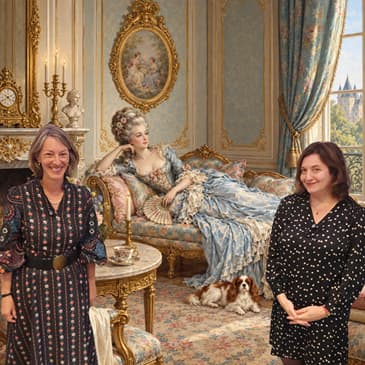
Things get rather raffish and French as Muriel entices Suzanne into that most Gallic of spaces - the boudoir - and tells her everything she ever wanted to know about it but was afraid to ask.
What actually happens in that room? What is it for? We open the door on the dazzling boudoirs of the 18th-century elite, filled with art and chinoiserie, on exquisite women’s retreats and on men’s delirious dens of debauchery. The Marquis de Sade, Balzac, Baudelaire and John Malkovich put in a appearance.
Hosted on Acast. See acast.com/privacy for more information.
[00:00:22] Hello, this is Garlic and Pearls with Muriel Zagha, who is French, and me, Suzanne Raine, who is British. And in this podcast, we take turns to look at something distinctly French or distinctly British and explain to each other why this has evolved in such a way because of our distinctive and very, very, very different cultures, even though we're not very far from each other as the crow flies.
[00:00:50] So Muriel, I think you're going to invite me, entice me today. Yes, I'm going to entice you into a room, a French room, that looms large in French culture, even though it is usually quite a small room. That is part of its paradox. So a box room then? A little box room. Now this room is called the boudoir. And boudoir is a French word which I believe has been imported into English.
[00:01:17] So if I say, oh, coming to my boudoir, you know, I have a boudoir in my house. What does that evoke for you? I mean, if you imagine a boudoir, how do you imagine it to look and be? The first thing that comes to mind is one of those lampshades with tassels on. That's pretty much it, actually. And maybe a chaise longue. Ah, yes, very good. I think that's really essential.
[00:01:43] But mostly, and I don't know if this is allowed, but probably a parrot. Oh, yeah. You think, actually, now I'm thinking they're not in boudoirs. Well, I haven't come across examples, but actually it would work. It would work. You'll see. I'm going to mention various other things, but I think you could add a parrot and that would fit very well. Or a monkey in the corner. Or a monkey. Which could be illegal, probably. Again, again, no, I mean, of course. But partly we're going to talk about the past. Partly we're going to go through the mists of time as we enjoy doing on this podcast.
[00:02:13] And we're going to go back to a time where it would have been perfectly okay to have a monkey in your boudoir. I mean, nowadays, not. But it's interesting that in your ideal boudoir, if you could design it to your specifications today, you'd have plenty of wildlife in it. That's nice. So I'm going to look a little bit more closely at that room, at the boudoir and its different sort of incarnations and its history. And as ever, what it tells us about Frenchness, because it's a French word, because it's a French word that's been imported in other languages.
[00:02:43] There are boudoirs in, there have been and are boudoirs in great British stately homes, for example, but somehow it's not quite the same thing. So why isn't it quite the same thing?
[00:02:54] So firstly, definition, very important. What is a boudoir really? So it's a room. And if you look at maps, plans, architectural plans of houses from the 18th century onwards, they will begin to include the boudoir as a little room, originally, essentially in aristocratic houses, in the houses of the elites.
[00:03:21] When it first appears on the map, you can see that it's situated, say, between the dressing room and the water closet and the bedroom. So in the sort of private part of the house, more private part of the house. So it is a private room. It's a room that's designed for privacy. It's not a room for socializing, entertaining, like your big drawing room, you know, it's different.
[00:03:45] And the etymology of it. So boudoir, do you know where the word might come from? I'm embarrassed to say this because at this point... Don't be embarrassed.
[00:03:57] I am embarrassed because I'm going to make myself sound awful. But I think, you can tell me this is wrong, but everything I know, I know from advertisements for Farron Ball paint on Instagram. And they have one called Sulking Room Pink, which I think is the... They say that that's what boudoir is in some way. It was the... But I don't understand Sulking Room. So you're going to explain that to me.
[00:04:25] It's great. It's great that Farron Ball... Thank you, Farron Ball, if you're listening, for leading us in the right direction. Also, don't judge me, everyone, for that. It just came up and I learned something. Or did I? I mean, is that correct, Muriel? It is correct because boudoir, we think, comes from the verb boudoir, which does mean to sulk. And boudoir is one of those words that, again, the origins of the word boudoir are not super clear, but it's almost a sort of mimetic word, you know, boudoir.
[00:04:54] There's a sort of pushing out of the mouth as if you're pouting and as if you're making the sound like this, you know, like a child. So it's petulant sort of grumpiness as a child would manifest. So it's a room to sulk in. It's a sulking room.
[00:05:12] But there are disputes around that as ever. So I found a French scholar of boudoirs called Joséphine Grimm. And she's looking at other possible routes. There's an old French word, boud, B-O-U-D-E, which means belly.
[00:05:28] And she thinks maybe the sort of intimate room, the private room that is the boudoir, that might be derived more or less consciously from the idea of being enclosed in a belly. I don't know. I think we're pushing, you know, perhaps unnecessarily away from what is quite a clear association of ideas between being in a particular state of mind and wanting to be on your own in a particular room where you can be private.
[00:05:53] Well, I'm interested in the concept of having a small private room that you can go and sit in if you're really grumpy. And I wonder whether that is in its, before we even start on the rest of it, whether that's a French concept.
[00:06:10] So this is a huge subject, and I will come back to it in another episode in terms of perceptions of particularly women and women's moods and how they should be accommodated and how perhaps in a weird way, French women is not expected to be as agreeable as you'd think.
[00:06:29] You know, I think there might be a received idea. This is a little aside, but it's quite interesting, actually, it's all connected, that British women, you know, you think of the suffragettes and, you know, British women are more assertive than French women, that French women are more conventional in their attitudes to femininity and they're more agreeable. And I'm not sure that's actually true.
[00:06:50] I think French women can be very, very disagreeable. And in a way, French men really, really like that. So that's the whole other, which is why having a room called the boudoir where your pretty wife or girlfriend will flounce off to this room to when she's annoyed with you and then you have to wait for her to come out. That's part of the whole ritual. It's quite French, that.
[00:07:12] Modern living is such that it's not really possible to have a room into which one may go just in order to display annoyance. It's a dream, you know, and hardly anyone has that. You just have to go outside when you're annoyed. And then you find it's raining and you regret it. That's right. That's right. But I suppose if you think of a British context of the room of one's own, you know, the Virginia Woolf idea, where you can't, so in terms of Virginia Woolf,
[00:07:42] it's to do with being a creative woman, a writer, you can't really write or create anything unless you have a room where you can be private, where you can be on your own and get on with your creative endeavor. That to me is a very British take on the something like the boudoir or a sort of studio maybe, which is your own. Whereas I think with the French, it quickly travels in another direction. So we're going to talk about that other direction. The word appears in the dictionary of the Académie Française.
[00:08:09] You know, we cleave to the Académie Française on this podcast. In the third edition in 1740. And it's defined as a petit cabinet où l'on se retire quand on veut être seul. A small room, a cabinet is a room in France, is a small room in French. It's a small room where you, that you retire to when you want to be on your own. And they say it's colloquial. Actually in 1740, it's a sort of slangy word, interestingly. Whereas now it's not.
[00:08:37] But it's no accident, just to give a bit of context, I'm going to go fast because everything we touch upon is huge, hugely complicated. But it's no accident that the boudoir appears in the 18th century because it's a time when there's a change, a profound change in the way people think of their living space. So different aspects to this.
[00:09:00] One is, before that, lots of rooms in a house have different functions depending on what you want to do in them. So you might sit in the room and then you decide to have a big dinner. So you bring in trestle tables and you set the table for dinner. Then you remove the tables and it becomes again a sitting room and there might be a bed in it as well. You know, it used to be a lot more fluid. And in the 18th century, rooms become more defined. And this is not exclusively a French thing.
[00:09:26] It happens in Britain as well, where something that would have been called simply a room or une salle becomes a bathroom, a dining room, a sitting room. You know, it has a function that becomes set. So the dining room has a table in it and that's where the table lives and you're not moving it around. And the furniture becomes very specific to different rooms. So the boudoir appears at that time. But what's weird is initially the boudoir doesn't really have a specific role.
[00:09:54] It's not a place where you only sleep or where you just, you know, dress your hair or whatever. It's a room for privacy. It's a room that set us apart from the reception rooms, the rooms where you're going to interact with your visitors. It's a room for privacy, but that remains a little bit sort of hazy in the beginning. And yet it must have answered a need.
[00:10:19] Because if there is such a room that begins to appear, and we know it begins to appear because historians look at architectural plans for new houses. And suddenly there is this little room called the boudoir that crops up. And so whether people started saying, I would like a boudoir in my house and or architects said, we could put a boudoir next to your bedroom. You might like a little boudoir. That'd be nice. You know, I did a boudoir for the Marquis of What's It and it's great. And maybe you could have one as well.
[00:10:49] We don't quite know. There's an effect of fashion there. So as far as you can work out, there's no start point where certain French noble or noble woman had this and then she was the height of fashion and everyone said, we need to have one like her. They haven't been able to trace it back, the source. They haven't. So there's no ur boudoir where you can say, okay, this is the moment.
[00:11:14] What we do see is, I suppose the word becomes attached to a small room, which until then might already have existed in the house, but would have been called a study or a cabinet de curiosité, you know, somewhere where you would keep your collections or a little rest room, reading room. The word boudoir comes into it and begins to sort of aggregate all these meanings.
[00:11:44] So looking at, again, plans, architectural plans, which are factual, you know, they're not just descriptions that how the thing was designed. What we see is that the boudoir is a little room. It's in the more private part of the house. It usually has what's called a niche, which is a small recess where there will be a day bed, which is called a lit de repos for resting. So this is not a bedroom where you sleep at night because you can't enclose the bed.
[00:12:10] It doesn't have curtains or the things that people needed at night in those days. It's a bed where you recline and relax. And so this is where it's halfway to the bedroom, but it's not quite a bedroom. It's a different, it's a halfway sort of room. And then it is also often a room where you will keep your books, where you go to read or, or and a book, a room where you keep your collection of porcelain, of whatever it may be.
[00:12:38] And you display curios or precious things that you've collected. But that's specifically women collecting porcelain or could a man have a boudoir? Right. So extremely interesting question, Suzanne, because I think we have come to think of the boudoir because of the sulking element and a sort of Brigitte Bardot sulking, you know, flouncing out of the room image that we have.
[00:13:03] We have come to think of it as a feminine room exclusively, but it was not to begin with at all exclusive to women, which is also interesting because you think with the resonance of the word, it doesn't sound very masculine. But I don't think people thought about it that way. They didn't worry about it. And I say this because there was a room like that as part of a plan made in 1764 for the Episcopal Palace, the palace of the bishop in Rennes.
[00:13:31] And this plan was approved by the king. And so the bishop clearly also needed one of those little rooms, like a little boudoir. Well, he'd have had a lot of sulking to do. I mean, imagine. And so I suppose, again, looking at plans, what we notice is often this boudoir will have a window. It will have a view on through the garden, usually. And it will often have a fireplace. So you can keep warm and cosy in it. So it's a little cosy room with a view.
[00:14:02] I thought the view is interesting. It is, isn't it? I hadn't thought of it having a view. I thought because of this sort of sulking room pink element of it, I saw it as being kind of cocooning rather than looking outwards. So there are exceptions and there are enclosed cocoon examples of boudoirs. I'll come to those. But generally, and certainly to begin with, it's a room with a view where you can sit quietly.
[00:14:26] And if we try and imagine the mindset of the men and women who have a boudoir in their house in the 18th century, who dwell in their boudoir sometimes, what they're fleeing is social life. I mean, think of the poor bishop, you know, but there are also ladies, grand ladies who do a lot of entertaining, life at court, all of those things where you are constantly on display and scrutinized.
[00:14:52] And it's the age of, I mean, it started in the 17th century in France, but in the 18th century, you're still being scrutinized for your manners, your wit, the way you present yourself, your fashion, your hair. Everybody's looking at you all the time and you're looking at everybody else. And it must have been heavenly to have a space in your house, which is not necessarily just your bedroom, but a space just for you, a space just for you where neither your husband nor your children or anyone else can follow you and where you can be private.
[00:15:21] And I imagine the privacy would have applied to servants as well, because again, a lot of these people lived with domestic staff. There was always someone in the room with you. You're very rarely on your own. So that's what I mean by maybe answering a need for privacy and for peace and quiet and being just at home with yourself. So I'm not sure whether I'm allowed to ask this now or whether we're going to postpone this discussion until later. But in my head now is John Malkovich. Yes.
[00:15:50] And the idea that... Did you ever go into your boudoir to be on your own also with somebody else? Like John Malkovich, for example. I know exactly. Okay. So I think you are referring here to the film Dangerous Liaisons. Is that right? Yes. Which is a wonderful adaptation of the 19th century novel, which is exactly of this period. So you're banging on the money as usual.
[00:16:17] It was an epistolary novel by Chauderlot de Laclos. So the story is told in letters. And the arch villains in this novel are the Vicomte de Valmont, who in the film is played by John Malkovich, and the Marquise de Merteuil, who in the film is played by Glenn Close. And they are both just terrific. And these people are rakes and libertines and manipulators, and they operate very much in a neuroticized boudoir environment,
[00:16:44] where there are spaces in their houses that are distinctly boudoir-like and that are places of seduction. So I'll come back to that in a bit more detail, but you're quite right. That's the thing. So we're going to talk about that later. We are. We are. Don't worry. There's quite a lot coming.
[00:17:05] Because in a way, what I want to do with this is demystify the boudoir to an extent or remind people that it's not just a place for frolics, which is what we think of it as. It was, for a long, long time, for men and women, also a lovely place of retreat and calm and where you could read your book. And indeed, in some cases, a place of prayerfulness and meditation, you know, all those things.
[00:17:32] Or where you could entertain a friend, a close friend, but certainly also a place where you could entertain a lover or multiple lovers in some cases. We'll get to that. But in terms of the decor, let's talk about what the boudoir would have looked like in the 18th century, just in a bit more detail, because it's just so interesting. So one aspect is comfort.
[00:17:55] You want privacy and you want comfort as opposed to, you know, those very stiffed back louis chairs that you have in your grand drawing room where people sit very straight and have conversation. And it's all very witty and a little bit stagey. When you get into your boudoir, you want a chaise longue, as you pointed out. You want sofas, you want Ottomans, all these lovely names that these sofas in the 18th century are called Ottomans. They're called sultans, like a sultana.
[00:18:25] So they are orientalist ideas of what furniture should be. You have a lot of cushions. There are lots of textiles. You know, it's very soft and comfortable and it encourages relaxation. So that's one aspect, sort of tactile aspect. And then in terms of what it looks like, the word is dépaisement. So dépaisement in French means when you're taken out of your pee.
[00:18:48] So when you find yourself in an environment that is completely different from the place you know and is completely unfamiliar. And of course, that can happen when you travel. You know, I went to Japan last year and I was really dépaisy in Japan. But you can also produce that effect by creating a very exotic room in your house where you don't need to actually travel. But the room will provide the illusion of travel because you're going to fill it with chinoiserie and turquerie.
[00:19:18] So Turkish style things, which was what they were wildly fashionable as well. Again, all these things happen in Britain. You know, people have... Totally. I'm thinking of Brighton Pavilion, obviously now at that time. Exactly. Amazing. And then all the Victorian tiles. Or you'd have, you know, an amazing Turkish smoking room or, you know, fumoir. All of the... fumoir also French weather. Maybe we could do a fumoir episode another time. So in... say you create a little Chinese boudoir for yourself, Chinese style boudoir.
[00:19:47] You will have panels of lacquer. You will have lots of porcelain on little plinths, you know, displayed. You'll have images of dragons and things and Chinese landscapes. And it will just be glorious and lots of gilt. Or if you have a Turkish style boudoir, then I suppose, again, a lot of textiles and perhaps images of odalisques, you know. So there's, again, a sensuousness there,
[00:20:14] which is driving us in the direction of the Vicomte de Valmont and his real-life counterparts. I'm also thinking about furnishing... Once one decides, once one has a boudoir, and then you think, well, am I going to go for Turkish or Chinese or perhaps a mash-up? Perhaps I'll make my own third way. You then have to... And I can't imagine, but were there kind of retailers?
[00:20:41] Would you have Mr. So-and-so who supplied great damasks and silks for making up one's cushions? Or do we know anything about how that all happened? I think it would have been... It would have been entirely like that. You would... I mean, we are talking again about elite houses where money was absolutely no problem. So you could afford the best silk artisans, the best tapestry makers, the best cushion makers,
[00:21:11] the best furniture makers, and the best sort of interior designers. Not that they were called that at the time, but someone who would come to your house and bring you samples of fabric and you would choose, you know, glorious sort of pale yellow or whatever it may be. And then you would commission paintings by famous artists, possibly just to finish as a finishing touch. So great luxury. That only you could see. That only you could see, except when other people were invited.
[00:21:39] But I mean, thinking about it from a... Something that only you can see from the point of view of that, it's a place where you can express your personal taste. So again, these are quite modern ideas. You know, it's not always been with us. The idea of privacy and the idea of personal taste being a thing has not always been with us. It's something that begins to emerge, I suppose, with the enlightenment. You can see how it would be connected with enlightenment ideas. Humanism before that, but also enlightenment ideas of the self
[00:22:07] becoming the sort of center of your life. There was a wonderful, just one example, wonderful sort of Orientalist take on the boudoir for a man. It was designed for a nobleman called Antoine Chartraire de Montigny. Wonderful name. He had designed for himself in his house a completely round room. It didn't have a window. It didn't have a fireplace. So it was a cocoon. And it was completely upholstered in white satin
[00:22:35] with designs painted on it so that it felt like sitting in a tent, especially as the only furniture in it was floor cushions. So he was already dreaming a sort of Lawrence of Arabia experience, this man. Before I move on to more detail about what boudoirs were like and what sort of activities went on in them, I think we should go to an ad break. I'm so excited to learn about what activities went on in them. And we're back on Garlic and Pearls.
[00:23:05] We're talking about boudoirs. I was talking about the decor of the boudoir being exotic. Another interesting element of the decor which becomes more prevalent as this particular material becomes cheaper, more affordable, is mirrors, panels of looking glass, which used to be excruciatingly expensive. They become a little bit more affordable, again, affordable for people who can afford expensive things. And so it becomes very usual in a boudoir to have a lot of looking glass panels
[00:23:34] and often an octagonal shaped roof. Yes. So they're all reflecting each other in one of those things. What are they called? I always forget what they're called. Mise en abime. Yes. It's like a mise en abime because the perspective is repeated at infinitum. So that is a feature that you find often. So, you know, really, it's the pièce de résistance of the house in a way, but it's a room that not everyone gets to see. Now, things are going to get a bit more French, Suzanne,
[00:24:04] so you have to hold on to your hat. And I'm going to talk about another aspect of the 18th century boudoir, which you saw coming from the first, because, you know, there's no deceiving you, which is the sort of libertine aspect of it. The French word is libertinage. And libertinage means two things, really. One is a libertine, and it's the same in English, of course. A libertine is first and foremost a free thinker. So that's somebody who operates
[00:24:33] outside of the strictures of conventional morality and religion. So again, think enlightenment. And then the associated meaning, perhaps inevitably, is a hedonistic pursuit of sexual pleasure outside marriage. So we're back to Dangerous Liaisons and our friends, Merteuil and Vicomte de Valmont and John Malkovich is looming large. And did the first one, the first definition existed before the second definition? Yes. So it's firstly a sort of philosophical stance.
[00:25:02] And then there's the kind of inevitable consequence of that stance, which is that you think, well, since I'm not following the dictates of religion, I can do whatever I want. And if I am a very rich nobleman who's a bit of a rake, then that will mean multiple seductions. And look, I have this beautiful Turkish style room in my house and that's absolutely perfect for it. This is partly to do with fiction. It's partly that writers of novels in particular thought, oh, there are dramatic possibilities
[00:25:31] with this room. So there's Dangerous Liaisons. There are lots of other novels written at the time, slightly saucy, titillating novels where the seduction scene happens in a boudoir. I did actually have a question, which was sort of pre-titillating scene, but about literary boudoirs. And you might not know the answer, but is there a first novel which has a boudoir in it, for example? And did it go from being a room that's sometimes mentioned
[00:26:01] to being one of the central characters of a piece of fiction? How does it show up in the French? So I can't answer your question precisely enough. In terms of sort of numbers and frequency, it's just that what you notice is that novels that are about a sort of Georgette Heyer, sort of rake person seducing a young woman, tend to have a scene in them
[00:26:30] where he gets what he wants by luring her into a beautiful little room in his house where she lowers her defenses because the room is so fascinating and dazzling and full of beautiful things. And so he gets her to sit down and then one thing leads to another. So it's just, it's a trope. I won't be able to tell you exactly when it begins, but it's certainly something that becomes a recognizable motif in novels of a more sort of, of a sourcier tinge
[00:27:00] in the 18th century. What has perhaps the most lasting influence on the perception of the boudoir is a book by the Marquis de Sade called La Philosophie dans le Boudoir, Philosophie in the Boudoir, published in 1795, which is written in the form of a philosophical dialogue and is a very Saeedian mix of pornography. It's about the sexual education of a young girl. A radical revolutionary philosophy, you know,
[00:27:29] is 1795. And it leaves a sort of dark seal on the boudoir, on the word and the room. And so the question, I suppose, is also, what about real life? And did people actually behave in this way in real life or is it just sort of the imagination of the writers? And yes, people did behave like that in real life. So the space becomes really eroticized because it will contain paintings. I think I mentioned paintings before.
[00:27:58] So noblemen who are super rakish will commission very saucy paintings of goddesses and nymphs wearing very little. For example, the Marquis de Marigny, an aristocrat, he commissioned, he had a little boudoir in his Parisian townhouse and he commissioned famous painters who are all members of the academy. So again, you can afford the best. So, you know, you hire famous painters, including Boucher, François Boucher is a famous
[00:28:28] 18th century painter, to paint four panels, four paintings, representing different love affairs of Jupiter, you know, with various nymphs. And he, the Marquis, made a specific request that there should be no coverings on the female figures or as few coverings as possible. He's less interested in the educational value of these paintings about mythology than in displaying a lot of female flesh in this little room. So that's not dissimilar
[00:28:57] from a sort of 1980s car workshop with page three passwords all over it. Yes. I mean, it's a lot more expensive, but you're right. And then, my favourite example in terms of a man who can afford a boudoir and who is very specific about his requirements is, so in 1777-78, I think it was, the Comte d'Artois, who was the younger brother of Louis XVI
[00:29:25] and a terrific rake, had an amazing pavilion and gardens built at Baguette. And the gardens are interesting, but in the pavilion, he requested three boudoirs for his own use. Not one, three. One was decorated with paintings of Venus, several panels which looked at in isolation were, you know, classic representation of Venus with a bit of drapery. But in fact,
[00:29:55] in every panel, she removes a little bit of what she's wearing and at the end, in the final panel, she's completely naked and she's dancing in front of the great god Pan. Okay, so that's one boudoir. Then there was another one which was decorated with paintings representing scenes from, again, slightly libertine plays of the time featuring famous actresses of the time in a semi-dissabillé. And then the third boudoir was a room
[00:30:24] that had a, is it a one-way mirror or a two-way mirror? I never know what you're supposed to call it, but you know, a mirror... where you can see through it from the other side. That allows you to see through it, yeah, purely for voyeuristic purposes. I don't know, I mean, never a dull moment with the Comte d'Artois is what I would say. And also possibly, I mean, we weren't there, but you can assume that you don't have rooms like that built in your special pavilion to play chess in them with your friends.
[00:30:54] You know, or to look at your collection of porcelain. I think the purpose was quite different. Do you think those, so we really weren't there, so we can't, is there any, is there any analysis of how many men or women might have been in the rooms together? has anyone done, I imagine somebody saying, well, this is a fascinating thing why, I mean, he's got three. They could be for his use at different times according to different
[00:31:24] moods or something, but does he invite everyone in for a kind of massive party or is it just close friends? It's possible. I mean, I suppose the word, and again, it's the word we find in Georgette Hare sometimes, the word you're looking for in a way is orgy, possibly. There was an element of that, I won't pronounce one way or the other, but certainly... I can't remember any orgies in Georgette Hare. I think there aren't any, but they are mentioned playfully and flirtatiously by rakes. That's what I do remember.
[00:31:55] Yeah. We'll have to talk about... There was another one. It was designed for a financier called Étienne Michel Bourret. He had a boudoir that was completely clad in mirrors. So it was like being in a sort of gilded cage because between the mirrors were little bits of gilt that represented garlands of flowers and palm trees
[00:32:24] and things, but it was otherwise completely mirrored, including the ceiling. And it's hard not to think that there was an element of what's going to happen in this room. You know, it's all... Of course, that's a long way from here's my collection of sevres, isn't it? It is. Especially as in that particular, the mirrored room, the mirrored boudoir, it also had a beautiful silk carpet woven at the Gobelin manufacturer. So, you know, you were asking about makers.
[00:32:54] And it represented Venus and her cortege. So that would have been reflected in the ceiling. And then if you'd been sitting in the room with three ravishing women, they would also have been reflected in the ceiling with you with Venus and her cortege. You know, there's a lot of, again, this kind of mise-en-air beam reflection thing. So I suppose what comes out of all this is the idea that when the boudoir is a sort of sexy room, it's a room that is designed by and for men rather than by women,
[00:33:24] interestingly. Yes. And I say this because courtesans, female courtesans had boudoirs in their house because the boudoir was a fashionable room. But the boudoirs they had in their house, these women who were high-class prostitutes, were the traditional sort of privacy room, you know, the room where they would retire and read a book or sit with a friend where they could be away from, well, let's call it the male gaze in this case.
[00:33:53] I think we can use that expression. Courtesans didn't really have a sexy boudoir in their house. If they had a boudoir, it was a place for themselves where they could be on their own and away from the men that they entertained in their bedrooms. So that is interesting, I think. And it's also interesting generally, again, getting back to a more, to what was going on in Britain and I mentioned Virginia Woolf and the room of one's own. I think for women to begin
[00:34:23] to have a room which is just for them, and I know that this was an elite thing that not all women, you know, if you go down the different social backgrounds, not all women had access to a room like that. But if you have a room of your own in your house, then it's easier for you, wife, mother, whatever you may be, daughter, sister, with a lot of duties, to think of yourself as an individual because you have your own space. And I think there is a lovely scene in, I think I remember
[00:34:53] in Pride and Prejudice, Lizzie Bennet's friend who marries the terrible Mr. Collins, you know Mr. Collins? Oh. And she has, she's never, I know, but she has a poor friend who marries him because she's poor and she has no choice. And she makes it work. And when Lizzie visits her in her house, this is actually a memory from the film, I imagine the episode is in the novel, but to my shame, I can't actually swear to it. But in the film, Lizzie visits her friend in the vicarage
[00:35:21] and her friend says, I have my own little sitting room where we can sit. And they sit together in this little room which looks out on the garden and through the window we can see Mr. Collins doing something ridiculous, obviously. But this is her own room where she can be private. That's the other thing that goes on is an emerging idea that women should have their own space and that they are individuals who have the right to privacy. So they're two very, very different, you know, one we've got the, you know,
[00:35:52] the mirrored room where, and then you've got the other one which is this sort of calm, quiet space that women can hide away in. Yeah, but I suppose where the Venn diagram overlaps in the 18th century is that this room can be equally gorgeously decorated. So not just the men who have wonderful, exotic, sort of orientalist rooms with lots of mirrors. Sometimes women have these rooms as well just for themselves and for their close friends. So it's just an interesting moment
[00:36:21] in architectural history and in the history of sensibility. So then a big change happens. But before we get to the big change, I think we should have another ad break. And then when we come back, I will tell you what the big change was. Okay, we're back. We are back. Hurrah. So big change in the perception of the boudoir, in the way we think about the boudoir, happens in the 19th century. And there are several elements to this. I'm going to compress because each element
[00:36:50] would be the making of a whole episode of this podcast. So we have to be economical. Firstly, and that's going to make you sad, Suzanne, I think, something like the end of the insouciance and joie de vivre associated with the boudoir. And I know that these are the things you like about the French. You like us to be full of insouciance, but the 18th century was a lot more insouciant until, of course, the revolution happened. And then after that, a lot less
[00:37:20] insouciant at the rivers of, you know, gore. Maybe that's the thing. All the stuff, I'm just, you're making me think, all the common conclusion that I tend to come to is that the British take themselves less seriously sometimes and are inclined to have more fun. Maybe that's how France used to be. Yes, it was. It was. I mean, I think the Ancien Régime, which of course had its limitations, you know, it wasn't rosy for everybody, but for the people
[00:37:49] at the top of the pile, I think it was great fun. Wonderful. So anyway, things become a little bit darker, the sensibility alters. Do you think, this is an essay question, to what extent is the boudoir responsible for the revolution? Ah. Well, it's true that when you hear stories of these incredibly lavish rooms and you think about the vast amounts of money that were sunk into commissioning these rooms
[00:38:18] while people were starving, there is a sense of, we've talked about this before, I think it was in the playing cards episode, there's a sense of dancing on the edge of the volcano that, you know, some of these aristocrats are really pushing it perhaps a little too far and there's going to be a comeuppance and we know it's coming, they don't know it's coming, of course, so they keep commissioning these amazing Chinese boudoirs and then eventually people are going to break into their house and smash the whole thing. Or if you're really clever
[00:38:47] and I'm sure some of them were, you'd have secret hiding places within your boudoir, so a kind of priest hole thing, so one of your mirrors you could then press it and it would open and then it would lead into another room which has got even more Yeah, amazing. I think if I could design my own boudoir, I would definitely have that. I think some of the boudoirs had things like, especially the ones that had very improper paintings in them had sliding panels that you could pull out to obscure
[00:39:17] the improper paintings and turn them into more mirrors or some innocuous drawing of a Chinese lotus flower or something but they didn't think about the thread, they didn't know what was coming. In the 19th century it's all happened, it's all happened, it's all behind us and so the sensibility is different and so I'll just give you very quickly two literary examples. Item one is Balzac. So Balzac, I'm rereading Balzac at the moment, he's absolutely fantastic, I can't recommend him highly enough. In Balzac's
[00:39:47] novels there are a lot of boudoirs and interestingly these boudoirs are sometimes women's boudoirs but sometimes men's. So again, we're back to this more fluid idea of who the boudoir is for, it's not exclusively for women at the beginning of the 19th century. I was looking at a book by a French academic called Jean-François Richer which is about the boudoir in Balzac's work and the book is called Surveiller, Mentir, Désirer, Mourir which
[00:40:17] means watching, surveiller, lying as in telling lies, dissembling, désirer, to desire but also to pine, to pine away and mourir, to die, dying. So they are dark places in Balzac where people pretend to be happy when they're not, when people yearn for someone who doesn't love them, where people sometimes kill themselves, you know, really dark and also places where people plot things. So I recently read
[00:40:46] a novel called, I think in English it's called Murky Business, it's called Un Tenebreux Affaires from 1841 but the action is set in the very early 19th century in 1803 and there is a boudoir in it where men congregate to plot the demise of Napoleon. The boudoir is a place of conspiracy, so all kinds of dark things happen in it so that is interesting I think, it's a real change of weather. And then item two, exhibit two is Baudelaire, the poet, where there are
[00:41:16] a lot of boudoirs in his poetry. Is that because it rhymes with soire? It does, it rhymes with all kinds of things. Yeah, it does. It's a great word for poems. Bonsoir. Bonsoir and everything, exactly. So I'm just going to read you a little quatrain from a poem called Spleen et Ideal. So spleen, which is another word for melancholy and ideal. And it goes, je suis un vieux boudoir plein de roses fanny,
[00:41:46] où j'y tout un fouillis de mode surannée, où les pastels plaintifs et les pâles bouchées seuls respirent l'odeur d'un flacon débouché. So nothing rhymes with boudoir in that. Nothing rhymes because boudoir is embedded in the first line. So he says, basically, I, the poet, I am an old boudoir full of faded roses, where a big sort of, what would you say, bric-a-brac of old pieces of clothing,
[00:42:16] is lying around, you know, like an attic, where plaintive pastels, the melancholy pastels and pale boucher paintings by boucher, alone, respire l'odeur d'un flacon débouché, breathe in the scent from an uncorked and open bottle of perfume. That to me, because it references explicitly that aesthetic style of the 18th century, the pastels, the boucher,
[00:42:45] and it says it's all faded and sort of falling apart and becoming all sort of like full of old ladies' clothing and it's all a bit sort of tatty. And I am that space. The poet is this decadent, the really strong scent, yes, and also feeling of decline, of decadence, of decline. So we've really gone to a completely different landscape. So, yeah, the petals have fallen off the rose. The petals have fallen off the rose.
[00:43:15] You know, I remember your episode about blue bells and the very dark Bronte poems about blue bells where the blue bell is really a sort of instrument of pain almost, you know, drags you back to terrible moments of loneliness and isolation. It's a bit like that, a similar period. I'm glad you took that away from the sunny, upland episode. I did. I was very struck. And also with Baudelaire, it's the time,
[00:43:45] it's the 1850s, it's the time when Haussmann is remodelling Paris, making it more geometrical. So, you know, all these old spaces, these Rococo spaces of the 18th century are declining, are being erased and replaced by what at the time would have seemed like very shiny modern buildings. But there is something else. So, these are literary examples, but again, back to real life, what was it like in real life? Another thing happens, which is a sort of Victorian thing. We didn't have Queen Victoria, but we
[00:44:15] had Victorian sentiment in France. So, we had this idea that the boudoir in the 18th century was a room for men and women to have privacy, to have a lovely, peaceful, calm environment and some personal freedom within the home. And now, in the rather febrile atmosphere of the 19th century, the room becomes a sort of embodiment of masculine fantasies about women. So, not just, oh, I'm an 18th century nobleman, I'm a rake and I want a
[00:44:45] place to entertain my mistresses, so I'm designing this sort of bower of pleasure, but more a sort of quite prurient attitude to women where the boudoir, when you think about it at all, if you're a 19th century man, you think of the boudoir as the lair of the prostitute and the femme fatale where she's going to be like a spider in her web. And that's what the boudoir is for, all kinds of tapitudes. And I mean, there's only one step from that to all the
[00:45:15] brothels we talked about in our episode about brothels and the spaces in the brothels. Which it is, in my head, you know, the whole thing with the frilly lampshade. The frilly lampshade and the chaise long, then you find that then in those spaces. So actually the idea that I and Farrah and Ball have is the Victorian one of that edge of brothel. It is, absolutely. And so in the 19th century, the boudoir is for the courtesan, for the prostitute. And then
[00:45:44] there might be a small drawing room in the house of a respectable woman where she sits with her children, with her friends, but that's not really a boudoir anymore because why would she need a private space if she's a respectable woman? You know, what would she get it up to in a private space? She sits in a room which often people start calling a nursery, using the English word, because that really sanitizes it. It's a lovely, wholesome room where your children might visit you and it's for respectable women. And that
[00:46:14] reflects, I think, that really rather hysterical dichotomy of the 19th century between respectable women and prostitutes. And that's really, really important. Yes, you can't both have a boudoir. No. There were rooms like that in there are. I mean, for example, I think at Kew, Queen Charlotte had a boudoir. You know, women and men of the same sort of class in Britain had boudoirs in their homes. I suppose what strikes me as
[00:46:43] French is the association with sexuality. Make of that what you will. Am I right? Well, you're obviously right. I mean, I think from what you're saying, it's not a British misperception or misconception of what the boudoir was. I think we have understood correctly what the boudoir became. Exactly. Exactly. But what I suppose, it's a bit
[00:47:12] sad for the original boudoir, which I think every time you read those adverts for Farin and Ball, it does say a boudoir was of course a special room that women could have and you know, they're not all brothels. But nonetheless, the idea that the boudoir would be, you know, gentlemen's quiet study, that doesn't work when you think of it like that. Well, now we have, you know, other spaces for men have become
[00:47:42] sort of overlaid, you know, like smoking rooms, like the kind of man cave, the shed. You know, we have all kinds of other spaces where men like sometimes to have in the basement a sort of playroom with a big telly or those kinds of spaces. There are still men who will have a private study in their house if they have sufficient space. The problem is space. The problem is space. Most people simply don't have space to have separate rooms for their own pursuits. It remains a sort of
[00:48:12] ghostly room. But you would have, I mean, I think you would have it, but you wouldn't call it in the same way. I think it's become very feminized. So now when we say boudoir, we think of a room for women or with women in it. We don't think of men in a boudoir at all. And yet they used to have rooms called boudoir, but it's going back to the Ancien Régime, so going back a long way. So I think what I've tried to do is demystify it a little bit by explaining a bit more about the context, but also
[00:48:42] maybe remind people of how lovely, once upon a time, how lovely it would have been to have such a room when you really needed it. And actually maybe we all need it now. Maybe we need more privacy and more... Yes, which we can't have. Which we can't have and we retreat into our phones instead. It's not as good. There's a concept which I'm hoping you can enlighten me about because you're the boudoir queen, not me. What is, Muriel, this can be our final five minutes, what is a boudoir photographer? Right,
[00:49:12] so this is where the word I think has travelled in English, in both British and American English, I think, and has travelled, I would say, down markets. I should be explaining it to you, but you know more about it than I do. I mean, I'm sure if you Google it, you'll see immediately the sort of thing. It's a photographer who offers boudoir photography, that's usually photography of wearing sort of underwear or maybe
[00:49:41] nothing, sort of what we also call glamour photographs, I think, nowadays, where again, the word glamour, which we like, we like that word, we did an episode about that word, that word has also travelled down market quite severely, boudoir now is associated with, I think, quite a tawdry, soft, porn, sort of visual universe to do with underwear. But it's also, I mean, there are a lot of female boudoir photographers
[00:50:11] advertising themselves and they're clearly presenting it as something respectable. Yeah, so it's all about women's self-esteem, it's good for their relationships, there's a woman called Alexandra Vince, that might or might not be her real name, who's written a book called The Queen of Boudoir, which is looking back on her career as a boudoir photographer, her favourite boudoir poses, and how she's helped people
[00:50:40] discover body confidence over the years. It's one way, I suppose. You know, if it makes people happy, I have no problem, I think people should do what they want. I think we've travelled quite a long way from the original purpose of the boudoir there and we, it's a very modern thing about, you know, a certain kind of body positivity maybe and empowering people to feel confident and there's nothing wrong with that, but it's a shame that the word has been captured for that, seems to me.
[00:51:10] You know, it can mean different things, but it's nice to be reminded of the older meanings and of... Yeah, isn't it interesting how it's... Of a connection with, I suppose, empowerment and freedom that didn't necessarily involve taking your clothes off. I mean, it did in some cases. boudoir photography in France or is that the British thing? We do. Yeah, we do have the same thing. Yeah, of course. So you can't have a boudoir because everyone's houses are too small and it leads to revolutions, you shouldn't.
[00:51:40] But you could have some boudoir photographs if you were so inclined. If you wish. And we're going to let our listeners decide for themselves and maybe we'll end it there with this puzzling question. Thank you very much, Suzanne. Thank you, listeners. Thank you, Mira. That was genuinely transporting actually. And I've got in my head the idea of having a room that is both a retreat and an imaginative opportunity somehow,
[00:52:10] a room that you can decorate entirely how you want. And that's a lovely idea. The minute it goes John Malkovich-y, it's sort of... Well, then it becomes quite a predatory space, actually. Yeah. So I think we're pro the earliest form of boudoir. I thought you'd say that and I agree with you. I like the earliest form of boudoir and maybe this is something that can be recaptured. But I don't know how we expand our houses to make that possible. This is
[00:52:40] where the sheds come in, actually. This is where exactly shed at the bottom of the garden that you can sort of clad in satin with wonderful chinoiserie. Imagine. Getting the spiders out of that. The possibilities are endless. Yes, exactly. Have to be really well insulated. Listeners, if you enjoyed this episode, then tell your friends. Consider recommending us to other videos. Do leave us a little review. We've been getting some cracking emails. I'm not going to get into them now, but I
[00:53:10] will pass them on at another stage. Some people are coming up with some fantastic anecdotes, rebounding from some of the episodes we've done in the past. So thank you for that. You can find us on the socials and on our website. And Suzanne, I look forward to seeing you next time for something different. Au revoir, Muriel. Au revoir, Suzanne. Amen.