
Hosted on Acast. See acast.com/privacy for more information.
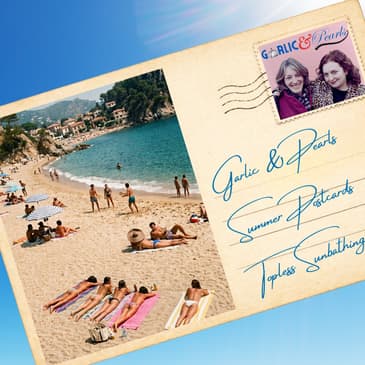
[00:00:21] Hello, this is Garlic & Pearls and welcome to this, the third in our series of... Garlic and Pearls Summer Postcards! Oh, it's so exciting, isn't it? Can you feel the breeze in the air, Suzanne? Well, hardly, frankly, Muriel. Or is it crushingly hot? Anyway, it's summer, it's summer, listeners. And it's my turn. It's one of my postcards today. It's a French postcard.
[00:00:49] And on this podcast, we don't shy away from anything. We face up to some of the more difficult or controversial issues of the day or of history. And so I'm going to take advantage of the fact that we are on holiday. A lot of our listeners are on holiday and so we're more relaxed and more meditative. Oh God, this is terrifying. I don't think we should do it. Well, you are going to be so terrified. And I'm going to bring up a very French topic,
[00:01:16] which is topless sunbathing. Oh, goody. Right. So am I right in thinking that that is really more of a French practice and has been, you know, than a British one? Well, I think times have changed. So you'd have much more of it now than you would have. But in, let's say, days of our youth, definitely it was more French.
[00:01:46] So, okay. So that's interesting because my research into it has led me to discover that there was a sort of golden age of topless sunbathing in France. And it was, let's say, the mid-70s up to and including the 80s. And since then, it's been on the wane. Something's happened. I think it is a French phenomenon for reasons that I will, you know, we'll go into and be very
[00:02:11] interested to hear your take. Yes, more common in France than in Britain. In Britain, it's not illegal, is it? No. But it's, I would say, culturally uncommon. Would you agree? More common than it was. More common than it was, however, because of the influence of the continent, presumably. The continent. The continent. Whereas in France, it's culturally common, but not as common as it used to be.
[00:02:37] So I'm going to give you some figures. Would you like some figures just to paint the picture for you? Figures. This is going to be endless. There was a bit of polling conducted in 2017, so just under 10 years ago, by the Institut Francais d'Opinion Publique, IFOP, which is the French Institute of Public Opinion. So this is France's principal polling and market research firm, which is based in Paris. And they look at,
[00:03:07] you know, things like political forecasting, but also societal trends, such as topless sunbathing. And they found that in 1987, 43% of French women who were polled were sunbathing topless either regularly or occasionally. And by 2017, it was only 22%. So that's quite a shrinkage. And then
[00:03:32] another figure, which is interesting, 2024, so a more recent bit of polling, they found that 90% of women aged between 18 and 24, so young women, you would have assumed would be the prime candidates, 90% of them do not ever sunbathe topless. This is French women. And the ones who do still practice
[00:03:57] this tend to be women over 65. So 32% of women over 65 who were polled in 2024 say, yes, habitually or occasionally I do that. So it's a generational thing. It reflects, I think, something that happened in the culture and sort of blossomed for a while for 10, 15 years, and then it ebbed away. And there
[00:04:22] are lots of reasons for that, for why it came and why it's going or receding. It's not gone completely, but it's receding. It's interesting to get a sense of something waxing and waning, I think. And the thing about topless sunbathing, listeners and Suzanne, is it's not part and parcel of French identity. It's not something that the French have always done. It came at a particular time in French history and culture. And it was really to do with fashion more than anything else. Fashion,
[00:04:52] but also, I suppose, some deeper trends to do with women's place in society. So very quickly, I'm compressing because this is only a little postcard. Let's recap the relationship of French people, especially French women with the sun. So for the longest time, and this is true in the West, this is certainly true in Britain as well. What was valued was pale skin, not tan skin, because
[00:05:16] women of the elite were trying to differentiate themselves as much as possible from working women. So from say, farmers, wives or tenants, wives were working in the fields and were tanned because they were working with their hands and in the harsh weather. Ladies had pale skin and they didn't go in the sun and they had parasols and big hats and so on. So how did this begin to change? There's,
[00:05:42] you know, the beginnings of obviously seaside holidays made fashionable by the British on the different parts of the French coast. So people begin to, the people who can afford it. So again, the leisurely happy few, the elite sunbathed, well, they spend more time outside in the sun and there's still the whole parasol apparatus, but the idea of being outside. And I think the sea and the sun become associated with health, aren't they? Yes.
[00:06:12] So hydrotherapy, the idea that the sea and the sun are actually quite good for you. So in the 19th century, there is this notion, certainly in France, and I imagine it would also be present in Britain that, you know, the scourge in terms of health is tuberculosis. And there is this notion that if you go in the sun, it will help you get over your TB, which of course, sadly isn't true. But people,
[00:06:38] this is the time of sanatorium and life and trying to spend the winter in the sun to stave away all kinds of horrible illnesses. And generally this idea that actually being in the outdoors is beneficial in some ways. And people start going in the sea in their very exciting little outfits that we've mentioned before in other episodes, but nobody's really going brown. So going brown begins later.
[00:07:06] And again, similarly in Britain, I think certain ideas about fashion, Coco Chanel, who is our friend, who we'll talk about more another time, but she appears in this briefly. She's one of those people who starts going to Deville. She opens a shop there and she begins to allow the skin on her face to become a little bit brown. So this begins, people are still covering their arms and legs, you know,
[00:07:29] it's very gradually. And I suppose the switch there is where before the ladies of the elite wanted to be pale and not tanned like working women. In the twenties, thirties, you have a lot of factory workers, everything becomes more industrialized. The factory workers, they're the ones who are lividly pale and the elite becomes healthily brown and bronzed to differentiate themselves. It's all about
[00:07:55] distinction. Always those fashions are about looking more privileged than the hoi polloi. So we're at a time when Chanel is swanning around in Deville, women begin to wear slightly shorter swimming costumes and beach pajamas and things, maybe bearing their arms, you know. And there's another designer, a couturier called Jean Petou, P-A-T-O-U, who's a bit forgotten nowadays, but he was a great
[00:08:23] innovator of sportswear, swimming things. In 1936, he brought out a scent called Vacances, Holidays. So, and he also created the first bronzing oil, which is really a coloring, self-tanning oil, as opposed to an oil to protect your skin so that you can actually tan naturally. So there's this very sort of art deco, almost ideal of the bronze skin. And in French, going in the sun is called
[00:08:50] bronzage. So it's making yourself look bronze, like a bronze statue. I can remember, do you remember Guerlain did those things called meteorites? Yes. And they're not bronzing, actually, because they were sort of pale pink and purple and stuff, but then you brush them all around and it gave you a sort of glow. And then they released one that was a bronze version of that. And I bought it once and I put it on and I looked ridiculous.
[00:09:18] I looked just sort of shiny bronze. I'm sure you looked lovely, but these things I find extremely hard to use. I'm with you. I'm not entirely sure that I understand how they work. We now live in this world where, you know, do you remember there was the craze for Saint-Tropez tanning and all kinds of quite sort of sophisticated treatments where people went to be painted. You went to a salon, you were painted from head to toe and then you had to pretend that it was natural. So this is where before all of that,
[00:09:47] we're still, I would say in my little narrative in the thirties, there is this trend for women looking, having a slight tan and also the oiliness, I suppose, and a bit of an element of makeup so that you make yourself look like a sort of ancient statue. So it's very art deco, that style. And it's also the time when, you know, Josephine Baker, who was this amazing American musical artist who became
[00:10:11] a huge star in France and is one of the most famous French, she became French. She, she became naturalized and then she joined the resistance during the war. She's an absolutely fascinating person, but she was a black woman from America. She became a superstar of the French stage. And I read an interview with her that she gave late in her life where she said, I was part of setting the trend for darker skin because women wanted to look like me. So that is
[00:10:38] also interesting. There's also a sort of an interesting cultural thing going on there. So it's not to say that in the 1920s and thirties, people are unaware that the sun is bad for you. They know it's, well, they want to tell themselves the story about the sun being good for you while at the same time, they sort of know that there are dangers because people did know these things. But there is a sort
[00:11:04] of deeper trend at play, which militates in favour of women taking off more and more stuff on the beach and gradually exposing themselves more. And I suppose what really is the big trigger for this, for the toplessness aspect. What's the big trigger for toplessness? Well, it's America. It's the 70s, well, late 60s and 70s, the flower power movement,
[00:11:29] the hippies seeing pictures of all these young people essentially naked at the Isle of Wight festival. This is not America, but you know, at Woodstock and in California and just living that life. And this filters through to France gradually. The French are sort of fascinated by it. There is a difference, isn't there, between naturism and topless sunbathing. So we have
[00:11:54] naturist sort of colonies and resorts. We've talked about these before. I think they exist in Britain as well, by the way. I mean, there are people who do that. Yes, there are famous nudist beaches. There are famous nudist beaches. There are, but it's not the same thing because nudist beaches, well, okay, you reject all clothing, you try to reconnect with a more sort of direct relationship with nature.
[00:12:21] Topless sunbathing is a halfway house, isn't it? So it's a funny sort of thing. Obviously, the contrast is less with the UK on this. Well, it's just the UK and France, but Germany, which is just a whole nother level. Nudist land. Yeah. In parks, in public parks, everywhere. Everywhere. It's unbelievable. And that's a different thing. It's just, that's different from what you're talking about,
[00:12:48] which is topless sunbathing. You're not talking about everyone wearing no clothes. No. And I tell you what, actually, those codes keep shifting and they are very difficult to keep track of. I remember once being at a swimming pool in Paris, in central Paris, getting changed. And in the cubicle next to mine, I could hear two German girls talking in German. And so this would have been the late 1980s. And I came out of my cubicle wearing my one piece black,
[00:13:15] you know, I'm going to do length sort of swimsuit. And the two girls came out just wearing their bikini bottoms. And they looked at me, that they looked at the pool where everyone was covered up. And they went, oh no. So clearly they had misjudged. They thought we're in France. So obviously they're not nudists like us. So we're going to wear knickers. It'll be fine. But no, that wasn't enough.
[00:13:40] Right. So before we get to that, what makes topless sunbathing a French phenomenon? And what makes it specifically French, the way it manifests, I will tell you after the break. Oh. So the reason why topless sunbathing takes on a sort of French, particularly French incarnation, is because of French feminism. So French feminism, qu'est-ce que c'est? You know, what's it like?
[00:14:10] What makes it different? We had some very serious, stern and austere French feminists. We were really comparable to some of the really fringe American ones or British ones, very, very uncompromising and sometimes separatist, all of that. But there is quite a lot of French feminism that somehow wants to have its cake and eat it. I think I can say this because I
[00:14:38] have observed it many times. In 1973, France gets its own edition of Cosmopolitan magazine. And Cosmopolitan is one of those ambiguous formations, I think, in its American incarnation, British, French, where it's a magazine for independent women. Yeah, you know, down with the patriarchy. Let's not be exploited by men. But at the same time, you have lots of features about what sort of underwear you wear with a strapless dress so that it looks really nice. And in France,
[00:15:08] it's particularly marked that there is that tension between not wanting to let go of seduction and wanting men to find you attractive. And at the same time, we're adopting all these new ideas from our British and American sisters. And we want to be free of the patriarchy and do what we want to do and, you know, embrace our independence. So it's kind of, it's a precarious balance.
[00:15:34] And French women managed to walk that tightrope for a while, but it's possible that now we've run out of rope. I don't know. So, you know, we touched, do you remember the episode we did on the Marseille soap? And we talked about French pharmacies and all these amazing images of women who are not naked, but the adverts for sun cream often, actually, sun cream and slimming cream, which show a lot of
[00:15:57] bronzed flesh. So this is it, you know, there is this pull of this ideal. And with the topless sunbathing thing, it's all about the cult of the body beautiful. And at the same time, you're trying to be a feminist. That strikes me as very French. So it really begins in terms of actually women on the beach, not just undoing their top and lying on their front, not to get Mark on their back,
[00:16:22] but removing the top of their swimming costume or rolling it down completely. That begins to happen in Saint-Tropez. Saint-Tropez, super glamorous resort associated with Brigitte Bardot and all kinds of stars and celebrities. It happens in the early seventies. Women begin to do this on the beach and the authorities are, it's not illegal, you know, but they, they're worried that it's going to upset
[00:16:47] other people. And it does upset other people. Depending on where the beach is in France, the reaction is more or less marked. So for example, in Corsica, which is fairly traditional society, a bit like, you know, the south of Italy, so fairly traditional, the local authorities are really incensed by this. And they think it's very disrespectful. But even then the police are told to, as it were, turn a blind eye and not
[00:17:17] verbalize these women, not tell them to cover themselves up, not find them or escort them off the beach. We leave them be. Because I think the culture more generally, you know, it's also the time when French people are going to see musicals like Okal Kata and Hair and there's nudity is, it's more in the mainstream. It's a little bit edgy, but, but it's mainstream edgy. It's a strange sort of thing. So there is this strange libertarianism in the face of the rules. I mean,
[00:17:47] it's not, it's not illegal in France to go topless in those years, but, but actually in some places it is. So for example, I thought that people went topless only on the beach in France and not, for example, in swimming pools, because I didn't remember ever really seeing people in swimming pools with their tops off. Although I suppose what kind of, it depends a little bit on whether it's a big outdoor pool, but you know, a pool in, in the city. So for example, there used to be a swimming pool in Paris. It's no longer there, unfortunately. There used to be an amazing floating swimming pool on the Seine,
[00:18:16] which was called Piscine de Ligny. And it was lovely. And you can see images of it. You can see little films on YouTube. It's just idyllic. And so I saw some footage from the seventies of women at this swimming pool. So outside, but in Paris central with their tops off being interviewed, being interviewed by TV journalists who say, do you not think this is a bit much? And they say,
[00:18:41] no, no, I'm just living my life. You know, it's also the time of club med. Remember we talked about all these things. This all plays a part. And then the interview, the lady who rents out towels at the pool and she says, oh, they know full well, they're not really allowed. I mean, the regulations of the pool clearly say you're supposed to be covered up, but we would spend the entire day chasing these women. And then as soon as we've told them to put their top back on and we walk away, then they take it off again. There is this deep cultural trend, societal trend, and it's very,
[00:19:10] very difficult to fight it. So it's allowed to continue. Back to Chanel just for a minute. She said in an interview in 1971, When you show everything, it kills desire. She wasn't even talking about topless sunbathing. She was talking about mini skirts. I don't know how she felt about topless sunbathing,
[00:19:37] but she was certainly, so there is still again, a tension between people who say, this is super fun and I feel so free. And the older guard who were perhaps the forerunners when it came to enjoying the sun and seaside and so on, but who say, this is too much, you're showing too much flesh. And also it's quite lookist. So there is, Chanel was definitely like that. There is this idea that only the beautiful should bear themselves and that ordinary people with ordinary figures
[00:20:07] shouldn't. And that's not very feminist. So again, we're in a really awkward situation trying to make it all fit together. I'm quite interested though, because being naked is also not illegal in the UK. And particularly topless sunbathing is not illegal. Yeah. If you look at the laws, it's essentially the tricky bit of the law, which I'm sure it's the
[00:20:35] same in most countries is, is how anyone determines when it goes from harmless public nudity to some sort of harmful public nudity, i.e. harassment or something like that. So it's perfectly legitimate for you to walk up and down the street naked, as long as you're not in any way causing an offence. But then, but then what you're talking about as well, that our first public nudist beaches,
[00:20:59] which we had nudist camps before then. And then, but then in the 70s, it was the 70s in Brighton. So it's the same kind of time. But I think then what you're talking about is something with a bit more, as always, a bit more public aesthetic in the mix. Yes. More public aesthetic. And again, the link with seduction or flirtatiousness. And that is
[00:21:25] the big balancing act, actually. There are lots of elements of balancing act about this period, but it's how men are expected to behave on the beach where there are a lot of women, some not particularly attractive, very ordinary, but some very attractive, who are sunbathing topless. And in the 70s and 80s,
[00:21:47] what's expected of these men is a fairly tricky balance of unspoken appreciation and admiration and apparent indifference. A book was published in the, it's 1995. There's a sociologist, there's always a sociologist thinking about these things. Sociologist, a French sociologist called Jean-Claude Kuffman.
[00:22:12] And he wrote a book called Corps de Femmes, Regards d'Hommes, Women's Bodies, Male Gazes. And this was before we actually had formulated the idea of the male gaze, but he was already very aware that these women are, that they're freeing their bodies, but there are these, these are mixed beaches. And so there are men there who have to somehow also enjoy being at the beach without
[00:22:37] causing offense. So he says, it's only, it's that very French notion of art de vivre, where everyone is terrifically relaxed. Everything is super relaxed and natural, but actually this is only a veneer because there are all kinds of codes and rules behind all this so that you may appear to be, so, you know, you are a man on a beach in say the mid seventies in Saint-Tropez,
[00:23:03] and you approach a woman who is topless and you look her in the eyes and you say, do you have a light for my cigarette? And she will look you in the eye and maybe light your cigarette and then you'll strike up a conversation. But the onus is on the man to somehow express sexual interest, romantic interest in this woman without staring at her in an uncomfortable way,
[00:23:29] uncomfortable for her. So it's a lot, culturally, it's quite a lot to ask of a sort of, so we're trying to create this compound, this sort of utopian society where it's possible for people to interact like that all the time. And the thing is, it did, it did work for a while. It did. I witnessed it. It was, it was possible. It's just that, again, there are lots of codes because, you know, I talked about
[00:23:56] how lookist it is, only the beautiful. Some of the other codes that were at play during those years were, ideally, you should have just the right sort of physique. You know, you should be not too young, not too old, not too well-developed, not too flat. It's, it's the opposite of nature. It's totally culture, culture and taste. And a certain idea of the relationship between the sexes,
[00:24:25] which is really idealized, it seems to me. And the insouciance. And the insouciance. And so men had to be insouciance as well. And they did, they did. So highly codified conformism of a certain kind. French women were the first to adopt this practice, this cultural practice, not the only ones, but the first. They've also been the first to abandon it gradually. So it's interesting that it's kind of run its course in France. I think one of the
[00:24:53] reasons is, there are lots of reasons, but one of the reasons is that where beaches everywhere, not just in France, beaches used to be this sort of semi-public, semi-private space where you could experiment a little bit with your behaviors. Now that people have mobile telephones with cameras, obviously it's not. It's gone. It's a completely public place. And your image might be stolen by someone
[00:25:19] and be on the internet. And I think that is one of the reasons why, especially younger women these days do not want to disrobe in public because they know that there is a danger that they'll be photographed, they'll be filmed. It's a very sad story, but I mean, that has had an impact on other aspects of social life. But it's one of the things I think that's really suffered. You can't really pretend
[00:25:43] to yourself anymore that you are in this sort of bubble of semi-privacy, utopian, false nature that you've reinvented yourself with your friends, because actually everyone can see you. Potentially the whole world can see you. And that leads me on to my point, which is, can you remember a story from 2012 where a very famous British person went topless in France? I think so. A royal person.
[00:26:12] Kate Middleton. Exactly. In 2012 was photographed sunbathing topless on a private terrace in Provence by somebody who then sold the photographs to a French gossip magazine called Closer. Closer. I don't know if you remember Closer. I do remember Closer. So then they basically had a long court case because William and Kate pursued a legal action
[00:26:42] against the magazine and the photographers. And in 2017, so five years later, a French court ruled that the publication was an invasion of their privacy. And then the magazine appealed as well over her topless photos. And it lost the appeal in 2018 and got fined 45,000 euros. Yeah. So it is interesting, isn't it? That thing about public-private distinction.
[00:27:11] I think if you're sunbathing in a private house or near a private pool, you're in a private space. And I mean, obviously when you're a highly famous person, then the paparazzi are going to try and take... The tabloids thing and gossip magazine thing also makes me think that at the time when women began to go topless in France in 1970, essentially, what appeared in British tabloids? The sun.
[00:28:08] It wasn't about sunbathing. It was about saying, oh, it's just harmless fun. And, you know, this lovely girl loves sauntering in front of the camera without a top on. And again, a sort of double think, double speak that was always a bit controversial. Nobody... I mean, it's not that everybody always agreed with it. It just... It ran its course. Well, the campaign to stop it went on and on and on. It did. It took ages.
[00:28:38] And just huge arguments about whether it was the woman's right to be exploited on page three or not. And it wasn't until... It was 2015, I think, that it got... So it ran for 44 years, page three ran. It did. So actually, it endured longer than topless sunbathing or, you know, very mainstream topless sunbathing in France. But it's a very different thing from every British woman thinking, I'm just going to go onto the beach and take my top off to... Exactly.
[00:29:08] These models will be paid lots of money and photographed in a certain way. And then we're going to sell them. And they'll become famous for that. Yeah. Yeah. It's an interesting thing. I think, again, in terms of why it's waning in France, so there is the surveillance society because of mobile phones. There's apparently been an increase that is also sad. There's been an increase in sort of sexual harassment on beaches. So, you know, that social
[00:29:35] contract that we tried to build in the 70s and 80s is breaking down. And I think it's also that topless sunbathing became very, very mainstream. And therefore, you lost that element of distinction, again, of being one of the cool people who does this slightly edgy, cool thing that shows that you're very progressive and forward thinking. And, you know, the messes, they don't do it because they're not as adventurous as you are. If everyone around you is also doing it, then you're not that special. Yeah.
[00:30:05] And so it removes the impetus to do it, to stand out. And in a way, there was a transition period where the cool person would have been the woman wearing a black, a very plain black one piece and looking very chic in a sea of women sort of letting it all hang out and not looking perhaps quite as comfortable as they thought they were. So that's fashion for you. So where do you think it's going to go next, Muriel?
[00:30:33] I have a feeling that it won't return in the same way. I think that we've lost that utopian thinking. I think that's gone. And also people worry about skin cancer so much more. They worry about their skins. I think we're now so incredibly precious about our health that if anything, we want to cover up even more. So it's possible that in fact, people might go back to beach pajamas. I would be in favor of beach pajamas because I think they are terrifically attractive
[00:31:02] and very, very forgiving for women of all ages. Bit sandy though. Bit sandy. Bit sandy. Yeah. And also depending on the fabric, you know, you get wet and then you... So they're really for strolling. They're not for going anywhere near the water. I'm not sure they'd catch on in Britain. They won't. I'm sure they won't catch on in France either because I think there remains this idea that it's the summer and we want to be wearing as little as possible. But in terms of
[00:31:29] bearing part of your anatomy, I think the sea change has been deep and that now there is greater modesty, a greater sense that actually it's more feminist. It's more supportive of women's rights and dignity not to disrobe in public. It's strange. It's a bit like seeing people smoke in films. You know, often I'm watching a film with my son and there are people smoking. Films that are not
[00:31:56] that old, but you know, back in a day when everyone smoked everywhere. And he's astonished that people used to smoke in the office, on the bus, on the train, everywhere, on the plane. Yeah. So it's, I think it's a bit like that. It's going to be one of those relics of a time past, but a relic I think associated with France particularly. So listeners, you're entirely free to do whatever you want on holiday. We're not going to prescribe
[00:32:23] or prescribe anything. Enjoy your holiday. Make sure you wear a high sun factor protection cream because we don't want anyone to burn, do we? No. No. We don't want anyone to burn except Joan of Arc. Sorry. She definitely wasn't topless.
[00:32:48] On that slightly whimsical note, I look forward to seeing you for your next postcard next time, Suzanne. And in the meantime, bonne vacance. Bonne vacance, Muriel. See you soon. Au revoir. Au revoir.