
Hosted on Acast. See acast.com/privacy for more information.
[00:00:21] Hello, this is Garlic and Pearls with me Muriel Zagha, I'm French, and the other half of this podcast, Suzanne Raine, who is British. And this is Suzanne, because it's summer holidays, this is number six of our Garlic and Pearls Summer Postcards. Fantastic. We take turns with these as we always do. And today you are sending me, presenting me with, sending our listeners a wonderfully British summer postcard.
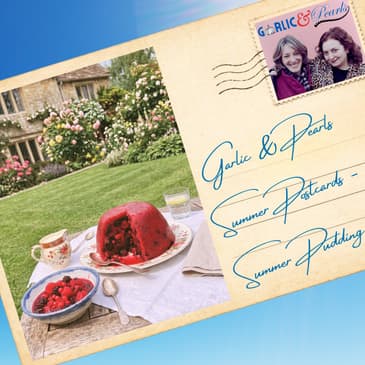
[00:00:51] And what's your summer postcard? It's a beautiful plate, upon which is a domed pudding. Bejeweled with berries. Bejeweled with berries. How wonderful. And it's a sort of purple colour. It is. It's very vivid, isn't it? And you love summer pudding. I adore it. And it was one of the great discoveries of coming to live in Britain, because I don't think that the French are aware of its existence.
[00:01:17] So for our French listeners, they're going to be falling over backwards, because it's such a, it's a very British pudding. So, I mean, you're going to tell us all about it, but it's not, I think, the kind of pudding that would occur to a French person to invent. I'm just going to say that. I adore it. It's not French. Well, here's the thing. Oh, no, it's actually French. Fantastic. We should go to an ad break now, shouldn't we?
[00:01:46] I mean, what a cliffhanger. Not quite. Right. Okay. But it is a curiously European story behind the invention of summer pudding. And elements of it, I think, are going to feel familiar and possibly even homely to me. Really? I wasn't expecting that at all. In a sort of clinical way. What? Yes.
[00:02:11] Because the origins of summer pudding lie in hydropathy, which is the treatment availments by water. And I know that you guys like that sort of stuff, because I once went to a, is it Therlussic? Yes. Teleso. Teleso. Therapy. I went to one of those somewhere in northern France, and I just had to stand there with no clothes on and get hosed down by people. Yeah, yeah. Hyderotherapy, all of that.
[00:02:34] So those are kind of spas, aren't they? But sort of old fashioned, it's a fairly ancient way of treating ailments, which, as you say, involves people standing in front of a wall and being hosed down. Yes. With cold water, usually. Yeah. Or having to go in the sea and then be hosed down afterwards. Yes. Right. So summer pudding is somehow to do with that. Yes.
[00:02:55] And I think this is what makes it such a brilliantly British thing, because what we've done is say, we see your continental hosing down naked people with cold water, and we raise you a cold pudding made of bread. So much better. Yeah. You've really found the sort of hub of Britishness, a core, a nude. It's amazing. I can't wait to hear all about it.
[00:03:26] Summer pudding, let's just describe it for anyone who doesn't know. Possibly there are some people who don't know, but it's a British dessert made of sliced white bread with which you line the inside of a deep pudding bowl. And then you put inside that a mix of British summer berries, leave it to soak overnight, compress it all, and then you turn it upside down, and you know this, and it is a dome of purple.
[00:03:53] Oh, because the juice has completely sort of saturated the bread. And it's called a summer pudding because it's all condensed summer fruits, and it's cold, and it has these wonderful juices coming out of it, and then you can serve it with lovely cream or yoghurt or probably creme fraiche. Creme fraiche works quite well, although I suppose the pudding itself is quite tart, so maybe double cream is a better...
[00:04:21] See, that's the sort of input that only a French person could provide. Yes, I mean, I always think about those things. I was thinking, I was being sophisticated. No, no, no, it's very sophisticated, but I think the double cream is a wonderful compliment. I would say, you know, I would normally always advocate creme fraiche, but in this case, jersey cream may be something amazing. And that's worth listening to the podcast just for that. Just for that. So it looks medieval. It does. Do you think it's medieval?
[00:04:50] Is this a leading question? Are you actually going to say it's... I'm going to guess it's an 18th century invention. 19th century. 19th century. And the Victorians did everything. Yeah, they did. I think what happened is that they've been making Christmas pudding for years. Yes. And they've got all those bowls, and that's what's in the kitchen. So it's just the bowl that you make puddings in.
[00:05:13] And there's been loads of people who have tried to find the, oh, summer pudding recipe in cookery books. And it's not straightforward because the first recipes for summer pudding in cookery books are called summer pudding, but they're not summer pudding. That's actually what we now know as summer pudding. They're not. So what are they? Good question.
[00:05:35] So the first one that's called a summer pudding really was Eliza Acton, who we've talked about before, who wrote Modern Cookery and all its branches in 1845. And she has Queen Mab's summer pudding. That's amazing. It is amazing, but it's not. It's a red herring. Sorry, I'm trying to... Which you would not eat with creme fraiche. No. And this recipe is basically a fruit-flavoured set custard with milk and ground almonds and egg yolks. So it sounds nice.
[00:06:05] It sounds nice, but it's not summer pudding as we know it. No. No. Okay. Nowhere near. And then the next one is from 1864, summer pudding, from an anonymous book called Crafford's Family Fair, The Young Housewife's Daily Assistant. That sounds great. And that's a sort of a batter. So it includes flour. So it says here, make a batter as follows. Moisten five tablespoons of dry flour with a gill of new milk.
[00:06:34] So milk and flour. Then add a pint of boiling milk and five ounces of sugar. Boil. Beat three fresh eggs and add to the batter while warm but not boiling. A lot of temperature regulation. Because you don't want to cook the eggs. Then beat it for ten minutes, which you'd do by hand. Elbow grease. Yes. Oh my gosh. That is, you know. That's gross. Then stir in three quarters of a pint of any kind of summer fruit. That's okay. So quite interesting.
[00:07:03] So could be gooseberry. And then you butter a basin, put in the pudding, tie a cloth and put the basin in boiling water and boil fast for an hour and a half. So again, I'm sure that's very tasty. But it's more cake-like somehow. Yeah. It's not a summer pudding. No. It's not in any way hydropathic. No. So we can cross that one out. Yeah. So there are a few, which I'm going to just skirt over because they're just annoying and don't go with my narrative.
[00:07:31] There are a few sort of American references as well in various American cookbooks. But I'm just not even going to talk about them. Then the first sort of published versions that anyone's found are in the Burnley Express and the Blackburn Standard in 1893, which talk about a bread dome version. Okay. Now we're getting somewhere. So we are. Now we're getting to Burnley.
[00:07:57] And that talks about lining a basin with bread, filling it with raspberries and red currants, sealing the top with bread, and then you're steaming it rather than boiling it. But you're still cooking it. So still not quite round. And the Blackburn version has buttered bread. So again, a bit like a bread and butter pudding. Bread and butter pudding. Yeah. So not... Not the same. Not the same.
[00:08:24] So the first identifiable summer pudding reference wasn't actually called summer pudding. It was called hydropathic pudding. Brilliant. That is just unbelievable. So good. Another slice of hydropathic pudding. Right.
[00:08:49] So was it then designed as a sort of cure food or health food, as we would call it now? Yes. It was. It was. So the first reference to recognizable summer pudding was in Lizzie Heritage's 1894 work, which was Castle's new universal cookery book.
[00:09:11] And that was a sort of big cookery book with all sorts of recipes and tips for housewives and a sort of encyclopedia stroke reference book. And this is what she said. It's very nice when properly prepared. And the pudding served very cold. It's very nice. It's very nice.
[00:09:43] It's very nice. It's very nice. Yes. I think there are rules now. Yeah. And schools of thought. Strong views about strawberries. And I think I would be in the anti-strawberry camp. So would I, because much as I love strawberries, I'm not a fan of the sort of wilting, spongy strawberry.
[00:10:12] I don't think that's very nice. Would you put blackberries though? Maybe so, because I think texturally they're quite interesting. I'd say, yeah, currants and blackberries. And raspberries. Red currants and black currants and raspberries. If you can get hold of red currants and black currants, then that's lovely. But it can't only be them. It can't only be them because it's too tart. And you need the complexity of flavour that I think the raspberry, the queen of berries, I think, will bring.
[00:10:39] But you can tell me more about how we came to devise the recipe now. So this is Lizzie Heritage's thing. Her name is Lizzie Heritage. Yeah. And it really appears to be. That's wonderful. I should say, I've spent a little bit of time trying to find out more about Lizzie Heritage. And I've not succeeded. It's another one of those, yeah. Quite a lot of these women. And there's going to be a few more come up.
[00:11:00] There's very little about them because they were essentially women who wrote domestic handbooks and nobody spent any time and energy finding out what their life stories were. And we don't know. So somebody probably does know about Lizzie Heritage, but I couldn't find very much. Anyway, she says, take a plain mould. So maybe you could make it in the shape of a rabbit.
[00:11:24] I have a mould in the shape of a rabbit, but it's terrible because then when you make the jelly and then the ears always stick in the moulds and it's just earless rabbit is a bit macabre. Take a plain mould, cut a piece of bread to fit the bottom, then put fingers of bread around. Fingers, not slices. Yeah. The sides should be bevelled a little so that they overlap and prevent the escape of the fruit.
[00:11:50] The latter is stewed with enough sugar and poured in and a cover of bread put on. And then a plate with weights is put on the top and the pudding put in a cold place to set. Right. Okay. And the plate with weights is part of the fun of making. Have you made one? I have. Yeah. And it's great fun. The weighing down is amazing. What do you weigh yours down? Tins. Oh. Yeah. And that's worked quite well. I mean, it depends, I suppose, on the surface you're working with.
[00:12:17] But when I do make it, I tend to make a big summer pudding to feed quite a lot of people. So it's made in fairly big, I mean, I'm demonstrating with my hands, which is useless to the listeners, but I suppose the equivalent of a medium-sized salad bowl. So you can put a medium-sized plate on top and then maybe three or four tins would fit on top of that. Are they tins of flagellet beans? Essentially, yes, they are. And tomatoes.
[00:12:47] But I suppose once upon a time, one would have had weights in the kitchen if you had one of those old-fashioned sets of scales. And my grandmother had one. And that was a massive weight. And a tiny weight at the other end. Do you remember those? What do you use? Have you ever made summer pudding? Yes, I have. Okay. Just checking. What do I use? No, well, the thing is, it always gets complicated.
[00:13:10] You've got to find something that is ever so slightly smaller in diameter than the diameter of the top of the pudding basin. And that has to be the right plate that kind of fits there. And then you do just pile stuff on top of it. That's right. So I put a tin in the middle and then I arrange more tins around the sides just for extra security of containing the pudding. But you need a small anvil, really, don't you? Ideally.
[00:13:42] Anyway. So the bit at the bottom of her description, I think, is really interesting because it's an indicator of why it's called hydropathic pudding. For a planer dish, a basin may be used and slices of bread put to line it entirely. And then either of the modes may be followed. So she's talking about turning out the bowl. Ah, yes.
[00:14:05] And she says, these should be turned out with care and may be served plain or with a simply made custard. They are useful for those who cannot take pastry or rich puddings and for children. Okay. So it's a lighter pudding. See where we're going. Yeah, yeah, yeah. So those references to those who can't take pastry and talking about serving it plain. Yes.
[00:14:30] They're hinting at a fashion in food, aren't they? That suddenly there's a bunch of people who are trying to simplify their diet and purify their diet in some way. And that's because popular at that time, which is the very end of the 19th century, where people looking for alternatives to steamed puddings and, you know, spotted dick and all those other treacle spots. Which are rich. Which are fantastic. Which are very rich puddings. Stuart.
[00:15:00] And so on. So this is arguing for, it's hydropathic pudding, it's saying this is a healthy pudding because it tied in with this idea that water can cure ailments. Yes. So you know this already, of course, whereas I don't. It's a discovery for me. But then maybe you think water can cure ailments, whereas I know it doesn't. Oh, I don't know. Shall we find out after the break? Yes, please.
[00:15:34] Welcome back. We're back. So now we're going to find out whether water can cure all ills. It obviously can. Yes. But in the shape of pudding, it's even better for you. I suppose, OK, so in what way is this hydropathic pudding, summer pudding? Because berries are essentially made of water. Berries are very watery. Just let me go on. OK.
[00:15:57] So I'm going to give you a tiny, tiny history of stuff you already know about spa towns. I may not know. I may not know. Well, Hippocrates, right, in the fourth century BCE, said you can treat disease with water. Then in the medieval times, spa, a small town in Belgium, became known for its mineral springs with healing powers.
[00:16:26] And then you've got spas, holy wells, everything. You know, the upper classes would go and bathe in restorative water. And then in the 19th century, there was an Austrian farmer called Vincent Preissnitz. Vincent Preissnitz. Who apparently cured his own broken ribs by wrapping his chest in damp bandages and drinking lots of water. Hmm.
[00:16:54] It doesn't sound very convincing, but OK. I'm glad he cured himself. And he found that that had a miraculous effect and he was suddenly mended. So he then set up a water cure in Grafenberg in Austria, which was known as hydropathy, and expounded the healing properties of clean water, stripped down diets and regular exercise.
[00:17:21] And you can see, I mean, that obviously took off all across Europe. So it was treatment of illness by the external application of water to the body using wet sheets, wet stomach packs, baths. And he thought that sickness came when you introduced, you know, bad or unhealthy material and so that you could expel those poisons with the cold water.
[00:17:48] So no drugs, no alcohol, no rich food, lots of sweatings. It went all across Europe, including to Britain. It's still with us. So in 1840. Is it still with you? Well, I mean, it's still with us. It's still with us in the culture. I mean, this idea of clean eating, of, you know, detoxing. You're against it. I am a little bit against it. But I mean, this is not about that. So I'm listening respectfully. I'm trying to get on board with it.
[00:18:18] In 1840, Malvern in the UK became one of the first places in Britain to offer the cold cure. Sounds fun. But, and now a lot of things that I hadn't previously understood make sense. What happened then over the next sort of two decades was the flourishing of the hydropathy spa or hydro. Yes.
[00:18:44] So there's a lot of places now that still exist around the country, like the Creef Hydro, for example, which when you hear about it, you think, why is that a nice hotel? What does, where does hydro come from? But it actually comes from the Victorian hydropathy thing that was particularly popularized by a few, you know, enthusiastic gentlemen. So I'm going to introduce you briefly to a few enthusiastic gentlemen. Can't wait.
[00:19:12] I wish I had more time for this, but this is actually supposed to be about pudding. So we're going to glance over the ridiculous career of Captain Richard Tappin Claridge, who was a prominent asphalt contractor and a captain in the Middlesex militia, who became best known for his fanatical promotion of hydropathy in the 1840s. And he is the one. I love him so much. Yeah, we, I mean, he's. I can see him.
[00:19:44] He's, he's amazing. He was born a Quaker. He had, he was a gentleman entrepreneur in many, many ways. But he ended up becoming acquainted with the methods of Vincent Prysnitz while in Europe and utterly convinced and converted by them.
[00:20:04] And so he came back and he wrote Claridge's Hydropathy or the Cold Water Cure as practiced by Vincent Prysnitz, which was published in 1842 and 1843. And that it was the textbook. Yes. After which everything is possible. I should say that just because we want a little bit of colour. I mean, he claimed that this promotion was completely philanthropic.
[00:20:30] Having gained my own health and saved the life of my daughter at Grethenberg and having witnessed the most astounding cures there, he came back and wanted to promote the system here. Before he became a hydropathy promoter, he had also been a boot and shoemaker and a wine merchant. And then, as I said, he pioneered.
[00:20:57] And I think, you know, we have probably have him to thank quite a lot for things that I think I should go on to look into more for another episode. And I almost, maybe I shouldn't flag it now. Flag it, flag it. Asphalt paving. Yes. And when you said asphalt, my ears pricked up. I think we need to put a pin in that for a future episode. Okay. So he's secretly quite an important guy. But also, at the end of his life, he lived in Nice. Ah.
[00:21:27] He's straddling. He's a little bit garlic and pearls himself. He is a bit garlic and pearls, yes. So anyway, so he published Hydropathy, The Cold Water Cure. And it got huge excitement and reached its third edition in the space of three months. And it got circulated everywhere at the Rooms of the Society of the Arts, Adelphi. The fifth edition had an advertisement saying, it's little more than nine months since the announcement of the work appeared.
[00:21:56] And during that brief period of time, five editions of 1,000 copies each and eight editions of an abstract have passed through the press, besides which several unauthorized publications in the form of pamphlets have been sold in great numbers. So almost a hysteria. And he declared the year 1842 may be considered as a new era in the mode of curing disease. It's year one. It's year one. Again, it's that idea that we're starting. It's tabula rasa. Yeah.
[00:22:26] And he was utterly fanatical about it. So he went off, he promoted it everywhere, he did tours, and people started to set up hydros. At the peak of the late 19th century, there were over 50 hydropathic hotels in Britain. And the best known are John Smedley's at Matlock in Derbyshire.
[00:22:51] So John Smedley, of course, was of the Smedley dynasty that produces those wonderful... Knitware. Knitware. He was a massive convert. And so alongside, again, a whole nother story, alongside the mills, the amazing knitware, which you can still buy today, which is very fine, he pioneered the hydro and set up numerous hydros, Smedley's hydros, they were called around the country.
[00:23:18] I just want to explain one bit, which is Claridge's specific references to the sort of things that constitute a summer pudding, because I think we can see here how it links. He recommended a diet of water and cold foods. He explicitly stated that hot food or food that had stimulating properties, such as spices or rich sauces, should not be served.
[00:23:49] He also says that the ideal breakfast is bread, cold milk or water and fruit. And fruit should be eaten cold and regularly. But, and this is the extra bit, only types of fruit that grow naturally in Britain. Ah.
[00:24:10] Because, he said, exotic fruits were often particularly juicy to refresh the blood of those who are parched up by a burning sun, which is not an issue in Britain, although maybe it is now. So, he thought that fruits such as mango or pineapple or, dare I say it, melons, were thought to overstimulate the temperament of the average Brit,
[00:24:39] undoing the good work of previous hydropathy treatment. It's so beautiful. It's such a complete vision of fanatical lunacy. But, it has its own logic, I guess you could say. Yeah. And everybody went for it. I'm showing you the cover of a book by Smedley. You can just read to me. So, Practical Hydropathy, fourth edition, 20,000. Wow.
[00:25:05] Including plans of baths and remarks on diet, clothing and habits of life by John Smedley, Lee Mills, Darby. With 160 anatomical engravings and physiological explanations, plans of baths, etc. Wow. A surprise, two shillings and sixpence. Interesting. So, really a complete design for living, you could say. Okay. It's not just being hosed down. It's what you put inside your body. It's how you clothe yourself.
[00:25:34] So, presumably it's got to be breathable. I mean, I don't know, I'm just guessing. There we are. Hydropathic pudding. Unbelievable. Got to just scoot through the 20th century where it became summer pudding. Yes. Because at some point, quite quickly, I think, quite quickly, genuinely, somebody obviously thought this name might be putting people off. Could we rebrand it a little just to make it sound a little bit nicer?
[00:26:05] More appetizing. And that happened really quickly. So, the first use of the word summer pudding, associated with the same recipe as hydropathic pudding, was the wonderfully obscure Miss E.S. Poynter, who was a missionary in India. And she wrote a book called, in 1904, Cooking in India.
[00:26:32] And it's also called What and How? Or What Shall We Have? And How Shall We Have It? And that is historically recognized as the first published text to introduce the term summer pudding associated with the recipe for summer pudding. Okay. We don't know very much about her at all because she was a missionary and she wrote cookbooks in India.
[00:26:57] But what she wasn't writing is what you now get, which is people who go to India and pick up Indian recipes and write. What she was actually writing was very British recipes for British people who were living in India, doing missionary work, often working in, you know, poor places in India, trying to help people and writing books for simple recipes, things that they could use to feed themselves
[00:27:25] and also to teach Indian people. Yes. To make summer pudding. So it was kind of evangelical domesticity in a missionary sense. Unbelievably good. And she took the summer pudding. So it was published in Calcutta and similar by Thacker, Spink and Co. And sorry, that's not funny. There's something funny about all the names. We've had this before.
[00:27:53] Also with French names of a certain vintage. They paint a picture. So Thacker, Spink and Co. were the premier publisher for the British Raj based in Calcutta and Simla. Simla was the summer capital of the colonial government. So Miss Poynter was a missionary, but she was within those administrative social circles of the British colonial infrastructure in northern India. And she was saying to everybody, eat summer pudding.
[00:28:23] So it's a British cooking book in disguise. It's 221 pages long with all sorts of instructions for a colonial homemaker. And then by the 1920s, it's become a classic British pudding. And there's a book in the 1920s that says, everyone knows this dish all like it. Then it had a dip somehow, probably to do with the war.
[00:28:50] And it then got rediscovered in the 1980s. The man who's credited with doing it is a Scottish sous chef called Andrew Robertson, who was working in a restaurant in Sheffield. And he was asked to come up with new and interesting desserts. And he went back to all the 19th and 20th century cookbooks and said, let's have a look. Let's see what I can find. And he drew the summer pudding, the hydropathic pudding.
[00:29:20] He pulled it out of the Samfelder, as it were. And he then gave it to a TV chef called Kevin Woodford, who was sort of mildly famous. I think he did Can't Cook, Won't Cook and things like that. Did he have a moustache? Yes. OK. And he then picked up on it and then Prue Leith picked up on it. And then suddenly the summer pudding, Nigella picked up on it. Didn't he, yeah, I think? They were, yeah.
[00:29:44] So it then became part of our culture and heritage again, in a way. And that, Muriel, is in a nutshell, in a bowl. In a bowl lined with bread. Racer, eat yourself healthy. I'm really pleased to hear that a British pudding I've always admired and found delicious, really delicious, is also so good for me. It's obviously good for you. It is.
[00:30:14] Well, it depends how much cream you have on the side or all over it. What came to me when you mentioned summer pudding is, so one, I am certain that it's unknown in France. It's not a thing. Nobody knows what it is. And it wouldn't occur to the French to make a pudding in this way. Because if you're going to make anything with fruit, ideally it will be a tart. And so you have to make buttery pastry. To begin with, you make a rich buttery pastry and then you put fruit in it, maybe with custard.
[00:30:42] You know, everything is, and the fruit is the sort of ornament, but really what you're eating is pastry with custard or cream in it. Nothing hydropathic in that. And so what I heard from French friends who, like me, are expats, live here, and who became more acquainted with summer pudding is, they would say things like, why would you make it with bread? It doesn't make any sense. You have to make it with cake. You know, the French are trying to make it make sense. And one way of making it make sense is to use slices of sponge cake.
[00:31:11] That's what a friend of mine did. So she lined the bowl with thin slices of sponge cake. So it's more like a trifle, really, in the French. And then she filled it with the fruit. And the juice did saturate the sponge cake. So when she turned it out, all was well, but it was just too sweet. It didn't have that quite stark Puritan integrity. And the bread holds the cold, watery feel. It does. It's quenching somehow.
[00:31:39] It's more the word that French is desalterant, something that's quenching. And I think summer pudding is that. And the revelation I had when I had it for the first time, it was at a summer party at somebody's house. And the hostess had made, it was quite a big party. It was the party at which I first met our other friend Annabelle. So that sets it as a sort of historical event for us. And there were maybe six or seven summer puddings on this table and bowls of cream.
[00:32:08] I couldn't believe the intensity of the colour. I didn't know what I was going to find inside. And the intensity of flavour, colour and the cold in this hot garden we're eating outside was unparalleled. So I think for me, it is one of the summits of British gastronomy. I'm willing to go as far as that. And French people who are listening to us, French people, but also British people who've never had summer pudding, make one now.
[00:32:38] Go and get the ingredients. Make it, eat it. I think make it yourself. I'm not sure that you can buy a ready-made. It's not something that... Also, one of the tips that actually I think everybody agrees on is don't use sliced white bread because it makes it slimy because it's got too many additives and things. So you kind of do need a well-made, proper loaf of white bread. And then you want to slice it quite thinly.
[00:33:05] So something with a bit more texture that will support the fruit better. Proper Victorian loaf. Yes. Think like a Victorian, have summer pudding. Susanne, this is great. It's been such a great summer with our postcards. Thank you so much. Thank you, Muriel. And so I look forward to seeing you next time and enjoy the rest of your holiday. Bonne vacances. Bonne vacances, Muriel. Au revoir.