Hosted on Acast. See acast.com/privacy for more information.
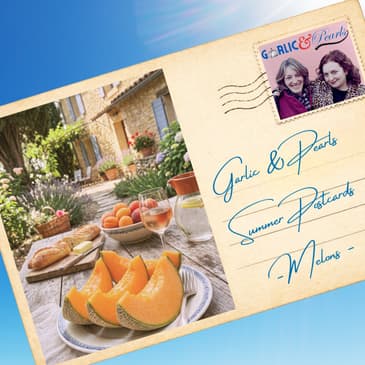
[00:00:21] Hello, this is Garlic & Pearls with Muriel Zagha, who is French, and me, Suzanne Raine, who is British. And this is the podcast where we explain inexplicable things to each other about our respective cultures. And this, Muriel, is the fifth of our Garlic and Pearls Summer Postcards. It's the fifth and it's French one again.
[00:00:45] So it's my turn again to transport you to a French part of quintessential French summer. This time, it's the food. It's the food that I don't know actually if this food is as important to the British in summer as it is to the French. I suspect not. I think I only realized when I moved to Britain and I began not necessarily always to spend my summer holidays in France,
[00:01:11] that one ingredient that was missing from holidays if I didn't spend them in France was melon, by which I mean the Charentais variety with orange flesh, you know, and pale green skin. So not the pale green melon, the watermelon, you know, they're all delicious, but it's not the same thing at all. I'm talking about the round melons. Sometimes they're slightly oval, but they are in the main round and they have this
[00:01:38] incredibly, incredible depth of flavor. And they are really one of the mainstays along with I think the tomato, the really ripe tomato, a French summer eating. It's not unusual in France in the summer to have melon every day and perhaps even at every meal, a bit as a starter was between the cheese and the pudding or something. So we eat quite a lot of it. Obviously not a melon connoisseur.
[00:02:06] Are you talking about, I thought they were cantaloupe, the round ones with the orange inside. So I think cantaloupe, you're right. Cantaloupe is the name of it, of those round ones. Charentais is the provenance. So I suppose the variety would be cantaloupe. That's what we call them. So that is what you're talking about? Yeah, that's what I'm talking about. And then Charentais because they're grown in the Charente region, although they're also grown in other parts of France.
[00:02:34] But I think that is one of the main growing areas in France. But yes, cantaloupe, I call them Charentais because, you know, again, immediately we're sort of accelerating ourselves towards the idea of terroir. Terroir is also present in the relationship we have with melon. French households eat on average eight kilos, eight kilograms of melon during the summer months, which is not monstrous, but it's quite a lot actually, given that it is,
[00:03:04] in a weird way, although it's mostly water, it's quite a rich experience to eat melon. You know, it's quite a lot of flavor and texture and sugar in the mouth and so on. For the British listener, we should say that eight kilograms, which is an unknowable quantity, is 17 pounds. 17 pounds per household, not per person. Oh, per household. Per household.
[00:03:32] But often there will be one or two people in the household who eat most of the melon, you know, who eat enormous amounts of melon. We produce about 300,000 tons of melon every year. And that places us third in Europe in terms of production behind Spain and Italy, because of course they have the even better climate. But that still isn't enough. The 300,000 tons that we produce is still isn't enough to meet demand.
[00:03:58] And we import another 90,000 tons from Spain, from Italy, from Morocco, from Israel, primarily. All places that grow lots of those melons that we like. So when the season comes around and the season is July to September, we go into a sort of melon frenzy. And I suppose it's so deeply woven into the behavior that I hadn't noticed how important
[00:04:26] it was until I found myself in the summer somewhere where that doesn't happen. So where you go into a supermarket in Britain at the height of summer, there will probably be some melon available, but there won't be piles of crates of melon and then people gathering around them and choosing their melons. That is, of course, one of the main things I'm going to talk about is how, how do you pick the right melon? How? A few more little bits of info.
[00:04:55] The season is quite short, so that explains the frenzy. It doesn't freeze well. It's not one of those fruit that you can freeze and then you can eat it all year round. It doesn't work that way. Nor is it a fruit. Oh. It's actually a vegetable. Oh, because it's like a cucumber. It is like a cucumber. It belongs to the family of cucumbers and squashes and things, which in French is called cucurbitaceae family, which would it be cucurbitaceae, something like that? Why are you asking me this?
[00:05:25] I don't know. I just want to torment you because you often ask me questions like that. It's an amusing name. Anyway, it's a big family of courgettes, cucumbers, squashes and pumpkins and melons. And they are all friends together and they're all related. So that's what the melon is. And it's another little bonus bit, which I'm going to disclose immediately because it's a bit niche. But some of our listeners who've listened to earlier episodes will get a great kick out of this.
[00:05:50] In our episode about Marseille soap, which is also about the South, I described a condition called heavy legs. And I was much mocked for it by you and our producer who was present in the studio when we recorded the episode, because I said a lot of French women suffer from heavy legs, jambes lourdes. And if you go to a French pharmacy, there will be lots of remedies against jambes lourdes, which is where it's almost like pins and needles, you know, very, it's just discomfort in the legs. And this is heightened in the heat in the summer.
[00:06:19] Melon allegedly helps with that. So that's an extra good thing about melon, which I'm just throwing in there. Melon is a great source of pleasure and joy and shared enjoyment in the summer for the French. It's also a source of stress and anxiety because of the selection of melons, the right melon and how on earth are you going to pick the right one when you're presented with mountains and mountains of melons that all look identical.
[00:06:44] Is it like avocados and pomegranates where you can't tell from the outside? I mean, sometimes you can, but pomegranates in particular, you can't know what it's going to be like inside. The pomegranate is completely sealed off. There's no way that you're going to know. I mean, it's possible that people who eat a lot of pomegranate or live in countries where they grow will know, will have some sort of knack or hack. We don't have that. I buy pomegranate hoping for the best.
[00:07:12] You don't know if you're going to get lots and lots of grains or almost none. Sometimes there are. And sometimes they're kind of browny colored and you think, what? Why? Why? And then it's all scarlet inside. So with the melon, it's become easier to get a reliably good melon in the summer in France because most of the Charentais melons, so the melons that are grown in the Charente or confusingly, Charentais de Cavaillon, which are grown in Cavaillon in Provence, but are
[00:07:41] the Charente variety, sub-variety. I'm not going to go into this, but essentially we use Charente as a shorthand for delicious ripe French melon in the summer. Most of these melons that are sold, they contain a guaranteed minimum amount of sugar, which is 10% because the producers verify the amount of sugar with each harvest. Either, this is fascinating, I didn't know about this science.
[00:08:08] They either take a representative sample of, I don't know how many melons out of the harvest, and they extract one drop of juice and they put this drop of juice through a special prism that reveals the sugar concentration in the juice, or they test the entire harvest, and this is done mechanically by scanning with a special infrared scanner each melon,
[00:08:36] and the scanner tells you automatically how much sugar is in the melon. So it's amazing special melon technology, which I didn't know existed. Which is a measure of the sweetness and the flavor then, is that what they're going for? Yes. So the sweetness, they can't really measure the flavor, but at least the sweetness means it's not going to taste like squash, because of course it is related to squash. If you get a melon that is unripe or has been harvested too soon, it might taste a bit like
[00:09:03] squash, and that's really not what you want in a melon. The sweetness is sort of taken care of, although it's not entirely guaranteed, but it remains an inexact science. And there are lots of other ways that you can try and stack up your chances of getting a good melon and delivering a good melon for your friends or your guests. So every year there will be articles in papers and magazines. You know how there are these seasonal articles about things in the summer, which will be tapping
[00:09:30] into people's anxieties, French people's anxieties to do with melon selection, giving you all kinds of advice. I've looked online. There are so many. It's unbelievable. So I'm going to share some of these tips with you now. Some of our listeners will be possibly in France, will have access to French markets or supermarkets. If you go to a market to buy a melon, you're fine because the seller will know
[00:09:56] exactly which melon you want. And you have to ask them. You mustn't be shy. You have to say, I'm looking for a melon for today's lunch or for Sunday supper, or I want to keep it in the fridge for a week. And they will give you exactly the melon that you want. There will be a melon with your name on it and they will give you that melon. If you go to a supermarket and you're faced with the big piles of crates of melons, it can be a bit bamboozling because how are you going to know? So you need to
[00:10:24] put in a little bit of time and you will see that a lot of other people are doing that actually, that there will be a lot of French people standing there, usually holding a melon in each hand. This is a gesture that in one of the articles I read, it was described as, a gesture as old as Thai itself. Because you're trying to find a heavier melon,
[00:10:50] the heavier melon will be denser. It will have a greater concentration of flavor and juice. So the light melon you discard, the heavier melon is your friend. This is the one you want. Of course, this can be endless because you could spend the entire day in the supermarket weighing all the melons trying to find. Anyway, but as an indication, if it weighs heavy in the palm of your hand, that's good. The other thing is the stalk. So the thing about melons, and I'm going to say
[00:11:19] it in French because it's incomprehensible, le pédoncule est déhissant. I'd never come across that sentence. Pédoncule is a sort of science-y word for the stalk of the melon. And déhissant, I think there is an English word which is déhissant. And all that means is that when the melon is ripe, the stalk tends to come away. So you're looking for melons where either it still has its stalk,
[00:11:46] but you can see a little bit of stalk left. You can see that it's beginning to come away or it's come away. Yes. And there's a sort of crater where the stalk used to be. So that's another indicator. Yes, I think of a melon not having a stalk. That's right. So sometimes they still have a little bit of a stalk. Sometimes there's a sort of crater, which is the relic of where the stalk was. You should smell it near the stalk or near
[00:12:13] where the stalk was because there are different schools of thought. Some people say, well, all melons smell okay. And then they're not necessarily all good. There is, I think, something about a really aromatic smelling melon. And this is all practice. It just takes years and years of practice. You have to put in the hours, but you will know when you smell a melon and it smells a bit kind of watery and boring, it's very unlikely to be good. If it smells like,
[00:12:40] oh, this amazing sort of face full of summer, then that's probably going to be a good melon. Although, again, there's no guarantee. Sometimes they smell wonderful and then you cut them open and they're nothing. So it's a really, it's a very stressy thing. And I wouldn't organize a high stakes dinner party all hinging on the quality of the melon, because if it's not good, it'll ruin your
[00:13:06] evening. The other thing, the last thing is the skin, the texture of the skin of the melon. It should be just a little bit supple. It should be firm, but there should be a little bit of give at the base. So the bit at the other end from where the stalk was, you do a bit of a camembert action. You know, French people test camembert with their thumb. You press slightly. And if there's a little bit of give, then that's usually a sign of perfect maturity. The articles are brilliant because they are so
[00:13:36] hysterical. So there are lots of, careful, you know, this is a trap. Don't be taken in by this kind of if the skin is too shiny, walk away now. If it's too smooth, it's probably been picked prematurely. You know, put the melon down, walk away, don't be taken in. Attention à la déception is one, a title I found. So at Australia, it's Beware Disappointment. It's a sort of existential experience. It's like life.
[00:14:05] So you're making me think, obviously, this is a cultural difference because we do have melon, you know, sometimes on sticks, sometimes with ham, sometimes in, I remember as a kid, and you probably do this as well. Do you do the sort of melon boats? Yes. Yes. I love melon boats. So that's nice. Do you do melon balls? Yes. I used to have a baller. I don't know what's come of it. It used to be quite an important part of my equipment in the kitchen.
[00:14:33] So we must have got melon balls from you, presumably, because we wouldn't have... Yes, because I mean, they're quite, they're sort of 1970s, 1980s smart. And you would boil the melon and then maybe put it back in its skin, maybe with some raspberries or something, make it into a smart fruit salad. So there are lots of things you can do, lots of fun things. But I can't think there's many British dinner parties where the melon is usually some part of
[00:14:58] the first course, where the person providing the food will have agonized for hours about the exact quality of the flavor. I don't think, I think they just say, here's a melon, I'll chop it up and stick it on the plate with the ham. Exactly. But I think it's partly because melons are a sort of gourmet treat in the summer for the French. So you know that everyone around the table will have high expectations. They will want the
[00:15:24] full melon experience, which is not just a sweet fruit that's ripe. It's scent and taste and mouthfeel. And it's also an attractive orange color. You need everything to be in alignment. It's a lot of pressure. So I think the hysteria is quite French. Could it be the case that we don't have this because our melons don't taste the same, because they've come so far?
[00:15:51] It's possible that it is a milder experience in all senses in Britain, that there's less investment, emotional investment or perfectionist investment, because you're not expecting something. I mean, as with tomatoes, in a way, not a bad comparison. As with tomatoes, you're not expecting the perfect Italian tomato that's lived all its life in the Mediterranean sun. You have tomatoes for crunch and
[00:16:19] a bit of color. And if the flavor is there, that's a bonus. And with melon, the same. It's a refreshing food. But it's not meant to be this explosion of flavor that's going to confirm that it is summer and that life is okay. You know, it's quite a lot of investment. There's also some good advice I found on what to do if you buy your melon and you do all the things and you smell it and the stalk is coming
[00:16:41] off and everything, and it's still a dud, is you can try and ripen it some more at home using a glass dome. So this French article said, just use whatever glass dome you have to hand, a cake dome or a cheese dome and you go, I don't really have a dome. But if you... Haven't you got a glass dome? If you have a glass dome, sometimes they're called glass bells, you know, the sort of thing I mean,
[00:17:10] then you put your melon under there and maybe chuck a banana next to it. You know, bananas release gases that help. I've done that with mangoes before quite successfully. And then hopefully after two or three hours, your melon will be better. It might not be perfect, but it will be edible. All is not lost. There are things you can do to salvage it. That's a lot of practical stuff I've
[00:17:36] given you, Suzanne, about how to pick your melon and the joys of eating melon. There is also in France a wider hinterland to melon. Do you want to know what it is? Are you going to tell me after the break? Yeah, I will tell you after the break. Come on, let's have a break. The hinterland that the French have developed around melon is to do with its excellence. It's also,
[00:18:03] I think, a sort of memory of its exoticism. You know, it's not native to France. Obviously, it came from Asia, introduced by the Romans. Everything we have came from the Romans. And then became popularized at the time of the Renaissance in France. It was introduced in France specifically in a more mainstream way. In the late 15th century, it was introduced by, we think, again,
[00:18:28] all these things are slightly dubious, but I found various sources that say it was brought back from Italy by King Charles VIII, French king, who is someone who married Anne of Brittany. I think you're in our Brittany episode. Do you remember when she was the much married Anne of Brittany? Yes. She was married to Charles VIII for a while. So he brings it back. He just got really boring with all his melon stories.
[00:18:53] And what's interesting is that melons immediately become a sort of poetic image. They inspire poets in the way that, you know, you talked about bluebells and the whole romantic, gothic inspiration of bluebells, how they resonated for the Brontes and was it Shelley. And here in the 16th century and 17th century, we get people writing poems about melons. That's really extraordinary to me.
[00:19:22] So there was a poet with an amazing poet's name called Marc-Antoine, like Marc Anthony, Girard de Saint-Amand, Marc-Antoine Girard de Saint-Amand, amazing poet's name. So he lived from 1594 to 1661 and he was a satirical poet. And he was also one of the early members of the Académie Française,
[00:19:46] which had just been founded, interestingly, when there were just a few, few guys making up the Académie Française. And so he wrote this poem, which is about smell. And I'll just read you the opening lines. It says, It's lovely. I'm not saying it properly, but it is quite evocative. He's asking,
[00:20:15] what is the scent I detect in this room? What sweet perfume of musk and amber? So quite oriental, you know, exotic sense. Yeah. Is causing my brain to rejoice. That's a really clunky translation, giving me joy and making my heart expand. So it's lovely. So he's going through various explanations. Is it flowers?
[00:20:45] Lots of quatrains about flowers. Is it wine? Delicious smell of wine in which he uses the word terroir, amazingly. No. He concludes the scent comes from a melon, which is in a basket in the room. And then he says, interestingly, it's the most delicious smell and the most delicious taste and nothing can compete with the deliciousness of melon. Neither la fraise avec la crème,
[00:21:13] strawberries and cream. Nor la manne qui vient du ciel, manna from heaven. So those are the two points of comparison. There's manna from heaven, there's strawberries and cream, which of course is one of the foundational summer foods in England, in Britain. And he claims that melon is superior to both. Interesting. Melon is quite stinky. So if you have it in a fruit bowl, you can probably,
[00:21:42] probably when it's gone past the point where it should be eaten, it then does smell and then it attracts all those flies. A bit like lilies in a way, you know, the scent of lilies, if you like it, is lovely, but often on the border of just too heady and too strong and turning. Clawing. So there is an element of that. Another little poem. There's a little quatrain of poetry about melons,
[00:22:08] which dates from the year 1583. So that's also quite early. And this is an epigram by another poet I'd never heard of who's called Claude Mermet, M-E-R-M-E-T. He's forgotten today. But apparently the one bit that people remember from his poetry is this quatrain which goes, Les amis de leur présente ont le naturel du melon. Il en faut essayer 50 avant de rencontrer un bon. Which means,
[00:22:39] Friends at the present time have the same nature as melons. One needs to try out 50 before finding a good one. So he was already describing the experience of being in the supermarket and trying vainly to find a decent melon out of the huge pile of melons. It's really interesting. And then another writer, and then we're almost finished with this Melanie story. As melons become more popular and more
[00:23:08] nationally, you know, consumed more widely all over France in the 19th century because of the railways. So you can, do you remember we talked about oysters? You can imagine all these trains full of oysters and melons traveling in every direction in France. So melons come to Paris, become more readily available in Paris. And the writer Alexandre Dumas. So he wrote Three Musketeers and The Count of Monte Cristo and Marine Margaux and all these amazing historical novels.
[00:23:38] He was very prolific. He wrote masses, masses of stuff. He was also a gastronome. I don't think I knew that actually, not very clearly. So in 1873, he published a Grand Dictionnaire de Cuisine, which is a bit like the La Russe Gastronomique. It contains 3000 recipes. So he had time to compile all these recipes. And I think he tried them all. He was, you know, he became increasingly quite portly. He was a great gourmand and he loved melon.
[00:24:05] That was one of the things he really enjoyed. I looked up melon in his Grand Dictionnaire, the cuisine. And he says melon should not be cooked. You leave it entirely alone. You might maybe add a bit of salt and pepper, but otherwise just eat it as it is because it doesn't require any center gilding the lily. You know, melon is what it is and it's not an ingredient for cooking. In 1864, so this is before he published the Grand Dictionnaire, he was busy compiling it.
[00:24:32] He entered into a kind of bartering agreement with the library in the town of Cavaillon. So Cavaillon is a town in the southeast and it's a region where they grow a lot of melons. And this was, I think, a newly established library. And they wrote to him, this great writer, asking him respectfully if he would send a few copies of his books for the library. And he wrote back saying, I will, I'll send you copies of all my books. But what I would like
[00:25:01] in exchange is an arrangement where you send me 12 melons a year from Cavaillon. Oh, isn't that delightful? Yeah, that's only 12. I mean, it's quite restrained in a way. 12, one for each month, I suppose. But he would have eaten that. They would have been in seasons. He would have had a big sort of orgy of melon in the summer. Would they have been in relative terms more of a luxury? Yes.
[00:25:29] I think they were more of a luxury because I imagine they now grow them. I mean, it's not industrialized exactly, but they probably have ways of growing more of them and a bit faster than they did then. And the demand is so huge. You know, you have to produce the 400,000 tons of melon that the French need to consume every year. So that's a lot. And then another last little delightful bit about the kind of obsession with melon, the cultural obsession, because it's
[00:25:58] considered to be a healthy food. Although the jury is out, you know, some people think that it's incredibly difficult to digest. Some people think you shouldn't eat too much melon. I think back in the day, the ancients were divided. Some thought it was a poisonous substance. But I'm taking you to 1924 in France. And there was a conference held by the Revue d'Histoire de la Pharmacie. So this is a
[00:26:23] society of people who think about the history of French pharmacy. There was a conference delivered by Dr. Henri Leclerc in 1924, which is all about melon and where he waxes lyrical about the benefits of melon, how good it is for you as a health giving food. But he also talks about the gastronomy of it, it's interesting that the French can't help themselves. So he says in particular, if you think about it,
[00:26:50] it's really just a very watery, sweet food. So he says, ce n'est à proprement parler qu'une sorte de sorbet. Properly, it's only like a sorbet. It's nothing more than that. But, and then he goes a little bit sort of insane with the desire of a melon. He says, he describes, cette chair de feu qui se liquéfie sous la dent, à la fois glacial, balsamique et douce. So it's like
[00:27:15] flesh of fire that liquefies under the teeth, under your bite, all at once, icy, balsamic, and sweet. There's a lot of sensuality there from this doctor or pharmacist. I think he was a doctor. And he does talk in his conference about, again, this sort of existential tension of wanting to eat
[00:27:42] delicious melon and every season having to face the challenge of finding a decent one in the sea of indifferent melons. That is, I think, a strong metaphor for how the French see their life. Oh, golly. Oh, very, very French what you've just done there. Very French. A delight, a challenge, an existential challenge, and also a promise of delight.
[00:28:09] I'm just saying to keep you on your toes in the summer, think of the French, think of their relationship with melon and how it is a lot more tense and trying than you might, it's more of an ordeal than you might have thought. That part of it is clearly stressful. But on the plus side, you have piles and piles and piles of ripe,
[00:28:32] juicy, sweet, fleshy melon, which we don't have because we have supermarket distribution and because even if we had different distribution, it wouldn't get here in time for it to be lovely. And so we just have sort of tired, dry ones that taste a bit not the same. No, no, no. But Suzanne, what you have is strawberries and British strawberries are supreme.
[00:28:59] And we will talk about them another time. But I think the British strawberry, when it's right, is just as much of a treat. And again, it's seasonal. You have to catch it when it's around. It's quite similar. So you don't have melons in the same way, but you do have strawberries, you know, just to even things out. Oh, I didn't know that you didn't have strawberries. Well, we do have strawberries, but I don't think they're as much of a...
[00:29:25] To me, they're not as much of an expression of summer seasonality as they are here. I suppose because it's a fruit that does ripen here. You have homegrown strawberries. That's fantastic. Oh, yeah. In a way, you know, quite comparable. We grow our melons at home. You grow your strawberries at home. And this is the seasonal treat. You have your terroir of strawberries and we have our terroir of melons. So don't feel left out. I killed my strawberry bed last year. So annoying.
[00:29:55] How did you do it? Well, creeping thistle. I've got creeping thistle. And creeping thistle has very, very, very deep roots and creeps under the ground, deeper than you can dig. No. And then it just kept popping up in the strawberry bed. So I got some quite strong weed killer because you have to be quite vicious. And I thought, I'll just spray it absolutely precisely, precision targeting on the creeping thistle.
[00:30:20] But it turned out that somehow that also spread to all the strawberries. Oh, no. So you accidentally poisoned them. I know. Oh, no. Yeah, I poisoned my strawberries. Next year, new strawberry bed, new strawberries. On that slightly melancholy note from a gardener, enjoy the fruits of the summer, whatever your preference is, whether it's strawberries or cherries or other things or melon.
[00:30:47] I would recommend that if you are in France, listeners, eat the melon that's on offer. And you can always ask people to help you select one, actually. That's just occurred to me that if you're not quite sure, you ask in a supermarket. If there's someone who looks like they know what they're doing, that's what I would do. You say, could you pick me a good melon, please? But in French. Oh, no. But then what if that? Oh, oh. I know. It's a way of making friends. I'm just freestyling.
[00:31:13] No, but you see, if a British person went in a French supermarket and said to a French person, could you pick me a good melon? Do you think they would? Or do you think they'd be terrified by this intrusion into their private space? Is that what you mean? Or would they say, oh, I'm going to pick her a rubbish melon. Oh, just to be a bit punk and contrary. Maybe. No, but do you think they'd be nice? Do you think they would say, oh, yes, I'm going to give you the best? Yeah, I know. I think they would. I think they would.
[00:31:42] I mean, I suppose you have to pick a nice middle-aged person with a nice face rather than a cheeky young person who might have fun at your expense. Thank you for that fabulous tip, Muriel. I live to encourage people to interact in supermarkets. That's what I like to do. Enjoy your holidays. See you next time for another postcard. You too. Bonne vacances. Oh, bonnes vacances, Suzanne. See you soon. Bye.