Hosted on Acast. See acast.com/privacy for more information.
[00:00:22] Hello, this is Garlic & Pearls with Muriel Zagha. I'm French and my co-host Suzanne Raine, who is British. And this is a podcast where we examine many different angles of difference between the Frenchness of the French and the Britishness of the British. And today, not only is it Suzanne's turn to talk about something British, which is exciting in and of itself, but it is also, Suzanne, the end of summer.
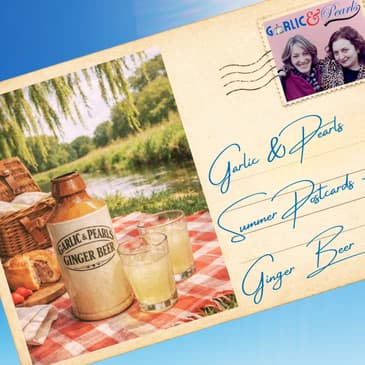
[00:00:47] And so today's episode is the final one of our Garlic and Pearls Summer Postcards. I'm quite glad we don't have to say that again. I am a little bit sad that they're coming to an end because I've really enjoyed them, but I'm also consumed with curiosity as to what your last postcard represents.
[00:01:12] Consumed is the right word, Muriel, because I would reflect that in these summer postcards, I have possibly unusually for the British contributor, gone quite food and drink. Yes.
[00:01:25] And the final postcard is also food and drink. It's about consumption. And I think I was wondering why I've done this. And I think the answer is, it is probably only in these condensed summer months that we actually have food and drink that makes us feel, I don't know, makes us feel good and happy and light and summery.
[00:01:51] It's because our winters have been all the way through time, sort of bleak and survival things. It's in those bursts of energy in summer that we get strawberries and cream and- Oh yeah. Pimms and- Pimms. All the good things, yeah. All the good things. So today I thought in a kind of last burst of nostalgia, nostalgia for the summer we've just had and for all the summers we've ever had,
[00:02:18] not least nostalgia for nostalgia because there's a question about whether any of those summers were actually true. I am presenting to you lashings of ginger beer. Oh, how wonderful. How wonderful. Which, of course, you know about. Yeah, I do because I've read The Famous Five in translation. So I grew up with The Famous Five. It's called Le Club des Cinqs. Oh.
[00:02:47] And I read all these books when I was little and so I have a feeling, you know, that ginger beer did not feature in the translation, which is very much an adaptation. This is, sorry, going off at a tangent slightly, but it's not irrelevant to what you're going to talk about because we don't really have ginger beer in the same way in France. That's why you're talking about it today from a British point of view. And The Famous Five books, which are full of lashings of ginger beer, this is what they take with them on all their picnics and things.
[00:03:17] They were translated brilliantly into French, but they were really adapted. So where they go to Cornwall in the French version, they are French children who go to Brittany and they have lemonade, which is a French thing. They don't have ginger beer. Just to say, this is something that, you know, I think more recently the French have sort of taken to ginger beer as an exotic drink, but it's not really something that we drink habitually.
[00:03:44] So I'm very curious about the British tradition. It's also very interesting that they chose to go in that direction with The Famous Five rather than use it as an example of what Britain was like so that you might have generations of young French people growing up understanding a bit more about British culture. So what they've done is take the idea and then put it in.
[00:04:15] Yeah, I know. I know. I think it reflects the general cultural attitude of those years. I'm sure that nowadays we would take a different view. And actually, we may have to cut all this because it's a little bit extraneous, but I'm just thinking the Mallory Towers books, they were left as they were. That's to say, the French translations are about an English girls boarding school and it's set in England and everything.
[00:04:44] I think because we couldn't have adapted it because we just don't have the same kinds of girls boarding schools in France. Yes. Although you have more convents, presumably. We do. So it would have been a completely different story. A completely different cast of characters. A lot of fun. We can imagine. Lots of fun. Lots of naughty, naughty goings on. Yeah.
[00:05:08] So back to lashings of ginger beer, which, of course, as we all know, is a phrase that was never used in an Enid Blyton book. It's retrofitted. You're saying we project this onto the famous five, but in fact, they never said it. They never said it. It's like let them eat cake. Exactly. So they did drink a lot of ginger beer.
[00:05:33] Let's start with very briefly the famous five drinking a lot of ginger beer because otherwise it'll be hanging like the elephant in the room. So there are lashings of other things in famous five books. There are lashings of hard boiled eggs and lashings of treacle, for example. I don't know how many lashings of hard boiled eggs anybody needs. Massive ginger beer consumption happens in Five Runaway Together, which begins chapter one, Summer Holidays.
[00:06:03] So already we're having the nostalgic summer holiday experience. It starts off, I can't know if you remember, but there's Anne, Dick and Julian, who are sisters and brothers. And then George, Georgina, who is their cousin, who dresses like a boy and wants to be a boy. And she has Timmy the dog and she lives with Uncle Quentin. Yes, separate. And this one, Five Runaway Together, starts with George's mum is really unwell.
[00:06:32] So it's sort of, you know, there's this kind of seeding of difficulty. And then Julian, Dick and Anne arrive to spend the summer holiday with George and Timmy at Kirin Cottage, close to Kirin Island, which is Uncle Quentin's Island. And they were planning to have an idyllic summer holiday with lashings of everything.
[00:06:55] But Aunt Fanny falls ill and she and Uncle Quentin have to go away for her to be treated in a far off hospital. And instead, they're cared for by the completely evil temporary cook, Mrs. Stick. No! With her husband. I know she comes with her husband and their awful son, Edgar. I'd completely forgotten about the sticks. They all hate each other.
[00:07:22] And Mrs. Stick repeatedly tries to poison Timmy the dog. No! And so George, I know it's ridiculous. I mean, it is actually ridiculous. But anyway, George and Julian, Dick and Anne decide to run away to Kirin Island. And before setting off, they raid the larder and they find the sticks' personal stash of ginger beer. And George says, all bought out of my mother's money.
[00:07:51] Well, we'll take the ginger beer too. It'll be nice to drink it on a hot day. Lovely. And then the ginger beer appears in almost every meal, including breakfast. And Julian says, ginger beer is a gorgeous drink. It seems to go with simply everything. And then, of course, they go to Kirin Island and they find someone else has been there and they think maybe it was smugglers.
[00:08:18] And then they find a young girl's toys and some clothes, which is very sinister. And it turns out to be super sinister because the sticks, who are clearly more evil than Darth Vader, have kidnapped and imprisoned a young girl called Jennifer Armstrong. What? And they're holding her for ransom. I know, it's just mad. So this is the actual plot. This is so much beyond what I remember.
[00:08:44] Gosh, I think I was probably so traumatized by all these aspects of the story. I didn't take them in. And so the famous five rescue her, take her to the police and say, the whole country has been looking for this child. And they go back, they trap and arrest the sticks. And then the kidnapped girls, so Jennifer Armstrong's father allows her to spend a week on Kirin Island with Julian, Dick, Ann, George and Timmy, the dog and all the ginger beer. That's very nice.
[00:09:12] So that's the plot because I think that's where we got it from. But the phrase lashings of ginger beer isn't in that book, although there are lashings of ginger beer. So it actually, you know where it comes from, don't you? Now that I've ruled out unique life. Does it come from the comic strip? Yeah, it does. Which again, and this is why I think it's all legitimate, because even though this is nostalgia, it's nostalgia or, you know, like multiple times.
[00:09:40] It's like, you know, we talk about that little picture where you look in and you see that what's it called again? Well, the mise en abime or the drost effect where the image repeats itself within itself. So this is that, but without an image. Yeah, it is. In words.
[00:09:56] So Five Go Mad in Dorset, which was filmed entirely in Devon, was broadcast on the first night of Channel 4 on the 2nd of November, 1982. Oh my goodness. And it's the first of the comic strip Presents. So it was written by Peter Richardson and Pete Richens and directed by Bob Spears.
[00:10:22] And it stars, obviously, Peter Richardson as Julian, Adrian Edmondson as Dick, Jennifer Saunders as Anne, and Dawn French as George. And it doesn't, I don't know who plays Timmy, but let's say it's a dog called Timmy. Yes. Anne-Marie. And so, I mean, the plot is very similar, but not quite the same. And so they arrive, they learn that Uncle Quentin has been kidnapped and they decide to spend several days on a cycling holiday in Dorset.
[00:10:52] And it's just fabulous because they're cycling down leafy lanes being, you know, blase and innocent and idiotic. So they're picnicking in this field. And Julian says, I say, this is a jolly wizard lunch. You'll make someone a wonderful wife, Anne, you know, and so on, so on. Ham and turkey sandwiches and lashings of ginger beer.
[00:11:15] And while this is going on and they're eating and drinking their ginger beer, a car draws up and throws a slab of steak onto the ground. And they say, oh, how lovely, somebody's feeding Timmy. You know, but obviously, Timmy's being poisoned. And then behind them, while they're having their lashings of ginger beer, two criminals are burying loot, you know. So the whole thing is just, it's very funny.
[00:11:42] It's very funny. But that is where the phrase comes from. So it's not something that we've always had, but it's something that represents something that we've always had. So where does ginger beer come from? I don't know. Is it beer? These are all, do you think it's beer? No, I don't think it's beer. I think I know that it's not alcoholic.
[00:12:05] It's more like it's carbonated soft drink, isn't it? Is it not carbonated? Terrible French answer to that no. Just no. Well, it's good. It's my job to give terrible French answers. Put me right. You're thinking of the modern carbonated versions of ginger beer and ginger ale, which are nothing to do with traditional ginger beer, of which one may drink lashings. Okay.
[00:12:35] Until one is lashed. I don't know how that works exactly. So ginger beer, this is a brewed drink. And it is in its proper form. It is alcoholic. Oh, what a revelation. I know. But so we're going to tell a little bit about all of that.
[00:12:54] So ginger is not obviously native to the British Isles, but it arrived in Britain quite early on in the explore the world, colonialize everything story. So it came to us from trading of exotic things and spices and ginger from Asia and the Caribbean. I mean, it grows in Nigeria. It grows in a sort of wide tropical zone. You can actually grow it here if you've got a greenhouse.
[00:13:24] And indeed, someone said to me, I watched lots of YouTube videos once because it said if you buy some in the supermarket and it's sprouting, just stick it in a plant pot and keep it warm and it will grow. And it did. Did it grow? It did grow. Ah, okay. That's great. And then I failed to tend it properly and it stopped. But it could have grown. Oh, it did. And you can grow your own ginger, but you'll need a greenhouse or somewhere that it makes it happy.
[00:13:51] So the ginger came and it started to come in particularly in ports. So there's a lot of connections here to trade and the sea in a nice way. And Leith is going to become prominent later on, which is Edinburgh's port. So in the 1700s, ginger started to arrive.
[00:14:12] And I can't pinpoint the exact place, but it is generally agreed that enterprising brewers in Yorkshire, which is what you'd expect, God's own county, began experimenting with all the imports. Again, it's so British. It's like, what can I make out of this that's got alcohol in it, basically? So they combined water, sugar, ginger, and a fermentation starter. Oh.
[00:14:42] And they brewed the beer. And they created a sort of mildly alcoholic, so kind of 5% rather than 25%. 40. Yeah. Yes. Naturally carbonated. So because cum dioxide, all of that, how to carbonate a drink hadn't been invented. But if you brew it, it becomes like cider. It's very similar to the way that cider was made, actually. So you get a natural carbonation from the fermentation process.
[00:15:13] Ginger's always been essentially good for us since forever. So it's been used as a medicine and a flavor forever. And it was seen by us as one of the spices. So it was first mentioned in this man called Thomas Spratt, who wrote A History of the Royal Society of London, published in 1702. And he writes of brewing beer with ginger instead of hops. Ah. Okay.
[00:15:43] So it comes from our obsession with beer. Yeah. And experimentation. Because, you know, we don't like to constrain ourselves with a terroir, for example. We like to say, we see this terroir. What if we did this radical mad thing?
[00:16:00] By the 18th century, it was being brewed on a large scale in Yorkshire and quickly then gaining popularity around Britain, but also being exported to Ireland, South Africa, the United States and Canada. So really early on, Britain was brewing and exporting. And it exported a lot in kind of stoneware bottles.
[00:16:28] So not in glass bottles, but in stoneware. Which I'm going to talk a bit more about because they became quite famous as ginger beer bottles. It was quite alcoholic. And it went around the world. Weirdly, in 1855, alcohol content was limited to 2% by excise tax laws.
[00:16:52] So there was a sort of involvement in our, like, you know, sort of interventionist state stuff ruining everything. Yes. So it made it less alcoholic. So the brewers had to respond. And so less fun. Much less fun. And, I mean, weirdly, in 1855, reducing the amount of alcohol in ginger beer made it much less fun. And it made some people not want to drink it anymore.
[00:17:22] But it was popular then with the temperance movement. And it, you know, meant that in America, for example, you know, all these prohibitionists and things, it sort of caught on in a different way. Yes. So it still existed, but less alcoholic. And that demand for the non-alcoholic version carried on. So I'm going to go back now to the science.
[00:17:49] The critical element in making ginger beer is the ginger beer plant, by which they don't mean the plant of the ginger. But it's like, you know, if you're making sourdough, you have the starter or kombucha. Yes. So ginger beer, it's the same. It's like that gooey, yeasty, bacteriary thing. It's a culture which consumes sugar, whether it's beet sugar or cane sugar.
[00:18:15] And then it creates that cloudy, bubbly beverage. That's the fermenting. So ginger beer plant is a thing. I'm going to tell you a little bit about what it is in scientific terms. And then I'm going to read you something wonderful from a man called Harry Marshall Ward, who was a British botanist and plant pathologist, who first really studied it in 1887. Oh, I love it.
[00:18:43] The ginger beer plant is a composite organism consisting of a fungus, the yeast Saccharomyces florentinus, and the bacterium Lactobacillus hilgardi. And they form a symbiotic culture of bacteria and yeast, which is known as the scoby, which you again, you have it in kombucha and things. And that's a kind of gloopy substance that you can then take.
[00:19:10] So you take bits out of it and you drop it in a new one and then it does it. And I think making vinegar is also the same as well. I seem to remember you explaining that when we talked about vinegar. And I've got actually a vinaigrette. No, I don't know how you say it. It's French. I've got a French one where I'm making my own vinegar. I put wine in it and I've got my little vinegar starter in there. It doesn't work. It does work.
[00:19:40] It's French word. Vinaigriere. Does it have a knee at the end? Vinaigriere. Yes. Which is a bit of a mouthful, but that's its name. Yes, it is. It works really well apart from I can't get the vinegar out the bottom because the tap doesn't work. That would be my feedback. It's trapped in there forever. The French manufacturers of my... Like the genie in the bottle. My vinaigriere. But it does work as you pour the wine in the top when you have a little starter and it turns it to vinegar. It's really good. That's great.
[00:20:09] So Muriel, you know, I'm feeling a bit thirsty. Are you? Yes. So I'm thinking now is the time really, because we've been doing a lot of talking, that maybe might just slope off for a quick top up of my huge bubbling glass of ginger beer. And we can listen to a few ads and then come back after we're refreshed. That sounds lovely. Let's do that. Hello, we're back again. Refreshed.
[00:20:39] I'm going to read you Henry Marshall Ward's day visual reporting of his analysis of the ginger beer plant. In 1887, my attention was directed to a curious substance or structure popularly known in many parts of the country as ginger beer plant. From its association with the domestic manufacturer of the well-known summer beverage, so often purchased in villages and towns in various parts of the British Isles,
[00:21:09] where it is usually put up in brownstone bottles with tied corks. My earliest specimens of the ginger beer plant were obtained from Mr. Thistleton Dyer of Kew, who called my attention to its mysterious nature, and from Professor Bailey Balfour of Edinburgh, then Professor of Botany in the University of Oxford, who exhibited specimens at a meeting of the Linnaean Society in 1887.
[00:21:36] Since then, I have obtained specimens from various sources in this country and abroad. And during the progress of a long series of investigations have elicited a number of facts as to the constitution and behaviour of this remarkable agent of fermentation, which, whatever their importance, cannot fail to be of interest to all biologists. And then he lists a whole load of other people who've provided him with specimens.
[00:22:05] So he was taking it apart, saying, what on earth is it? And it became clear that it was those yeasty things that I said earlier. It really mattered as well in Victorian times, because as you know in France, there was problems, particularly in cities, with fresh, clean water. People were dying of pointless diseases. And so if you had your ginger beer and it came in this stone bottle,
[00:22:32] which is salt glazed, and then it's impressed with the name of the ginger beer brewer's name and town. And brilliantly, again, in a sort of way that we've lost stuff, the bottles remain the property of the brewer. Oh, lovely. And so you return it once you've drunk the contents, and then they washed and refilled and resold. And they remained, why don't we do that anymore? Why don't we do that? Okay, I mean, exactly what I was going to say.
[00:23:00] This is so clearly a solution to our plastic problem. Instead of recycling plastic bottles, why don't we reuse glass or stone containers? I don't know. Which they do in Germany with the fan flasher and everything. And they really do do it in Germany. You do return it. And you do get money off. But here we don't do that. We just throw everything away in our massive wheelie bins.
[00:23:29] Referring to an earlier episode. Indeed. I see that bins are in, you know, anyway. Bins are always in the news, Suzanne. It's a live issue. It's a massive issue. And whenever I see something about bins anywhere, I think, shall I post a link to our episode? Sometimes I do, sometimes I don't. I can't do it all the time because then people hate you. But actually, our finger is on the pulse.
[00:23:52] It was one of, for me, one of the episodes that most made me think about society and how we could do it differently. Honestly, I think about it all the time. Whenever I put something in a big wheelie bin, I think of the episode and some of the things you explained to me. It was really illuminating. So people could drink ginger beer and not die because it was a safe drink. People could drink ginger beer and not die.
[00:24:18] And it continued to be popular well into the 20th century. So you still had, by the late 1920s, nearly all towns and some villages had ginger beer brewers, large scale. And then they started to use glass bottling, as they did with beer. And that's a whole other story. But it's a fascinating thing, actually, because you like bottles. I don't know with wine, when wine bottles came in.
[00:24:46] But we used to have beer on tap or draft. So you would go in and you would have it poured. But it was only quite late in the day that everyone realized that you could actually stick them in bottles. So by the 1930s, two things happened. You had carbonation starting to come, glass bottles, public demand started to fall away.
[00:25:13] And other things happened in what we drank. So lager was introduced in the mid-20th century. In the early 1960s, lager, for example, was only 1% of the beer market in the UK. But today, it's more than half. So kind of big transformation in the kind of things that we drank, which is to do with modern means of production as well and distribution, I think. But we have, of course, had CAMRA, the campaign for real ale,
[00:25:41] which is fighting back, calling this modern stuff too fizzy with no character and no taste, which is the thing because if you're using artificial carbonation, you're using, you know, it's synthetic compared to the real stuff that is brewed with the special starters. The other thing that happened because of the temperance movement, probably more or less, is that ginger beer and ginger ale split. Ah, yes. I was going to ask about the difference. Well...
[00:26:10] So ginger beer being the alcoholic version and ginger ale non-alcoholic. Ginger ale is a carbonated soft drink made from ginger extract and sugar. So it's sweeter and milder than the brewed ginger beer. It's basically what you would say in America is a flavoured soda. Yes. It was invented in Ireland, modernised as Canada Dry. There really is a kind of new world sort of thing. Yeah. I did grow up with Canada Dry, actually.
[00:26:37] Thank you for this repressed memory, the return of this repressed... This was a drink I did enjoy as a child once in a while. Because obviously in those days, children were rationed with drinks of that kind. But I do remember that their ads on French TV were all riffing on the prohibition, on the American prohibition. So they're all set in speakeasies. They were great fun. So Canada Dry, I do remember really well. And I think that's still... Is it still with us, Canada Dry? Is it still... Yes. That's ginger ale and not ginger beer.
[00:27:07] So there are still... That's right. Two branches of the ginger family. Because this is lashings of ginger beer. We're talking only about ginger... Because ginger beer is the... I don't know. It's the craft version, really. You know, often in my narrative arcs, everything gets bought by Diageo and it collapses. So often. Eventually you and I will be bought by Diageo, I think. I think it's inevitable. Yeah.
[00:27:35] So has this happened again? No. No. Actually, rather pleasingly. And the reason I think it's legitimate to go with the nostalgia on this is that ginger beer has a narrative arc that has come sort of full circle. And we're now drinking lashings of ginger beer in different ways. But we are esteeming it and brewing it in a way that we used to as well.
[00:28:03] So I was going to talk very briefly about a couple of big names, just so we can put little tent pegs in. Crabbies. Have you heard of Crabbies? No. Have you heard of Crabbies ginger wine? John Crabby. Not really. Not really. That's why we're doing this, because you're teaching me. No, not really. So John Crabby. Maybe. Are there green bottles with a green label? Yes. Okay.
[00:28:32] So I have, I've never bought it, but someone once made me a drink called a whiskey mac. Yes. Which I think is whiskey scotch with that ginger wine, isn't it? So I've had that. It's really good. Yeah. Okay. And ginger wine's fabulous if you're unwell in the wintertime. Oh, I'm going to get some. Yeah. You should. It's in Tesco's, near to the scampi fries. Genuinely.
[00:29:01] Soon there will be a garlic and pearls aisle in every supermarket where they sell all the things that we talk about. This is the dream. The takeover. We can do it. Anyway. There's a reason, I think, why that ginger and whiskey typically goes together. And it's because their origin story is connected. So John Crabby was based up in Leith.
[00:29:27] And he started off as an upholsterer, but became, and it is 1801, he discovered the perfect recipe for green ginger wine where he steeped it in ginger for eight weeks and blended with citrus, herbs, and spices. So he was an expert. They were all experimenting up there. And Leith in the 19th century was a haven for smugglers and pirates. And it was a big, busy port.
[00:29:55] It was the golden era where Crabby and all the others had first dibs on these fruits, spices, ginger coming from Indonesia, India, China, loads of exotic places. And they then started to experiment with that. He also massively contributed or the Crabbies, you know, it became a brewing dynasty, but they
[00:30:21] also became a massive part of the Scottish whiskey distribution story. So he teamed up in 1885 with some whiskey magnets to form the North British Distilling Company to supply new, independent and cheap source of grain whiskey. When the wine harvests across continental Europe started failing, they were producing
[00:30:43] over 13 million litres of grain spirit at the Fins de Siecle, which is more than any single malt distillery in Scotland today. And Leith became very famous for its whiskey storage facilities. You've got whiskey and you've got ginger, wine, ginger beer. So Crabby's original ginger beer still exists. You can still buy it. It has a sweet, this is according to them, a sweet ginger aroma that smells natural, not
[00:31:13] artificial. Its pale golden colour sparkles bountifully as it reluctantly settles beneath a thick head of fuzzy white foam that quickly fades to a thin collar with some clingy lace. It tastes just as crisp and refreshing as it looks. The spicy kick of ginger balances out the distinct soda sweetness very nicely, while the burning sensation intrinsic to the palate of all ginger-based drinks is far from overpowering and does not linger. Who wouldn't want to drink that?
[00:31:43] No one. I'm going to talk about two others. Fentamins. You know Fentamins. Oh yes. So I have had that one. Have you? Ginger beer. Good. Yeah. So Fentamins is from Cleck Heaton from Yorkshire. So in 1905, Thomas Fentamins was an iron puddler and he was approached by a fellow tradesman for a loan.
[00:32:08] And he said, okay, but only if you hand over as security your recipe for botanically brewed ginger beer. And the loan was never repaid. So Thomas Fentamins became the proud owner of a recipe that would change his family's history. That's what they say. That's what they say. He started to produce Fentamins ginger beer and he sold it door-to-door by horse and cart
[00:32:35] in stone jars, which he called grey hens. And at that time they didn't have a logo, but soon they got the logo Fearless, the dog, who was Thomas's loyal German shepherd, who still guards every bottle and guards the head office, Fearless House. Still, Thomas's great-grandson, Eldon Robson, is proudly continuing the tradition of hand-crafting drinks in the northeast of England.
[00:33:05] And it's botanical brewing. So they would say exactly like they would, you know, using a blend of natural ingredients, fermenting botanicals and expert craftsmanship, the drink achieves its bold flavour and signature depth. So that's Fentamins advertising. Yes, but your man, whose name now I've forgotten, but the amazing botanist who looked into the alien entity of the ginger plant. Yes. What was his name? Harry Marshall Ward.
[00:33:34] Harry Marshall Ward would still recognise this product today, wouldn't he? Absolutely would. And then I'm going to give you a third local craft brewer. So this is what's happening. And I think this is so interesting. As we've got with all the craft beer breweries now, we now have an uprising of craft ginger beer breweries. So this is an example.
[00:34:02] DMC Brewery, which is brewed in a quiet industrial estate near Wakefield City Centre, where a husband and wife, Duo Giuseppe, Jez Romano and his wife Ellie. So Jez was head chef at a top restaurant in Leeds until it closed down during lockdown and never reopened. And Ellie worked part time for Lush, the soap maker. But and they've got three children. And during lockdown, they've had they've had loads of spare time.
[00:34:32] So they said, we've always been home brewers. We love making mead and stuff. Why don't we make ginger beer? So they started and then they started researching ginger beer and found that it actually originated as a fermented beer in Yorkshire. So they thought this is our way forward. So they from March 2021, DMC Brewery began and they now sell particularly their 1700s OGB alcoholic ginger beer.
[00:35:02] So it's not just the big names, it's lots of people around the country are making these craft ginger beers. And why are they doing it? Because we like to drink it. That's what I say. How do we like to drink it? Obviously, just from the bottle or poured, you know, poured into a glass with that nice head and everything. How else do you think we like to drink it? Can you make cocktails? Yes. With it.
[00:35:32] So that's the other thing that's led to the resurgence. So what cocktails, for example? Moscow Mule. Yes. Yes. Bang on. This is, we're coming full circle. We are closing the loop with the onion, with the pickled onion episode where there was a variation of Moscow Mule. Yes. With the pickling juices of the onion. I remember that went into the mix. So you don't have to add pickling juice.
[00:36:02] Delicious though that must be. You can make a Moscow Mule with ginger beer and vodka and whatever else goes into Moscow Mule. I've got the recipe here from BBC Good Food. Right. Ingredients. 50 milliliters of vodka, crushed ice, 150 to 200 milliliters of ginger beer, few dashes of ginger bitters, sprig of mint and wedge of lime to serve. Lovely. And you just, and this is quite interesting actually.
[00:36:30] You pour the vodka into a metal mug or tumbler or julep tin. Load it up three quarters full with crushed ice, which is quite difficult in Britain because we don't really have crushed ice. But, you know, maybe you've got it. I haven't got it. I suppose you can. I don't. I think you need one of those American fridges with a special. Or those crushers, which I did have once. Yeah. Then filter the top with the ginger beer and stir to combine.
[00:36:57] Add a few dashes of ginger bitters and garnish. Apparently, the name Moscow Mule actually originated in America. So, again, this is something we exported to America really early on. But apparently in New York in 1939, there was a man then called John G. Martin who bought the U.S. rights to Smirnoff and no one was buying it. And he thought, oh, God, how can I get the Americans to drink vodka?
[00:37:25] And then he went to a bar called the Cock and Bull and met a man called Jack Morgan who had a cellar full of ginger beer that he couldn't sell. So they said, why don't we mix the two? And there's a whole load of things about you're supposed to serve it in a copper cup, which was what John Martin had traveled around America trying to sell his vodka.
[00:37:53] So it's actually come to us from America. There are lots of other cocktails which riff on the whiskey and ginger theme. So there's something called the Yardhead Mule as well, which Crabby's recommends, which is malt whiskey, lime cordial, Angostura bitters and Crabby's ginger beer.
[00:38:17] And again, you just mix it all, put the bitters, cordial and whiskey in a high ball glass, stir it nicely, fill with ice and top up with the ginger beer. So Muriel, that's it in a nutshell. It's gone full circle. We're brewing ginger beer again. We're drinking it with vodka or with whiskey or just over ice with a splash of lime. It's health giving. It's naturally fermented.
[00:38:47] What's not to love? Nothing. I love ginger personally. It's a taste I acquired in Britain and you've completely converted me to drinking more ginger beer. So that's what I'm going back to school. We're about to go back to school, aren't we? I'm going back to school with bottles of ginger beer in my knapsack or satchel. I think it's technically lashings. Yes, but you can't really put lashings in a bag, can you?
[00:39:16] Because it would just leak. And on that surreal image, I think we should say goodbye. And I hope everyone had a wonderful summer break and summer holiday. And we look forward to seeing you all next time. Don't forget to subscribe. Don't forget to follow us on the socials if you would like to and leave us reviews, comments. We love hearing from you. We also have a website. You can find us there. Everything's on there.
[00:39:44] And Suzanne, I look forward to seeing you next time for something else. Garlic & Pearls. See you soon. Au revoir, Muriel. Au revoir, Suzanne.