
Hosted on Acast. See acast.com/privacy for more information.
[00:00:21] Hello, this is Garlic & Pearls with Muriel Zagha, who is French, and me, Suzanne Raine, who is British. And today we have episode seven of our Garlic and Pearls Summer Postcards. I should have said that the whole point of this is that we talk about what makes the French so French and the British so British. And because I'm introducing it means that today is a French episode.
[00:00:49] So Muriel, tell me something summery in French. It's summery in French and it's also perhaps a little bit... We're getting towards the end of summer, aren't we? It's just a melancholy time. In the midst of all the sun and fun of the holidays that we've all been enjoying and I hope our listeners are also essentially disporting themselves in the sun, there is sometimes a little tinge of melancholy when it gets to this bit of the summer, because maybe because we know that it will end.
[00:01:18] That we can't be on holiday forever, you know, and especially as a child. You look sad, I'm sorry. Especially as a child that used to hit me a little bit when I knew that school was coming back and I was going to have to go back. And so maybe especially if you're French, you feel this. Maybe I've kind of infected you with it, but maybe it's more of a French thing, especially if you've had your head turned by highfalutin ideas and philosophy and existentialism. This is a way of introducing... That would be a... It would be a terrible way to approach summer.
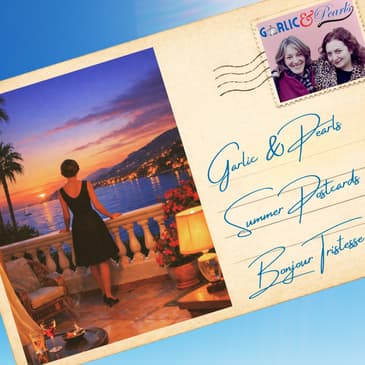
[00:01:47] So my postcard today is... That's not Elton John on the beach in a leotard singing I'm still standing, is it? It's not at all. It's a girl in a black dress looking at you solemnly. My postcard today is about that feeling of melancholy in the midst of summer. And a very good illustration of it is, I think, a book and a film adaptation of that book. We haven't had a film for a while, so it's time to mention one. Both called Bonjour Tristesse.
[00:02:17] Does that mean anything to you? Yes. Right. But, as usual, not great. So I think I've read it, but I can't remember it, which says something terrible about me. No, no, no. It's very likely that you have read it. It is a slender novel and quite a modest thing in a way. But it had a big cultural impact. So the novel, firstly, Bonjour Tristesse. So Bonjour Tristesse means hello sorrow, really, doesn't it? I mean, tristesse... Does it mean sadness?
[00:02:47] Sadness. Well, tristesse is the feeling. It's the feeling of sadness or sorrow. I think in English sometimes people will say I was feeling a bit trist, or tristesse, like ennui, has sort of been imported a little bit. Because I think it's a more delicate... It's not as harsh as sorrow, in a way. Sorrow, I think, is really deep sadness. And sadness is perhaps a bit vague. Tristesse is a... An achy.
[00:03:17] Exactly. And a sort of achy, gentle, achy sadness. About lingering. So this is... Firstly, this is a revelation to me because I always thought tristesse was... It meant a sad woman. No. So... Of course, when you say, when you call a book Bonjour Tristesse, which by the way is a quote read from a poem by a surrealist French poet, you're hailing tristesse as if she were a person. So it's personification.
[00:03:47] So that's possibly why, you know, you read Bonjour Tristesse. Okay, so you think tristesse is the name of a girl or a woman. Well, no, I thought it meant a woman who is sad. Who is sad. But that's what you visualize. Definitely what you visualize when you read Bonjour Tristesse. There is this figure. It's a female figure. She is sad. We're hailing her. Yeah. So that's what the book is called. It was published in 1954. So we're going back to the 50s. Quite a summery sort of decade.
[00:04:17] By a writer called Françoise Sagan. S-A-G-A-N. So the name may ring a bell. And it was very unusual. In fact, it was rather scandalous because it was written by a very young woman who was technically then underage. Majority age was still 21, then she was only 18. And in fact, 18 in any time, you know, 18 is very young to publish your first novel, especially for it to go so mega as it did.
[00:04:45] And it was also scandalous because it told the story of amoral family life, amoral youth, and terrible consequences of a deregulated upbringing. What's the story of the book? It begins with the sentence. Let's have a French sentence. Sur ce sentiment inconnu, dont l'ennui, la douceur m'obsède, j'hésite à poser le
[00:05:13] nom, le beau nom grave de tristesse. This unknown feeling whose boredom and gentleness obsess me, you know, work me over. I hesitate to name with the beautiful name of tristesse or sorrow or sadness. I don't know quite how we would translate it. So the voice uttering that first sentence and the narrator throughout is the heroine.
[00:05:41] She is a 17 year old girl called Cécile, very French name. And she lost her mother when she was very small. Her mother died when she was two or something like that. She doesn't really remember her mother. And she's recounting, so it's still in flashback, really. She's recounting a past summer holiday on the Riviera. So immediately your mind goes to 1950s Riviera, all those colors in a villa with her father, her rich and adored father, who is a widower.
[00:06:08] And at the time of the story, he's been widowed for 15 years. So, you know, he's brought her up. But he's brought her up in a fairly laissez faire insouciance. This is where insouciance comes back, you know, big way. So they're holidaying together in this villa on the Côte d'Azur. And she's also thinking back, reminiscing, reconstructing what's happened there during that summer
[00:06:33] to bring all this tristesse into her life because tristesse is her constant companion now because of what happened that summer. Her father is a sort of merry widower. So, okay, he's been widowed for 15 years. During those 15 years, he hasn't been very much alone. He's had lots of girlfriends. And so on that holiday, he's got with him his young mistress, who is a little bit older than his daughter. She's probably 20-something, but, you know, she's quite young.
[00:07:01] And this is clearly how he lives quite openly. So this young woman, Cecile, who's only 17, she knows full well that this other woman who's staying in the villa with them is her father's girlfriend. And they're also rubbing along, you know, nicely. And it's a very sophisticated setup. These are people who, you know, rising above moral conventions. So everyone's being terribly grown up and arch and very male coward, you know, like that. Is this exactly contemporary with the rise of Johnny Alliday?
[00:07:30] It is. Everything's happening at the same time. Good point. Rise of Johnny Alliday, rise of Brigitte Bardot, Françoise Saigon. Okay. All happening at the same time. It's a time capsule of something is about to blow, really. Yeah. Tremendous internal pressure in French culture. Cecile, the girl, is quite pally with the girlfriend, the mistress, who's called Elsa and is a bit of a, I mean, I suppose we'd say dolly bird maybe. This is, you know, she's not terribly bright. She's very pretty, but she's not.
[00:08:00] She's not a threat to her close relationship with her father. You know, she still comes first and then there are other girlfriends and keep changing. And so it's all fun and games in this idyllic Riviera setting, which I'm sure you can imagine. And everyone is full of insouciance. Right. Then they're joined by an old family friend who was in fact a friend of the dead mothers, a woman called Anne Larsen, who is a grown up woman, the same sort of generation as the father.
[00:08:30] And she's sophisticated and intelligent and stylish and an adult. And she takes maternal interest in Cecile.
[00:08:38] Cecile is growing up in a sort of wild thing way, proto, you know, it's girl or she's having that kind of life with her father, going to parties and spending all her time with much older people and being accelerated in a way that Anne, the visitor, when she notices all this, she thinks, well, that's wrong. She should be, well, she should be studying for her baccalaureate, for one thing, and she shouldn't be going out at night all the time and spending all her time at the beach.
[00:09:08] And there should be some sort of structure in this young woman's life. So that's one aspect of Anne's arrival. And the other aspect is this sophisticated woman bewitches the father who knew her before. But, you know, it's that sort of thing. He'd never really seen her properly. He sees her properly. She is wonderfully beautiful as well. And so they fall in love. They fall in love with the view to marrying. And so the younger girlfriend, the mistress Elsa, is discarded, has to leave.
[00:09:36] And Anne and the father, who's called Raymond, amazing French name, start a romance. And it's a very serious adult romance. And they are going to get engaged and be married. And so Cecile is a bit divided initially because she likes, well, she's a child who needs attention. She likes Anne. Anne brings her clothes from Paris. You know, she's great. So there is a godmother element. But she's also saying, Cecile, you have to pull your socks up.
[00:10:06] You know, this is not good enough. You can't waste the summer. And you need to get your baccalaureate. And you need to go on to proper adult life. So Cecile doesn't like that. And she absolutely does not like the closeness with her father and the sense that this idyllic, insouciant life is going to end and that it's going to become a lot more conventional, like proper family life. So I'm afraid that's when it turns really dark. Oh, brilliant.
[00:10:33] In that, Cecile, who is only 17 and is herself going through a romance of her own. She's essentially exploring her own love life with a slightly older student who is 26, I think. So 10 years older than her. So all that is going on. And again, completely unsupervised. And although Anne, the older woman, has noticed also that this is going on and thinks it should be monitored a bit more closely in a protective way.
[00:11:01] Father, completely oblivious, just wants to have martinis on the terrace, basically. What Cecile devises is a trap for Anne, her father's fiancé. It's a convoluted thing, but basically she engineers for the discarded young girlfriend to start walking out with the student she, Cecile, is having a little romance with.
[00:11:27] And when her father notices this, that this beautiful young mistress of his is now seeing this younger man, he goes after her. And then Cecile arranges for poor Anne, the older woman, who by then is engaged to be married to this man, is very happy, to walk in on her fiancé, Cecile's father, with the younger woman. They have a tryst and Cecile sends her there.
[00:11:53] And poor Anne is absolutely destroyed by what she sees. And what does she do? She gets into her car and drives off in a frenzy of despair and she crashes the car and she dies. Yes. Bonjour Tristesse And so... But this is so he shouldn't have done... I mean, that's him, isn't it? He doesn't come well out of this story. He comes out terribly.
[00:12:18] He comes out terribly because with the young protagonist and machinator, she's only 17. She doesn't know what she's doing. She has absolutely no notion of what the consequences might be. So it gets quite Greek at the end. It's like a tragedy. It ends like a tragedy. And then, initially, he, the father, is inconsolable. It's this terrible thing that's happened. Anne is dead. How will I ever get over?
[00:12:43] And, you know, within months, he gets over it and resumes his old life with his daughter in tow. And she is going through the motions of this, again, sort of socialite, insouciant. Insouciance having been entirely voided of its meaning, of course, by then, and just being a mask. That's what it is. It's a mask. Because, actually, what she's living is this empty, sad life and being haunted by the guilt of what she did.
[00:13:08] It's a short, dark story set in the sunniest, most colourful place in the world. But, hang on, it's not her fault, is it? Because he shouldn't have gone off with the... He was the one who went off. He can't have really loved Anne. Entirely agree with you. A very shallow man. He doesn't come well out of this. And what this does is just expose the hollowness of the father figure. Everything is his fault. Because he's brought up his daughter badly. He's messed around with all these young women.
[00:13:37] He finds true love, except he obviously wasn't true love. Because then he, you know, I mean... All it takes is a little bit of threat to his masculinity. And off he goes chasing the younger woman. I know. It's not an edifying tale. So, before we talk a bit more about the story and then the film, I'm just going to bring in the film quickly. Just want to tell you a little bit about Françoise Sagan, the author. So, the herring of the book is 17. The author is 18. So, Françoise Sagan, for a start, it's not her real name.
[00:14:06] It's a nom de plume. Her real name was, is Françoise Quarez, which is spelt with a Z at the end. Her family is from the north of France. But she was born in the Lotte region in the southwest. So, she comes from a family of industrialists. Her father is a successful industrialist. So, her background, interestingly, isn't a million miles away from Brigitte Bardot's background. It's the industrial bourgeoisie. So, there's plenty of money.
[00:14:35] Very substantial family. Very substantial father behind her. By the time Sagan writes Bonjour Tristesse, the family have moved to Paris. And this is on the back of quite chaotic schooling for her. So, she's been, I'm not going to get into detail, but she was expelled from various convent schools. Back to back. Either for lacking spirituality or for pranks.
[00:15:02] Like in one of the schools, she, there was a very tedious lesson about Moliere. And so, there was a bust of Moliere, the dramatist, in the classroom. So, she hanged it by its neck from the ceiling. And that didn't go down well. So, she keeps being expelled. But she is quite bright. She's just not a conventional schoolgirl. She sounds brilliant. She's great fun. But she's, yeah. And some people say she was perhaps overindulged by her parents. She's one of four children. And I think she came in the sibling group.
[00:15:31] She came after the loss of another child. So, then when she came, she was the miracle child and she could do no wrong. She's indulged by her parents. She's indulged by her brothers. You know, it's that kind of thing. And she's quite an androgynous, tomboyish figure. She's very slight. So, she's not doing well at school. But alongside all this, she's reading an awful lot. A very voracious reader. So, she's reading, among other things, Camus, the author of L'Etranger. Rambeau, the poet.
[00:16:01] Cocteau, your friend, who's not the deep sea diver. But the filmmaker and writer. Shakespeare's sonnets. Proust. Nietzsche. Faulkner. Colette. Flaubert. Hemingway. Scott Fitzgerald. Hard-boiled American detective novels. And Sartre, who will later become her friend. Because he's also in that 1950s post-war mix of what France is like. So, she's reading all this and absorbing all this. She scrapes through the baccalaureate. It takes quite a lot of...
[00:16:31] She goes to lots of cramers. You know, it's like that. And then she enlists the Sorbonne. And she becomes a student. She joins the student nightlife on the left bank with her brother, Jacques, who I don't think is a terribly steadying influence. He takes us to jazz clubs and various boites. And they go dancing. And she begins to enjoy drinking. And, you know, drinking all night and partying all night. And as she said later in interview, at that time, girls of her background were just expected to get married.
[00:17:01] And that was... She's only 17. She's 18 by then. Okay. She's very young. And essentially, her parents are waiting for her to meet an eligible, you know, engineer or someone from Polytechnique or one of those Grands Écoles and to marry. And she wasn't keen to marry, although she did marry and have a child. I'm not going to go into details of her biography. But essentially, it came out after her death that she'd always been a gay woman and that
[00:17:27] the love of her life was a woman who was her best friend, but was in fact her lover and that they were in the closet all their lives. Really interesting story. We'll talk about that another time. At this stage, this is before any of that happens. She's 18. And she begins to write this story in cafes. I mean, literally, as you would imagine it to be. I mean, the legend is that she writes it in six weeks and it's a short book. And then she shows the manuscript to a friend whose mother is an intellectual who's very connected with publishing.
[00:17:57] This mother, intellectual mother of her friend, passes it on to a publisher. And then what happens? Shall we have a little break at this stage? And then I'll tell you the rest of the story. Okay, let's have a break. So we're back. Segan, or Françoise Coires, as she still is then, has given her manuscript to this intellectual lady who glanced at it and said, yeah, I don't really know what that is, gave it to a publisher. The publisher doesn't read it.
[00:18:27] So that could have been the end, you know. That often happens. It happens so often you wouldn't believe listeners. And I think we both speak from some kind of experience. It's very difficult to place a novel. She is not discouraged. And she's also friends with an academic woman. Her world is a world of women. It's really interesting. In the same way that Bardot, actually, all her close collaborators were women. You can sort of imagine why that would be in the 1950s.
[00:18:55] So this sympathetic academic lady reads the manuscript. And she says, actually, this is pretty good, but I think you should change the ending and make it darker. I don't know what the ending was originally. I didn't think Anne died. So she rewrites it and makes it really Greek, where really, you know, the lady drives off and she car drives off a cliff and she dies. And so it becomes a Greek tragedy set on the Riviera in the 1950s, which is the present day.
[00:19:23] And then the same friend gives her the names of three publishers. And one of them says yes. The two others ignore. It's always funny to imagine how hard people will be kicking themselves afterwards, because of course, what then happens, and it's the kind of JK Rowling story, is after all this, oh, what's this? I don't really understand what that is. It becomes the most enormous bestseller. You can imagine. That's so... I was amused. It's ready.
[00:19:52] It's the right time. But nobody saw it coming. We often have stories like that on the podcast. Nobody knew that they needed this book. But everybody did need it. She is offered a contract. She is still living at home, of course. So she announces this to her parents. Her parents are not hugely thrilled. And they don't take it that seriously. And her father says, well, you can't use the family name. You have to find a pseudonym. So she takes the pseudonym of Sagan, which she borrows from a French aristocrat called
[00:20:22] the Princesse de Sagan. And the Princesse de Sagan inspired one of the characters in Proust's La Recherche du Temps Perdue. So there's a nice sort of pedigree there for her. And Sagan is a nice, memorable name. Was there still a Princesse de Sagan or is it just taken from as a character? It's taken from, well, there had been a Princesse de Sagan who had inspired a character in Proust. So I think she's, you know, because she's read Proust and she knows this stuff.
[00:20:48] And then the book is an explosive success, both in terms of reviews and awards. She wins prizes and things. And in terms of sales, it sells 500,000 copies almost immediately. Can you imagine? And it's acquired for translation into 20 languages. That's instantly. And so she's presented as a bit of a prodigy and freak. You know, she's a schoolgirl, essentially. She's a student, but she is still, she looks very young. So this is, I'm showing you a photo of her at the time of publication.
[00:21:16] So mid-1950s. She's very spare. She's a tiny, slim slip of a girl with short hair, gamine and quite androgynous, I think you might say. She's quite boyish. So it's a little bit of the Audrey Hepburn style or the little short fringe. I think she both looks young, but also actually quite old and white simultaneously. There's something about the solemnity of the face. Yeah. So she doesn't really smile for the camera or try to ingratiate herself.
[00:21:46] She's also perceived as somehow a bit of a monster because there's something odd about a person so young writing a book that is so grave and solemn. And I think, as is always the case with new things, things that come a little ahead of their time. Some people compare her to, there's a writer, an 18th century writer called Chauderlot de Laclos who wrote Les Liaisons Dangereuses, Dangerous Liaisons.
[00:22:16] Which is, again, it's a very good point of comparison because that's a book that is perceived at the time of publication as scandalous and immoral. When, in fact, the author would have said it is a moral book about retribution, about what happens when people transgress. And Sagan would have aligned herself with that. So she said a few years later, she was interviewed about the scandal of the book, the succès de scandale.
[00:22:43] Because part of the reason why people buy it is because they want to read this terrible book, you know, there's sex in the book to a degree, you know, there's allusions to people having sex. And so she said in an interview that she'd been very surprised by all the outrage. She said, three quarters of people thought that what was scandalous about the novel was that a young woman, said the heroine, could go to bed with a man without finding herself pregnant and having to marry him.
[00:23:10] For me, her, Sagan, she said, what was scandalous in the story was that through thoughtlessness and selfishness, a character could bring someone else to kill themselves. So she does see herself as a moralist, but that's not immediately apparent because she's so young and she's a girl and it's all a bit raw and direct. So she's also certainly an expression of that youth quake.
[00:23:34] So we mentioned Johnny Halliday, Brigitte Bardot, all these young people who are unusually, and it's a sort of inauguration of something, irreverent, insolent and assertive and unapologetic. She's part of all that. The other thing that happens is because of the sales, she makes a mint of money from that book.
[00:23:56] And because her family is rich, her father says, her father is, who sounds not as sober as some other figures we've discussed on this podcast. You know, we have all these very Victorian figures. Her father says, oh, you've got money, spend it. Better spend it. So she does spend it. So she buys herself with the money, the first bit of money that comes. She buys two Jaguars, cars rather than animals. She buys her mother a mink coat. That's amazing.
[00:24:23] And she spends everything else on partying in Saint-Tropez with her friends. So she's 19 by now. And that, I think, also causes quite a lot of unease, this hedonistic. She's a forerunner, isn't she? So like Bardot, she's ahead of her time. She's already living the life that a lot of people are going to be, celebrities are going to be living in the 70s. But she's 20 years ahead. She continues to write. She continues to be successful. And then she gets into gambling.
[00:24:52] She buys herself a small chateau with some of her winnings at the casino. You know, so she's always in the papers. And she becomes an icon of her time. So like Bardot, you know, there are fashion elements to this. She's a very black polo neck sort of person. She wears stripy tops and jeans and espadrilles and all these things. I'm going to leave it there because we're focusing on this first novel and then also on the film.
[00:25:16] But it's just such an interesting period of French society after the war where people are still putting themselves together after the war. And then all these young people come and they are so surprising. And different. Yeah. So just a word about the film. Yeah. Getting to the end. There have been a couple of adaptations. Interestingly, no French ones. Oh. A couple of American adaptations.
[00:25:41] And I love to see a French story adapted by Americans because it's just so funny. So the one that really matters, there was a more recent one. I won't mention it. People can look it up if they want. I don't think it was particularly successful. But there was a 1958 adaptation. So at the same time. Contemporary. Yes. Immediately, you know, by Otto Preminger. So I would say Preminger, although he is, of course, German originally. So it'd be Preminger. Preminger, I think we'd say in English.
[00:26:11] Otto Preminger. He made a lot of great films. He was a huge tyrant, apparently, like a lot of those Hollywood directors. You know, it later comes out that he bullied his actors and actresses relentlessly. He made them cry. You know, he made them tear their hair out. He was dreadful. So he was actually really dreadful to work with. But then we have to look at the body of work and say it was probably worth it. I don't know. It was not worth it. Well, no one would tolerate it now. And that is better. But at the time, nobody really cared.
[00:26:41] It's such a different way of thinking about making art. So this film, this 1958 film, which is also called Bonjour Tristesse, en français, because the book was so famous, I think. In the film, Cécile's father, Raymond, the French father, is played by David Niven, who is as unlike a Frenchman as I think you could imagine.
[00:27:08] He's nothing like how I'd imagined the character already sitting on his sun lounger. How do you imagine the character? Well, more kind of... Raymond the Playboy. Well, I'm a bit embarrassed to say this because, of course, I'd imagined him as kind of like Magnum P.I., you know, sort of Tom Selleck character. But that's also not French. So I realised that I'm not a good witness. So fairly hirsute. Yeah. Very sort of tall and strong and athletic.
[00:27:37] Probably wearing dressing gowns most of the time. That's how I'd imagined him. But probably not incorrectly. So I would imagine him more as a sort of suave Frenchman of middle years. And, you know, the Frenchmen who have this kind of winged hairstyle, so mid-length, which is wrong for the 1950s. But you get these quite well-preserved middle-aged Frenchmen who still have a full head of hair and they're quite narcissistic about their hair. That's what I imagine.
[00:28:07] So no, it's David Niven. David Niven wearing shorts and swimming trunks and little sort of short-sleeved beach shirts and things and looking, again, like the incarnation of Insouciance. So the Insouciance thing is done very well. And Niven, it's almost like he's parodying himself as this sort of gatherabout, you know. So he's charming in the film. And the dangerous charm of the character works very well.
[00:28:33] So the daughter, Cécile, the very young woman, is played by Jean Seberg, the beautiful young American who is then with Godard in Aboud Souf and Breathless. So she went straight from one to the other, Bonjour Tristesse, and then straight into Breathless. And Godard was aware of the Bonjour Tristesse film. That's partly why he cast her, you know. So she's lovely because she's so, oh, she's so young and beautiful and has a wonderful expressive face.
[00:29:01] You know, she played Joan of Arc, working with the same director. She played Joan of Arc, and you can see how she could also do that. So with Jean Seberg, I'm going to show you a couple of photos from the film so you can see. There's a photo in colour where she's dressed for the Riviera. It's a wonderful Technicolor. And she's wearing a gingham sleeveless shirt and some high-waisted, very short green shorts, which is a super outfit. And her haircut is terrific, isn't it?
[00:29:30] She has this very short elfin haircut, which was much copied. So that's Riviera. This is she, the same character with her father, so with David Niven. So, I mean, isn't that just insouciance on legs? It's amazing. And in the background, you can see the lovely villa in the hills where they're staying. And then, you know, there's a private swimming spot. And it's all just delightful. They're wearing chambray shirts, which have been tied. Everything is so cool and wonderful. Nice.
[00:29:57] And then the part of the older woman, Anne, this is the photo, is played by Deborah Carr. So Deborah Carr was a massive star. And she's British, actually, originally. And she is so sophisticated. And I should say in the film, she, Deborah Carr and Jean Seberg are dressed by Givenchy. So all the clothes they wear are stunning, absolutely beautiful. Beautiful. And one of the, I mean, one of the appealing things about the film is, one, it's quite faithful.
[00:30:28] It follows the story. It doesn't then tack on a happy ending where actually she didn't die in the car crash. She dies. And the moral thorniness and the melancholy of the whole thing is preserved, partly because the genius thing that it does. So it's not the best film in the world, but it's a great summer film. That's why I'm recommending it. It's narrated in the voice. So there's a sort of, you know, voiceover from the Jean Seberg character.
[00:30:52] And it alternates between present day scenes after the events, which are in Paris in black and white. And then the flashbacks are in Technicolor on the Riviera. And so that in itself is great. In the black and white scenes, she wears this astonishing dress. It's not all about fashion, but it does matter. Gosh. So this is a Givenchy evening dress and it's black.
[00:31:21] She is essentially in mourning for her life at that point. But isn't it just the most drop-dead chic thing you've ever seen? Is that a halter neck or is that something else? Because I don't know if the technical name for that. It's a very distinctive design in that it's a dress that leaves the shoulder bare and there's a sort of little bow around the neck. Yeah, and then it hangs from that. So it's a sort of halter neck, but it's a particularly elegant and minimalist one. It's very minimalist. It's very good.
[00:31:48] But is this, these black and white scenes though, they're not in the book? Or are they? Well, no, no. There is a little bit at the beginning and the end in the book where it starts at the present day and it ends at the present day. And it's, I suppose the film fills in some blanks because it shows you, she might talk in the book about going out with her father, being at an event or going to a party and talking to a lot of grown-ups. And then you see it in the film. So it's shown rather than explained.
[00:32:17] But you can see this young woman who's already sort of lost a bit of her glow because of what's happened and because she's shackled to her father in some way. And they continue on this round of nightclubs and discotheques and parties socializing. But in fact, she's sort of been nipped in the bud in a way that is quite troubling. It's a tale of wickedness. It is implacable, as implacable as the novel.
[00:32:46] But it's so gorgeous with it that I would say if you wanted to watch something towards the end of summer that helps you to channel that melancholy of the end of summer, then that would be it. Read the book. Watch the film. Let me know what you think. There you go. Bonjour Tristesse, Suzanne. Thank you. Well, I am going to buy it and read it. Although now I know what happens. But then you can see how it's done. And it's a short book, which I like. People should always write short books. Short books are great.
[00:33:15] The film is also comparatively short. In this day of three-hour epics, the film is an hour and a half. The book is short. It's all good. Mireille, thank you. That was a masterclass in literature appreciation and in film appreciation. And I've learned a great deal. And I feel ready for some summer melancholy now. Yes. Let's indulge it. And listeners, thank you for sticking with us throughout the summer. We hope we've brought you some interesting postcards.
[00:33:45] And we'll be back next week with something else. In the meantime, don't forget to subscribe to the podcast. Don't forget to leave us any reviews if you feel that way inclined or comments. We love to hear from you. And I look forward to seeing you, Suzanne, next time for something completely different. Bon balcons, Muriel. Bon balcons, Suzanne. Bye-bye.