
Hosted on Acast. See acast.com/privacy for more information.
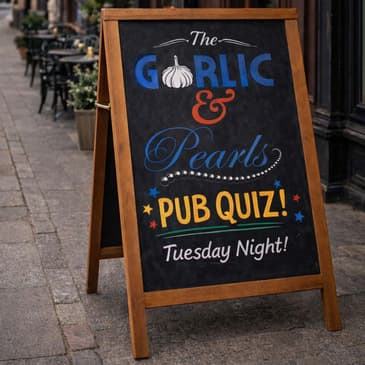
[00:00:22] Hello, this is Garlic & Pearls with me Muriel Zagha, the Frenchie, and my co-host Suzanne Raine, who is British. On this podcast, we talk about the Frenchness of the French, the Britishness of the British, many aspects of those things, and we take turns. Today is a British day. Suzanne, you're going to lead this and tell me about something quintessentially, delightfully British.
[00:00:49] Yes, Muriel. I need to do my very best to conjure up for you all the atmosphere of the pub quiz. Yes. And you can't have that, of course, in France because you don't have pubs. No. So you can't do pub quizzes. No. Because you haven't got essentially the arena. We don't have the infrastructure. You don't. And so I'm going to start off by giving you a small present. So this, listeners, is a book. I like getting books from you.
[00:01:19] This is the pub quiz book, or a pub quiz book. It's the ultimate general knowledge, pub quiz. Book over one million pub quiz books sold, it says on the cover. And it contains more than 8,000 quiz questions to test your trivia expertise. So I should say that I am the person who's rubbish at Trivial Pursuit, has always been rubbish at it, and that I don't know very much about anything, which is why I need this podcast, like a lot of other people.
[00:01:48] But thank you. And this will help me to prepare. Are we going to enter a pub quiz together? What we're going to do, I thought we'd start off, Muriel, with some questions for you. And I'm going to start with quite easy and then go through to slightly more difficult. Okay. Which county is traditionally famous for its hot pot? Lancashire. Yes! Yes! See, I did that deliberately so that you have a sense of it. The question is easy, thank you. And then it's going to get impossible.
[00:02:16] Who wrote the song Where Do You Go To My Lovely? Oh, I can't remember the song. I don't know. Peter Sargett. Right. Okay. Who won the Wimbledon women's singles the most times in the 1980s? Was it Chris Everett Lloyd? Oh, no. Nice, nice try. I mean, I'm grasping at things there. I don't remember who. Martina Lafratola. Of course.
[00:02:45] Oh, I'm such an idiot. Sorry. I love Martina. This is great because it really feels like a pub quiz now. I know. And this is the final one at this stage. Which illness killed Oliver Cromwell, who died on the 3rd of September 1658 at the age of 59? Oh. Or was it something to do with his gallbladder? No. I can see from your laughter heartless laughter. No, I don't know.
[00:03:12] The answer, rather surprisingly, certainly to me, is malaria. Really? So you see, I would never have guessed that. No. Not in a month of Sundays. Apparently. I mean, I think... How did he catch malaria? This is fascinating. So this, I think, underlines what usually happens at pub quizzes, which is at some point you get an answer that's so surprising everyone thinks that can't be right. And obviously there's some complication because, of course, we probably don't know what he died
[00:03:41] of, but modern medical consensus does appear to attribute his death to complications from malarial fever, possibly contracted during his Irish campaigns. Okay. Now, maybe there was a rogue mosquito that had flown from far away places. I don't know. I should say also just to set the scene for our listeners that we are not in a pub and that I do not have a drink,
[00:04:07] because I think a drink surely is a very useful adjunct when you're doing pubs. Yeah. Well, you have a cup of tea. I have a cup of tea. So that's great. That will strengthen me. So I think I should now just give us some framing. Mm. You don't have pubs. We do. Although there is an... I think there's going to be... I don't want to foreshadow something terrible, but I think there may be a melancholy ending to this podcast,
[00:04:36] because of course we do have pubs, but diminishingly. Fewer. The pub quiz has a very specific place in the British psyche. And it is astonishing actually how central it has become across the whole country, across England, Scotland, Wales, Northern Ireland, in the way that we relate to each other socially. It's kind of is invented here. It lives here.
[00:05:07] There are some statistics and they're all... They're all astonishing statistics. And who knows whether they're right, but let's say they probably are. So statistics from the early 2010s say that the UK had at that stage 60,000 pubs. Gosh. And about 22,000 of them had a pub quiz once a week. So that's a third of the nation's pubs had a pub quiz once a week.
[00:05:32] Then I was looking for authoritative surveys, quite hard, but Green King, who are brewers, did one in 2023. And they said, this is the Green King survey. 70% of people in Britain regularly take part in a pub quiz. I mean, that can't be... 70%. It can't be right, but that is what they concluded. And regularly. I don't know. That's a lot. I don't know how you define regularly.
[00:06:01] I mean, I suppose, when did I last do one? Some time ago. I don't know any of the answers except really depressingly ones about Taylor Swift. And that feels like... I know about 80s pop. I think you'd be quite good at that as well. I'm very good. And celebrity gossip, but that's embarrassing. Not only from the hairdressers. So anyway, the thing is we have to get our knowledge from somewhere in order to do pub quizzes. That's why it's so important to get to the hairdressers regularly. And there's a big question actually that came with some of my researchers.
[00:06:30] There's a whole load of stuff that collectively we don't really know about geography, about literature, about because... Science. About science. We're not all polymaths. You know, schools don't teach the classics anymore. We don't learn about classical music, all the rest. And yet somehow we're obsessed with knowing the right answer to questions in pubs. So how do we get that knowledge is a question that I can't answer.
[00:06:56] There are people who live for quizzes and who spend their entire time memorising the contents of a book like the one you gave me. Which you will be doing. And testing themselves, which of course I'm going to be doing. This is my project for the summer. But it's a particular kind of mindset that, and not all British people are like that. More stats. One in ten people, almost, attend a pub quiz every single week. I mean, again, I thought, this is, this is an authoritative, well, I don't know, Green King. But anyway.
[00:07:27] 72% of Brits say that a good pub quiz is an integral part of a traditional British pub. That, I can imagine, a lot of people feel that way, certainly. Yeah. And then I asked myself, what is it about our psyche that makes us love facts, facts, facts?
[00:07:50] You know, I want to know more facts than you about the length of rivers in South America or the, you know, how many toes some pangolin has got. You know, why? I don't know. Does it have any toes? I don't know. So, I don't know the answer to this. And I, what I think sometimes you do brilliantly is you listen to me speak and then you give the diagnosis at the end. I'm your doctor. I know.
[00:08:16] So, I'm going to speak a bit about pub quizzes and you're going to tell me why you think the British people… I will tell you why later. I'm listening to your symptoms first. When did all this start? So, is it actually more recent than one might think? Is it one of those where in fact it really started, say, in the 1970s or something? Or was it older? It's older than that. Right.
[00:08:41] But it appears to have co-developed alongside broadcasting, radio and TV broadcasting. And when you think about it, it's kind of obvious because you have the idea of a quiz and you put it on the radio and then you put it on the TV and then people realise that it's really easy, they can do it at home. So, it's a 20th century phenomenon. And then you dig a little bit deeper. So, the Guinness Book of Records…
[00:09:11] It's back. It's back, listeners. But what would we do without it? Of course. It tells us everything we need to know. It is generally accepted, including by the Guinness Book of Records, that the first pub quiz or sort of a club quiz in a way was the York Club and Institute Union Quiz League, which was formed in 1946, immediately after the war. And it was in Fulfogate in York.
[00:09:41] And there was a man called Gordon Falconer who… That's a great name. It's a great name. It's a great name. Lovely name, really. Gordon Falconer played in that team and he was the last surviving member of the first matches who only died in 2008. And he was still quizzing up to that time. So, that made him the world's oldest quizzer. Amazing.
[00:10:09] So, he was, again, someone with an amazingly capacious memory, I'm guessing, who could retain all these facts, big and small. You know, because it does take a bit of a retentive memory because I love facts. But they tend to go into… I love facts. They go into one ear and out of the other. I love learning them. I love it when you tell me things. You're the same. I tell you things and then I quiz you later and you've forgotten about them.
[00:10:37] Which is why we have to record what we discuss. So, there's a trace and we can go back into our archive. Sorry, I'm interrupting. So, Gordon. I had a look… So, I'm just trying to investigate the York quiz scene because it does seem to be quite strong in the northern areas from quite an early stage. And I got this report from the local newspaper, The Press, in 2003. So, quite old.
[00:11:05] But I just thought I'd read it to you as a little snippet so you get the sense of the competitive element of it. In Division 1 of York's Working Men's Club and Institute Union Quiz League, Burton Stone maintained their unbeaten record with their win against Southbank A, making it eight wins out of eight. York RIB stay in second place with their win against bottom of the table Haxby B. That's brilliant. So, it's like the same as football but… It's the same as football but it's facts. Yeah.
[00:11:36] But it's facts. But it's competitive and it's war, basically. Well, only in some cases. Right. Oh, that's so French of you. I don't know. It's sort of sublimated war. No, this is it. Yes, because is it war or is it fun? Ah, interesting. It opens a whole obit of perplexity there. Fun, yeah. It's a fun version of war when nobody dies. That's perhaps one way of resolving it. I hope nobody dies.
[00:12:05] I hope you're not going to tell me that people have died of pub quizzes. Please don't say that. I don't think people have died of pub quizzes. So, that's 1946. Actually, this whole radio and TV thing goes back slightly earlier. So, the very first TV quiz, which was a spelling bee, was created in 1938, really soon after the BBC began its regular broadcasts.
[00:12:30] And that was hosted by a man called Freddie Grisewood from Alexandra Palace. And it was a 15-minute show which asked all the contestants to spell words, basically, a spelling bee. And that was borrowed from American radio. So, that wasn't invented here. But we were the first people to put it on the TV. And that was the birth of the TV quiz show. So, late 1930s.
[00:12:58] And then it really was broadcasting doing that innovating. And it would be interesting to know how the French did this. But the Brits and the Americans sort of co-evolved the genre as it went. I mean, there's some big famous American kind of quiz shows. But then we kept coming back and then, you know, so who wants to be a millionaire, for example, which we'll come on to later. You know, we invented it.
[00:13:23] There's been interplay across the Atlantic in terms of formats, which still goes on, actually, in the X Factor, Traitors and things. We're all inventing different types of quiz shows. So, then how did it break out more broadly across pubs? In the late 1950s, you'd had quite a lot of quiz shows on TV throughout the 50s.
[00:13:50] So, things like, for example, the Brains Trust on the BBC for the whole of the 1950s. Animal, Vegetable and Mineral was on the BBC from 1952 to 59. Top of the form, BBC, you know, it was quiz for school children. All came in the 50s. So, at the end of the 50s, across Merseyside and Lancashire, so in Liverpool, across Southport, a place called Bootle. I don't know if you ever heard of Bootle.
[00:14:19] No bit of legs than that. You should go. They set up the Merseyside Quiz League from 1959. And that carried on into the 60s. So, in 1963, the Liverpool Echo does an interview about the Merseyside quiz scene. And there was a man called Jack Robinson who just said, it's a jolly good way of enjoying yourself and learning at the same time. Wonderful.
[00:14:46] So, then, more quizzes on TV. I'm not going to give you loads of details, but they go all the way through the 50s and 60s. I think two critical ones that have endured to this day, University Challenge and Mastermind. Yes. Both great shows. I love them both. Do you have equivalents to those in France? No, I don't think so.
[00:15:12] We have quiz shows, but nothing with that sort of pedigree that they both have. And, you know, a memorable host, which, I mean, I know there are new people doing it who are doing a great job, but the shows were established by two very memorable, distinctive idiosyncratic hosts. And nothing that's really part of the collective psyche in the same way.
[00:15:38] I mean, the only thing that's as successful, I think, on French TV has been good, is our equivalent of Countdown, which is called Des Chiffres et des Lettres. Des Chiffres et des Lettres. And that, I remember from my childhood, everyone in my family watched it. But again, it's due with spelling. And remember, we talked about the dictation and public dictations on TV, no, no, no.
[00:16:01] I think that's where a lot of French desire to know stuff and educate and entertain goes into that. But there are other quiz shows like, you know, the ones about general knowledge. I don't think they've achieved the same sort of status as something like University Challenge. I can't think of any university connected shows on French TV or Mastermind where it's really your specialist knowledge. That's great as well.
[00:16:29] I don't think we have the equivalent of that. So, you know, they are, they're different. Interesting. So, little bits of facts. So, University Challenge first aired 1962. Gosh. Yeah. And then it had 913 episodes on ITV until December 1987 when Bamber Gascoigne retired. And then, of course, it got revived in 1994 with Jeremy Paxman. And so, it's still going now. So, that's, that's a lot.
[00:16:59] And then Mastermind started slightly later 1972 to 1997 with Magnus Magnusson. Yes. Who, I mean, again, just the best name. It's the best name. And it got moved in 1973. It got moved to a prime time slot. So, that tells you something. Yeah. It became one of the most watched shows on British TV. And I can remember, again, I can remember my grandparents' house. We would sit and watch Mastermind.
[00:17:25] And it's something about the, it's about the staging as well with the black chair and the spotlight and all of that. So dramatic. Yeah. I've started self in it. So, and an interesting and slightly odd extra thing was that they filmed all the original series in academic or ecclesiastical buildings. Did they? Yeah. Which gives you an extra something about the… Because you absorb something by its mood. The sanctity of the quiz. Yeah. In a special secret space. I know. It's unbelievable.
[00:17:58] So, the 70s, you know, everything cuts loose. And that is when pub quizzes started to be organised in much more of a way. And everything changed in the 70s, didn't it? Because things became so much more accessible somehow. There was a plucky pair, Sharon Burns and Tom Porter, Burns and Porter, who are credited with founding the first mass market pub quiz company in 1976.
[00:18:27] And they organised 32 pub quiz teams in three leagues in southern England. They were publicists, so they wanted to get people into pubs on quiet nights. And they began a weekly quiz in the 1970s and that popularity grew from the original 32 teams to, by the end, 10,000 teams in their weekly events. I know. So, they dominated it in a way.
[00:18:55] This was the kind of real start of the boom. Explosion, really, yeah. And I was reading, so in August 2019, Tom Porter died. And I was reading his obituary because he's, you know, like all these people, everyone's got interesting lives. So, he's known for founding the pub quiz, but he did many other things. So, his first pub was the Baker's Arms at Litchett Minster. He died at the age of 93, I should say. So, a good life.
[00:19:24] He served in the Royal Navy with his Royal Highness Prince Philip after attending the Royal Naval College in Dartmouth. And then he went on in the 60s and 70s to work as an executive with the Brickwood and Whitbread Breweries before developing his own range of restaurant pubs. And that was when he worked extensively with Sharon Burns to develop the pub quiz.
[00:19:51] And he also wrote many books, including… I'm bracing myself. You do need to brace yourself for this. Do It Yourself Divorce. I wasn't expecting that. Do It Yourself Divorce. And How to Build Your Own Computer. Right.
[00:20:19] Why didn't you give me How to Build Your Own Computer? I'd like to have a go. Can you imagine how that would go? Good. Anyway, he was obviously a character. In his 60s, he got a helicopter private pilot's license and bought his own aircraft, which was a Robinson R-22. And he had a flying instructor called Harry Knapp who used to train him at Bournemouth Airport.
[00:20:48] And he said that it had been a challenge to train Tom and a unique experience. Read between the lines. Oh dear me. Yes. Okay. But the thing that I'm finding quite odd is with Do It Yourself Divorce. I don't know how, but he was married to Pip for 63 years. Okay. So he obviously didn't divorce himself.
[00:21:17] But was he trying to help people divorce amicably? Because presumably, is that what it means? Do it yourself, i.e. just find your way through with your spouse rather than involve lawyers and things. Yeah, I thought I was going to be telling you about pub quizzes. Yeah, we're not going to talk too much about that. But it's intriguing that he considered himself an expert. Sadly, in 2013, Pip died and Tom's health began to fade. But I don't know.
[00:21:47] You see, again, you think it's a measure of the man that having been with Daywood and having failing health, presumably he stopped flying helicopters, but he did take up canal boating. I see. He sounds amazing. He was obviously amazing. Anyway, and he lived to the great age of 93 and died in 2019. So we have him to thank for the spread and popularity of the pub quiz.
[00:22:18] But we don't only have him to thank, we also have ourselves to thank because we were there open to the possibility. It was like the entire British nation was just waiting for someone to show them how to do pub quizzes more. They've got everything. You've already got the pubs. You've already got the people sitting in the pubs. All you need is a list of questions and a microphone and some BIROS and some bits of paper that you can rest on beer mats. So easy. It's so easy.
[00:22:47] So it has an enduring and simple proposition. It's analog, isn't it? It's just real life, real things, real people. Yes. So you're, but you've put your finger on something here, of course. Yes. So I wonder if this is where you're going, but I was thinking of COVID and how one of the activities people turn to when they couldn't socialize in person was to have quizzes with their friends online.
[00:23:18] Yeah. And I know a lot of people who did that and I took part in a couple, not many, but I think it became a way of trying to recapture that lovely thing. Yeah. But on a screen. It's not the same thing. No. Not to say that it couldn't be fun, but it's really not the same. I think it's very much an in-person activity. That's my impression. That's exactly right. And I am going to come onto that, I think, because we should, we should discuss this at the end. And I think with something of a call to arms to go out there and-
[00:23:47] And quiz away in the pub. Yeah. So just going back to the TV. Mm. In the 80s, and quite interesting, you talked about Countdown because it's, I don't know where maybe the French invented Countdown before we did. I think it's possible that we did, you know, because we only had it from 1982. And then we had it before because I watched it all the way through my childhood and I'm ancient. So yeah. And then we had, who wants to be a millionaire?
[00:24:14] Which, you know, a million pound prize, which was as a result of deregulation actually. And that became hugely prime time successful spread around the world. And then other things like the weakest link and deal or no deal. These are the quizzes that we started selling to the US, making money for their British originators.
[00:24:38] And I mean, a whole load of other quiz things that still exist, like, have I got news for you or never mind the buzzcocks. They're all variations on getting a bunch of people together. And never mind the buzzcocks. So much fun. Yeah. It's great. So they're all fun. And so the 70s thing became a kind of 90s, noughties thing all over again. We didn't lose the enthusiasm in a way. No, it just evolved and developed. Yeah.
[00:25:08] So I'm going to do little bits of entertaining. I've done you some information. Tell me, according to the Green King survey. Yeah. What are the characteristics? What type of people would be the most desirable to have in your pub quiz team? So different kinds of people. I would have thought you'd want sort of one of each. It's a sort of Mr. kind of Noah's Ark situation. Yeah. Not just your friends.
[00:25:33] So you need someone who's very solid, I should think, on science and geography and stuff. Yeah. And who retains these facts with great exactitude. Who would that be? You mean in our own circle of friends? No. I mean, our producer, I think, is pretty good. Yeah. Does he do pub quizzes? I think he does. Well, he does. And he certainly did a lot of quizzing in COVID. Yeah. So you need a person like that. You need an arty person.
[00:26:01] Let's talk about professions. Oh, professions. So maybe, ideally, you know, a maths teacher or a science teacher, I would have thought. Can I just say? Wearing cords. Points to you. And knitted ties. Brits voted, according to Green King, teachers as the most knowledgeable profession to have on the team with 46% of their vote. I'm with these people. I agree with that. Who else? Who else? Someone who's travelled maybe quite a lot? Maybe.
[00:26:31] Or is this a kind of offbeat? No, it's a good guess. A traveller who's been around and who's able to visualise rather than just know facts about geography and other places. Okay. I'm going to just, I mean, if you want to put the audience out of their misery. Yeah. Journalists were second at 33%. They have a lot of facts. Doctors, 31%. I would have said doctors as well. And solicitors, 16%. Ah, solicitors because…
[00:27:00] I suppose they just know lots of them. They have lots of general knowledge, yeah. It's people who have access to or need a lot of general knowledge to sort of feather their nest professionally. Also, it's a chicken and egg thing because as you choose what your career is, certain kind of people find some things easier than others. And to be a lawyer, you have to remember a lot of facts, presumably. Yeah. So you have a filing cabinet mind. But ringing endorsement for teachers, nearly half the population would choose teachers to be in their pub quiz team. Yeah.
[00:27:30] So that's important. Then there's… This is where we come frequently back to this thing about Brits like to have fun. Oh, yeah. Choosing the name of the quiz team. Oh, that's so brilliant. Yeah, I really love that. Do you… Have you done this a lot, pub quizzes? No. Only pub… Properly in a pub, one time. Only one time. Locally, actually. And then we should go back.
[00:27:58] And the other quizzes I've attended have been at my son's school. So they've been a quiz for the parents, where the parents pit themselves against the teachers. Oh, my God. So you can imagine how that goes. The teachers always win. Of course. Because the teachers make up a team of universal knowledge and the parents are just desperately trying to keep up. It's really brutal. But it was fun. And the idea is to socialize. I mean, again, yeah. The idea… Okay.
[00:28:28] The idea is to socialize. The idea is to do something where you don't take yourself too seriously. So, of course, there'll be someone… There's always someone on the team who takes it incredibly seriously and gets very cross with the people who are not trying hard enough. Yeah. So, I suppose there's a universal… in a sitcom sort of way. There's the universal composition of the team where you get a little bit of everything in terms of personality types now.
[00:28:53] So, the person who gets quite drunk and answers, you know, with no relation to the question and loses you points. The person who has false confidence, who says, no, I know this, absolutely write it down and is wrong all the time. I often had people like that on my team. And you can't challenge them, can you? You can't challenge them. And the incredibly earnest person who takes it so seriously and is staking their own reputation every time.
[00:29:19] And you want to say to them, it's only a game, but that it makes them very cross. It's true. And I also think there's the person, this is often me, who likes to sit there with the pen and the paper and write the answers. Oh, yes. I really like numbering. And likes to write the name of the team at the top of the sheet. So, how… okay, the name of the team now. This is a whole other British nest of goodness. It is, isn't it?
[00:29:46] Because that's where people express their whimsy, isn't it? And maybe sometimes slightly irreverent, you know, so there'll be, in my experience, again, this is limited experience, but I think, you know, certainly in Britain. Things to do with politics. So little jokes at the expense of politicians. That's fun, the prime minister and other people. And then puns. Word games. It's all about words. So often… It's all about words.
[00:30:16] Yeah, homophones, things that sound like one thing but mean another thing. Should I give you… Give me some examples, please. I'm dying to hear. Obviously, both brilliantly and depressingly, on the internet are now loads of websites where you can go to get ideas for the names for your pub quiz team. It's really sad but also brilliant because I had a lot of fun. So did you compile a kind of top? I've got… Well, I was going to have just like one or two that I was going to tell you.
[00:30:45] You have a lot. I can see your script. I've got 17. Lovely. I want them all. So I think… Well, the first one, and this is a sort of standard thing, is the quiz masters or the quiz champions. Some people put quiz in the name. Yeah. Then they get more interesting. I am smarticus. Brilliant. Agatha Quizty. Oh, very good. I love that. Simple Minds. That's actually boring. Let's get quizzical.
[00:31:15] Yes. I think I've had that at one of the quizzes I took part in. I'm going to miss that. Village Idiots and the A-Team, they're just commonly used. Quizy McQuizface, obviously. Which, I don't know, it's that… If you were to say, what is it that encapsulates Britain? It's… There's something about that. Just looking you in the eye and doing something really mischievous. That's it. The Wise Quacks. And then there's these…
[00:31:43] These ones are alcohol-themed. Oh, okay. And I like them. The Three Must Get Beers. Very good. Tequila Mockingbird. Alcohol-hooligans. Yes. Blood Sweat and Beers. Know It Ales. Smarty Pints. Smarty Pints is great. Squisly Beers. Yes. Smartinis. Very good.
[00:32:13] Very good. They are good, aren't they? That's part of all these things. It's like little bits all added up together in a little pyramid-y way to make a peak of fun. Yes. That's exactly what it is. Then you have the Quizmaster. Very important. Really important. And this is where, again, there is a narrative arc and I'm signposting your notice, but this
[00:32:39] is where, again, the narrative arc, you know, there's the potential for this to go wrong. The Quizmaster can be the landlord, can be an amateur, volunteer, local person who lives in the village who does this and it's the thing that makes their life… A retired teacher, for example. For example. This is what they all do. Yeah. It can be a professional. Mmm. But the host is the crucial factor to the chemistry of the event.
[00:33:09] So if it feels not authentic, if it feels like it's come out of a box in some way, it's not fun. It has to feel like it's being a part of… It's the terroir. It's the terroir. Absolutely right. Yeah, yeah, that's very good. Thanks. Please do it. This is what the terroir is. This is our terroir. Yeah. So I've been on the camera website, the Campaign for Real Ale, and there's a lovely
[00:33:37] article by a lady called Laura Hadland who is what she calls, she's a caller, which is what you had in bingo as well. Oh, yes, yes, yes. Oh. Which means Quizmaster really. And this is what she says. I've been calling pub quizzes on and off for several years now. I'm rubbish at quizzes. I have a terrible memory and the admittedly extremely low pressure of the environment makes me forget what little information my brain can retain. That's why I like to call them instead.
[00:34:04] I love picking the questions and shouting them out. I love the little groans when I reveal an unexpected answer. The muffled hisses of celebration when a team suddenly works out the solution to a dastardly puzzle. Being gently heckled by the local bar flies who never participate but always have an opinion. I even relish the disagreements and the diplomacy when a team challenges my authority as Quizmaster and lets me know that I've got something wrong.
[00:34:34] The pub quiz is just so much silly fun. It's all of life, isn't it? It really is. I've just remembered, this is a little aside, I've just remembered team names, quizzes I took part in. One was the bipolar expedition, which I thought was great. And I think a person on that team was actually bipolar. So, you know, they were allowed to make that joke. And then there was Quiz Quiz Quiz Let Me Get What I Want,
[00:35:01] which was a riff on this song by the Smiths, which is called Please Please Please Let Me Get What I Want. Sorry, we might edit that out. I just thought I would add a bit of real life experience. No, but that's… And actually, now I'm thinking about it, there is a real skill to coming up with a really brilliant name. On the hoof, I think that's brilliant. Which clearly people are doing, they're clearly getting them all off the internet in some way.
[00:35:28] Do you remember when we did Conkers and we talked about cheating? Oh yes. Whether cheating was allowed or not. Oh, cheating, yeah. So with quizzes, how do people cheat if they're in person? That's the thing. Because of course with famously, I don't know, but who wants to be a millionaire? The coughing person, the major. Major. Yeah. That story. So if you have someone in the audience who can signal things, that's one thing.
[00:35:58] How do you… Suppose people have their phones with them and that's what they do. That's terrible. They've got their phones. Because they've even now got their iWatch things. No. So they can Google things. Yeah. That's awful. So it's a scourge. How would you demean your team in this way? Come on. So what happens, of course, is I suppose what you have to have is an ambient level of collective agreement of how much this is going to be tolerated. Because you are all in it.
[00:36:27] At that moment, it's a piece of collective endeavour and something quite theatrical about it as well. It's a collective performance that you're all in and doing. That's it. So if somebody's cheating, it undermines everything. So quite a lot is self-policed. You know, if people see people doing it, then they'll tell them off.
[00:36:47] But, Green King facts, almost a third of Brits, 28%, admit to having cheated on a pub quiz. That's quite a lot. Searching for answers on smartphones, asking members of staff for help, and looking at another team's answers. That's like school. It is. In a way, it's like school, but fun, isn't it?
[00:37:15] It's like going back to school, but it is fun. So I'm going to do a little story from The Guardian, which by Alexandra Topping in November 2025, about a cheating thing, just a small one. But before we do that, we're going to ask a question, which this is from her article. So I myself cheated, but I'm going to ask a question and not give you the answer just yet. Okay. Who is older, Gary Neumann or Gary Oldman?
[00:37:47] They're the same age. No, they're not the same age. You've got to pick one. Okay. So I'm going to say Gary Neumann is a little bit older. Yes! Gary Neumann is older than Gary Oldman by 13 days. This is where my team embraced me and I downed my drink in one. Oh, how lovely. Yeah, but in real life you would have had doubts at the last minute and crossed it out and put Gary Oldman. Well, that's the thing, because there's a lot less pressure here. It's just us. It's just us.
[00:38:15] So the story that this brilliant question was asked in was about a quiz master in Manchester who outed a team for cheating because everyone said, this is just not okay. It was, according to the BBC, which is of course always impartial and doesn't ever exaggerate, a massive whodunit.
[00:38:44] Because the landlord at the barking dog at Ermston… You're making this up. …had revealed that cheats were whispering questions into their smartphones, but he refused to name and shame them. Okay. So, I mean, I suppose that's how it works, isn't it? You whisper it in and then your phone gives you the answer so you're not obviously playing on your phone. Yeah. And so then the article goes, there's a whole load of quiz masters saying, it's not okay
[00:39:15] because I've put a lot of effort into making up all these questions. I've hosted quizzes for nearly a decade. And there's a guy called David Hartley, who's a quiz master from Staffordshire, who started banning devices. He said, it just takes the mickey out of your quiz master if all you're going to do is sit on your phone and look up the answers. So basically, problem is sometimes you have to be able to prove that they're doing it, which you can't.
[00:39:42] I think everybody should put their phone in a basket or something when they come in and do it without. I do think that would be a good thing to introduce. The Prince of Wales in Highgate, North London, has a really fierce policing policy. Okay. They say, we're really harsh on anyone who cheats, so no one does it. The regulars would rather boil themselves in oil than cheat.
[00:40:11] There's something quite old England about all this. How harsh are we talking? Do they put them in the stocks outside the pub? This is good. This is good. People should care and not want to be exposed as cheats. It's shameful. Yeah, I think so. I agree too. So there are amateur quizzes and there are professional quizzes. I mean, that's just how it is. Yeah. We are a nation of amateurs.
[00:40:38] I think it's a bit mad to say pub quizzing is a professional sport because, sorry, you've pulled a face. But at the same time, it is… It slips into that sometimes. It slips into that. Yeah, yeah. I see that. The format, I don't know whether you want to talk a little bit, probably only a tiny bit about the format. Mm. But you've already alluded to it. You have different types of questions. You can have special rounds where you have puzzles rather than questions, general knowledge.
[00:41:08] All of that happens. But the basic format is a set of rounds and then the answers and then somebody wins. The other thing is the night of the week. Oh yes, okay. So you'll have pub quiz on a Wednesday night or something. A Wednesday night or something like that. Wednesday or Tuesday. So it's usually a quieter night of the week, which is obviously connected to the pubs wanting to get people in.
[00:41:34] And it's usually around eight o'clock-ish or something like that. So you'll notice the character in the pub will suddenly change and people will come in and they're sitting at tables and it's quite a fun thing to do. I think we should also recognise that although we have in our heads the cutesy ye olde England
[00:41:57] pub, one of the things that makes this so brilliant is that it's not a cutesy ye olde England enterprise. So it really happens all across the country in chain pubs on the side of a road. Yeah, in pubs that are a concrete box essentially. It's everywhere. So then you talked about the pandemic.
[00:42:26] And there was an article in the Atlantic on April the 13th, 2020 by Yasmin Serhan. And the title of the article was, the pubs are closed, but Brits keep quizzing. In an era of social distancing, one British institution has proven resilient. And it did, didn't it?
[00:42:48] And I think even, weirdly, the pub quiz could be credited for holding the nation together, even though it wasn't taking place in a pub. Yeah. Because we recreated the pubs on Zoom. On Zoom, exactly. So necessary was it. The Zoom arms it became. The barking Zoom, whatever.
[00:43:15] So there was a pub landlord called Jay Flynn, who was suddenly able to reach out to thousands with his pub quizzes during the pandemic. And he made £1.3 million for charity at that time. That's very impressive. More than half of UK pubs had a regular online quiz during that time. Which is interesting.
[00:43:42] That is very interesting in terms of, I suppose, what remains when you take everything, when you strip everything away. What people, what is the thing that will remain where people continue to express who they are? Yeah. Really. What I would like to do, if I had more time, is really dig into some of the geographical variants. Because there will be. There must be.
[00:44:07] But for example, Durham, in another survey, apparently might be the British pub quiz capital because it has 24 weekly pub quizzes in a city with a population of only 50,000 people. So that's quite a lot of people having to do weekly pub quizzes. Chichester, Wakefield, Salisbury and Preston are the others in the top five. Yeah.
[00:44:36] So quite distributed in England, those ones as well. I'm going to do a little shout out to Val and Jeff King. This was on the BBC only recently in April. They've been running a pub quiz in the same venue for 30 years because they think they've set a British record. Of course, we're back to records. I don't know if you, I know. So this is all of our things all in a one. Yeah.
[00:45:05] And they've been running it at the Long Shoot Hotel in Nuneaton in Warwickshire since 1996. So they're saying it's the longest recorded pub quiz residency hosted by the same duo at a single venue anywhere in the UK. Wow. And Jeff King said, we just set out to create a bit of fun. Hmm. 30 years came along very gradually and we never thought it would happen.
[00:45:32] And they continued running it throughout the coronavirus, kept all the teams happy, he said. And Jeff King said he had a pretty good memory to make sure questions were not repeated as well as a database of quiz books going back to the 1980s to help with question setting. Amazing. And he said, I don't claim to be the brain of Britain. I just wanted to do quiz nights for all age groups and knowledge levels. Yeah, that is lovely.
[00:45:58] And that phrase, a bit of fun, is one that one day you may want to, you know, really dig into a bit more because it really encapsulates something about a British character. A Brit of fun. A Brit of fun, exactly. Because it's, it's about fun, but it's also a bit of self-deprecation always, you know, that not taking yourself too seriously, we're doing something just for a laugh. But in fact, as you've just demonstrated with this, a lot of preparation goes into it.
[00:46:27] Not unlike this podcast, which is also a bit of fun, but where listeners enormous amounts of preparation go in. All right. Right. Let's take a dark turn. Yes. Okay. Because what do you think happened? Well, okay. After the pandemic, are we talking or… We're talking concurrently and it's not about the pandemic.
[00:46:50] It's about technology and globalization and just… it's what always happens. And it's partly professionalization, it's partly entrepreneurial activity. But basically, pubs realize this is a great way to bring people in. Yeah. It's a lot of effort to produce a new pub quiz every week. And some people are better at asking
[00:47:16] questions than others. Some very clever people thought there's an opportunity here. Because actually, I really love doing the research and coming up with the questions. I really love asking them. I can set up a company which creates the questions, which sells and provides a service to London pubs. Of course, it gets really fun. So there's the brilliantly named Inquisition. Sorry.
[00:47:48] That is a kind of summit. Can I just say it's going to be very hard to meet. Inquisition. And the brilliant man who set up Inquisition is called Alex Douglas. So he was an avid quizzer, according to his website, and a musician. And he hosted his first night at the Regent in Ballham in South London in January 2011. And it was just an exciting side hustle, as he said.
[00:48:14] And then other pubs heard that he was really good. So they said, would you do it for us as well? And then he started to think, actually, God, you know, I can't keep up with this. So he hired some other people. Yeah. Set up Inquisition. They now have over 60 quiz masters on their books. They run quizzes across London. There's a bunch of them who sit there in Inquisition's offices.
[00:48:40] Or maybe they do it at home. I don't know where they sit. But they work for Inquisition, his two business partners. They take about 50 hours a week to compile the questions. And then they have an in-house verifier called Rob, who just checks that the answers are right. Because of course, I mean, that would be reputation killing if you're selling a pub quiz with the wrong answers.
[00:49:05] So he said it's really difficult now because, for example, if there's a medical question, you need to have a doctor or nurse who can tell you that the answer is right. You have to research really thoroughly. So on their website, what we do, it says, we are a high end pub quiz creator, operator and supplier based in London.
[00:49:26] Alex, Neil and Ollie write the quiz. And Rob, the verifier, they call him the corroborator 3000. I live for this.
[00:49:42] And then it's got where we're going. So under the where we're going, it says, whilst retaining the integrity of a proper pub quiz, we're also looking for ways to improve our offering, whether through technology, design or simply keeping the content fresh and exciting. We know we have to innovate to remain the market leader in our field. So that's it, some pressure. There's a lot of companies that do this now.
[00:50:06] And one of the biggest, I think maybe the country's largest provider is one called Red Tooth in Derbyshire. So not really a pun, but they provide a service for more than 3000 pubs and clubs a week with weekly quizzes. Yeah, I'm not completely unrelated to this. The two quizzes I attended at my son's school, they were devised by an organisation like that.
[00:50:33] I don't remember their name, but they were an outside provider who came in and did the quiz with a screen and everything. And it was okay. But it was not sui generis. Whereas at that school, and it's true, I'm sure of a lot of other schools, it used to be the case that the headmaster set the quiz. And you can just imagine the difference. And I don't necessarily mean because it would be more highbrow.
[00:50:57] It's more, there's someone who belongs to the place, whether it's the landlord, the headmaster, whoever it may be, or someone who lives in the same village or in the same street as the pub. And they have a feel for that particular community. So the quiz will be more personal to everyone. It will arise out of that community. And I think, however good and well-intentioned the professional quizzes are, it's not going to feel the same. It's going to be very corporate.
[00:51:28] And of course, there's demand for that in the corporate world. And that's a slightly different thing. But it's going to feel a bit sterile, isn't it? Yeah. Sorry, I don't mean to dismiss the whole section of the market, but I do think there's a difference. So that is the risk. And the risk is that it then ceases to be the thing that everybody wants to do on the Wednesday because they can do it on their computer at home.
[00:51:51] And it also taps into that other quintessentially British thing, which is the desire to have an argument. So, although not an argument about politics like you would in France, but an argument about something entirely trivial. Yes, brilliant. So, one of the quotes in one of the articles I was reading saying, you know, people told it's not the same when the pub has just bought it in because the quality of the arguments that you have aren't as good. It is lesser, yeah.
[00:52:20] Well, you can't argue against a computer that's telling you a set of already existing facts. Exactly. So, we've kind of gone… it links to Wikipedia and AI and all the other things which are saying, and these are the facts. And what we're saying is there's a terroir… There's a terroir that we need to retain. Totally. And talking of terroirs that we need to retain, and then this is the bit where the bell starts tolling really slowly…
[00:52:49] …for last orders, as it were. I have so immersed myself in the pub setting that I can almost hear the bell. This is from the BBC this May. So, approximately two British pubs closed every single day in the first quarter of 2026, according to figures produced by the industry.
[00:53:14] So, the British Beer and Pub Association, BBPA, says 161 pubs closed in the first three months of this year across England, Scotland and Wales, which is the loss of around 2,400 jobs. Hmm. And of those, Wales is the only region to report an increased number of pubs. Oh, good. I know. Well, that's the real hope.
[00:53:40] Well, not for Scotland, which suffered the heaviest losses, 41 closures between January and March this year. And why is this? This is… I should say this is on top of… …336 pubs closed in 2025. So, it's happening at a great rate. It's a proper problem. Yeah. It's attributed to a whole set of decisions that the government has taken about employment and tax.
[00:54:10] Yeah. And the campaigning is saying these closures are highlighting an urgent need for longer term changes, including a big overhaul of taxes on the hospitality sector, which is… …and you can see lots of campaigns at the moment on social media about that. So, they've had massively increased pressure with increased labour costs, rising business rates, all the taxes on the things that they're selling…
[00:54:38] …and people not having money and not going out anymore. And it's cheaper to drink at home. It's cheaper to drink at home. I mean, it's really sad, but there we are. Yeah. So, the government has said, actually, we are trying to help and we are backing Britain's pubs. They've cut the business rate bills by 15%. And then there's going to be a two-year freeze. I'm just saying what they've said. I don't really know whether this is going to work or not. They've extended opening hours during the World Cup.
[00:55:07] And they increased the hospitality support fund to 10 million to help venues grow. And they're also doing something called the Pride in Place programme, which will be giving grants for locally led solutions in 280 neighbourhoods in England as part of a scheme to revitalise high streets. One could argue that that is a bit late. But anyway. So, and then capping corporation tax, cutting alcohol duty on draft pints and cuts in interest rates.
[00:55:36] So, that's the government position. But obviously, the facts at the moment are speaking for themselves. And the effort involved in running a successful pub is clearly too much for a lot of people. So, we've got potentially, having said how much this is about fun, but also so important for Britain and community.
[00:55:59] A double whammy, which is technology making it easier and therefore less interesting to compile a pub and deliver a pub quiz. And the pubs themselves not being financially viable anymore. So, just a diminishing number of possible venues to do it.
[00:56:17] And so, I got to the end of it and I was, I thought this is, I mean, maybe these things come and go and we've done our quizzing and we're just going to do less and less of it, just like we're doing less and less of going to pubs. And then the big bit of me thought, but this is clearly part of community cohesion and people meeting people and having fun in a way that doesn't involve talking to them, you know. No, exactly. That's why it's so brilliant.
[00:56:44] And also, all sorts of opportunities for passive aggression, which I know you think. So, what I see in all this, I mean, terrific story and let's not be too downcast. Yes, we have to accept that things evolve and change, but also maybe encourage people and ourselves to seize this. We have to use these things or lose them because France operates in a very different way.
[00:57:10] We have a different way of doing this. Britain has all these little everyday local ways of bringing people together and gluing them together. As you say, gluing them together in a way that sometimes allows them to just be alongside each other and not have to talk directly. That's what's so good about it. That's what's so good. So, going to watch a football game, going to the pub, you know, you're with other people, you don't necessarily have to listen to their tales of woe.
[00:57:37] And you can use the other bit of glue that you've flagged up before, which is passive aggression, which is those short bursts of passive aggression where you chastise the person who's not taking the pub quiz seriously enough. And that means that society continues to cohere. And we have other ways of doing that in France. It's mostly to do with food, I'm afraid, and arguing about politics. But we do need those things.
[00:58:04] And it's also really enjoyable when you do these things. And again, hiking, okay? You go hiking with people. You don't really talk to them. You're doing something together. It's very bonding. You see the same things, but it's not a big heart-to-heart situation. So, all these ways of being together with sufficient distance so that you don't go insane and end up at each other's throats are really important.
[00:58:33] This is not quite the same, but I've been watching that documentary about the Beatles, you know, the Peter Jackson re-editing of all the footage. It's called Get Back. And you see the Beatles in the studio together. So, this is 1969, 70, something like that. It's amazing to me, watching it, really interesting, because it's the Beatles, obviously. But also, it's so fascinating about what it is to be a group. Yeah.
[00:59:01] And not just that, but what it is to be a group of British men. A group of men. I'm watching these men. It's the Beatles. And I'm thinking, these men are so English specifically, I think, but British in everything that they say and do. And a lot of it is to do with manners and with how, when you're so close and you know each other and you have direct access to each other in a way that you can infuriate each other so easily.
[00:59:26] You devise something, being in a musical group together, that allows you to co-exist without killing each other. That's different, but not completely. They would have been a great pub quiz team. Imagine. Yes. Imagine. I think we should stop there because it can't be bettered. It's brilliant. Suzanne, thank you so much. It's wonderful.
[00:59:50] The thing is, I'm not a good quizzer, so that's partly my own internalized sense of incompetence and, you know, imposter syndrome. But I should get over that. We should all get over that, listeners, and join a team and just try it. Give it a try this week, next week. Find a local pub quiz and go. And then you can make new friends. You don't really have to talk to them. They can just be your quizzing friends, which is fine. And don't cheat. Don't cheat.
[01:00:16] And if you enjoyed this podcast, finally, do please tell all your friends, send them a link to this excellent episode. Encourage them to listen to it. Subscribe. Find us online at garlicandbells.com. Find us on the socials. We love to hear from you. Leave us some comments. Leave us some reviews. That'd be great. And I look forward to seeing everyone again next time for something completely different. Au revoir, Muriel. Au revoir, Suzanne. Bye. Bye.