
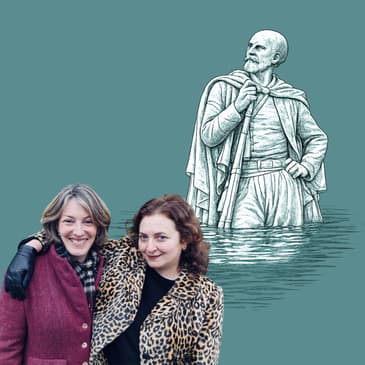
Hosted on Acast. See acast.com/privacy for more information.
[00:00:22] Hello, this is Garlic and Pearls with Muriel Zagha and me, Suzanne Raine. We are the podcast that explores why the French are so French and the British so British. And we alternate. This week is Muriel's turn to explain something so French about France. It couldn't be more French. It could not.
[00:00:48] I think I'm going to, I'm about to be engulfed by Frenchness. Very good. Perhaps a deluge. A deluge, almost a tsunami of Frenchness. No. Yes. So brace yourself, Suzanne, because… I'm getting my snorkel on. Today we are going to talk about the Great Paris Flood of 1910. Do you know about this? Did you know that Paris had been submerged and had resembled Venice for a couple of weeks in 1910?
[00:01:18] No, but as you know, I know very little about France. But that's why we do this podcast, isn't it? It's your raison d'etre. It's also for me to learn about Britain, listeners. It goes both ways. That's why there's perfect equilibrium in garlic and pearls. So, when I was little, when I was little growing up in Paris in the 70s, sort of turn of the century imagery was very fashionable. I think there was a kind of, I don't know, sort of retro fashion for those things.
[00:01:48] So, my parents gave me a lot of postcards that were reproductions of advertisements from the 1900s that were really lovely and exotic and transporting. And then also some sepia postcards, photographs of Paris in that period, in the 1900s, including some astonishing images of Paris submerged.
[00:02:09] I mean, when I say submerged, obviously not completely submerged like Atlantis, but images of Paris showing people in their bowler hats and frock coats and things rowing through the streets of Paris. And I was enchanted by these images as a child. So, this is something that actually happened, although it looks like nowadays, you know, in our era of AI images, it looks like... 28 days later. Exactly like that.
[00:02:38] But in fact, it did happen in the winter of 1910 when the seine overflowed in a spectacular and surprising way. People were not prepared. So, this is very much a story for you. If they'd had you with them, it would have gone a completely different way, but they didn't. I love a flood story. It is a good story. And there is something universal about this and kind of timeless because, of course, floods happen all the time everywhere.
[00:03:06] But I suppose in this particular case, because it happened in Paris at a very particular time of French history, it is also a distinctly French story and people reacted to it as French people. So, that's why I think it makes it a good subject for our podcast. Can I just note that I love a flood story, but I love it also very sympathetically because I know that flooding is horrible.
[00:03:31] And I don't want to give anyone the impression that I derive satisfaction from it, but I find the idea of monitoring a river increasing in volume and how quickly that happens and how you prepare for it and how you defend against it. I find those fascinating things to study. That's just my caveat.
[00:03:55] Well, I think this is where it taps into, as it were, your interest in the weather and in landscape. You know, so it all comes together in a really nice way. So, I mean, I agree with you. I love the images. As a child, they were like something out of a fairy tale. Now, I know more about what happened.
[00:04:18] I understand that although the images give a slightly idealized version, you know, impression of what it was like, in reality for people who went through it, it was an absolute nightmare and must have been utterly terrifying. So, of course, we feel for all people in the world having to face floods. I'm not minimizing this at all. So, maybe just to give you a little bit of context, Paris is in a part of France called the Bassin Parisien.
[00:04:49] And that's a basin. So, it means a sort of bowl, an earth bowl in which the river flows. That bowl valley, that bowl-shaped valley, it used in ancient times regularly to become flooded because it rains in the winter and so on. And so, this is a very old narrative, really. And then I'm compressing, but by 30,000 BCE, it had become much drier.
[00:05:18] Though much of the right bank of the Seine remained really wetlands for a very long time. And you know that part of Paris called Le Marais? Yes. The beautiful area with all the 17th century mansions and the Place des Vosges, which is a particularly beautiful bit of old Paris that hasn't been housemanized very much. Le Marais means the marsh. And that's because for a long time, again, it was a marsh adjacent to the river. That's like Lambeth in London, isn't it?
[00:05:46] So, the south bank of the Thames was all marshy floodplain for a very long time. So, there are parallels. So, for this episode, I've drawn a lot of my information from a brilliant book about the flood called Paris Underwater, How the City of Light Survived the Great Flood of 1910, which was written by an American academic called Jeffrey H. Jackson. And this, if our listeners want more detail about what happened, an incredibly detailed and gripping account of this flood.
[00:06:16] So, that's utterly brilliant. And what the story is really, and again, this taps into areas of interest of yours and mine, is it's, you know how much the French love order and control. So, this is a story of hubris, surprise and disaster, where all order and control temporarily become impossible to maintain. And it plays out in the streets and boulevards of Paris. And so, that makes it quite a kind of cinematic story.
[00:06:48] So, the valley, you know, that sort of bowl valley, which floods regularly, okay, there are a lot of serious floods recorded over the centuries. I think there was one in 582, there's one in 886, there's one in 1206. You can see there's a sort of pattern. And because of this, successive kings of France build quays along the river and they elevate them more and more. And they try and contain the river as much as possible.
[00:07:15] And then later on, locks and canals are introduced in other ways of channeling water, controlling water. And of course, the river is super useful because the river is how we get goods into the city and also people. And, you know, it's wonderful, but it's also a curse and a threat. By the 19th century, I would say, because of all these canals, locks, you know, keys, the floods have become noticeably smaller and less alarming.
[00:07:43] And people think certainly by the turn of the 19th century to the 20th century, most people feel, even engineers, that a catastrophic flood is highly unlikely. People have been lulled, Suzanne, into a false sense of security. And this happens. This always, always, this is the thing. Like it can't happen. We're so scientifically brilliant. We've anticipated everything. Nature has been conquered. And tamed.
[00:08:13] And so then also looking at it from the point of view of 1910, other things have happened to reassure people and make them feel invincible. So our friend Baron Haussmann, one of our garlic and pearls barons, you know, he's remodeled the streets of Paris in ways that I know you don't approve of. But Napoleon III likes very much. Haussmann has also renovated the city below ground, the plumbing, the city.
[00:08:38] So in order to bring fresh water into the city and to remove waste from it, there are some excellent new sewers. You know, all of that is great. He wrote, this is a great quote. I'm just going to read it out. Haussmann wrote, So Paris is this perfect body.
[00:09:08] Everything flows in and out just as it should. Another good thing that Haussmann's done, he's such a hero, is to create in 1854 a department called the Hydrometric Service, which is basically a lot of engineers measuring water levels. You would love it. It would be perfect for you to do a stage. And they are really, they're really good at forecasting high water, these men, because they're measuring across the length of the seine. There are different stations. They speak to each other by telegraph.
[00:09:37] It's fabulous. And among these people, there is in particular a very brilliant engineer called Eugène Bellegrand. So this is in the 1850s, before the flood. He's the top expert. Every now and again, I'm sorry, I'm interrupting, but every now and again, when you come up with these amazing names like Eugène Bellegrand, it's like your Bob Mortimer telling one of his stories, just making up people's names. Yeah, I know. I know. Especially at certain times of history.
[00:10:07] I think people had names that seem made up now, but what back then would have been perfectly normal. So his name, yes, it was Eugène Bellegrand. Eugène Bellegrand, he recommended raising the level of the quay's walls along the Seine, especially at the east side where the Seine enters the city and also where it exits downriver in order to accommodate the seasonal high water and prevent any future catastrophic floods.
[00:10:37] So he said, let's raise the walls. And what do you think happened? Well, either they ignored him and decided that it would be better to spend the money somewhere else, perhaps on some fancy bars or they did. So they did, but they didn't do it to the level that he suggested. And why not?
[00:10:58] Because if they had raised the walls as high as he suggested or proposed or really advised, it would have blocked the view from one side of the Seine to the other. You wouldn't have been able to see the river. You wouldn't have been able to see the beautiful buildings across the way. So as in many, many cases in France, beauty before safety. This is what happened. So they did raise the walls a little bit, which was better than nothing. And it did help, but they didn't do what Bellegrand had recommended.
[00:11:28] So there we are. The other thing is, in terms of people being lulled into this false sense of security after Haussmann and the Grand Travaux by Haussmann, was, I think, the Exposition Universelle, the great exhibition of 1900, which was such a triumphant moment of modernism, forward thinking. You know, it was all electrically powered. There was a palace of electricity. There was a great hall of machines. People came from the world over.
[00:11:58] It was just so beautiful. Everyone believed, really, that the whole world, not just Paris, Paris leading the way, obviously France leading the way, but the whole world following, was entering into an era of progress, unstoppable progress, where we had tamed nature. And we would just continue to progress scientifically and technologically ad infinitum. So people did really feel that way.
[00:12:21] And all the time, you know, during the big expo in 1900, the Seine is flowing beneath all these wonderful structures that they've built, but nobody worries about it. So there you have, on the one hand, modern, forward thinking, faith in the future. And you also have the deep history of the land, on the other hand, where the Seine and the weather actually cannot be tamed, couldn't be tamed.
[00:12:49] I don't think they can be tamed now, but they certainly couldn't be then. In the disaster risk reduction world, they say that there is no such thing as a natural disaster. It's just where mankind has put themselves in the way of nature. Yeah, well... Which is what you're saying, isn't it? It is, it is. And we forget about that. It's so convenient not to think about it. Maybe if you don't live in a big metropolis, you can't forget about it as easily because you have a lot more weather.
[00:13:16] But in a place like London or Paris or, you know, other big cities like that, I think it's easy to forget about weather and about weather events and change in nature's behavior. So a couple more elements, just to paint a picture for you of context, a statue and a man. The man was in 1910, the prefect of police in Paris, and he was called Louis Lépine, another amazing French name.
[00:13:44] He was a really energetic bloke. So he was one of these men who's in the right job in that he was perfectly capable of being in charge of keeping order in Paris and also, the other side of his job, of managing public health issues. He was a modernizer of the police. I'll just say a few words about him just to paint the picture. So quite a small, wiry man, very energetic face, always wearing a frock coat top hat, you know, but very much on the ground always.
[00:14:11] And somebody who, for example, he created a corps of armed policemen on bicycles known as les Hirondelles, the Swallows, because they wore cloaks that fanned out behind them and they could move quickly and easily on their bikes to go to the outskirts of Paris and catch ruffians. He was that kind of guy. He also experimented with, this sounds mad, but I think it did happen. He experimented with some sulfuric acid capsules that could disperse a cloud of poisonous gas and drive criminals from their hiding places.
[00:14:40] That's quite clever. He installed telephones around the city that the police could use to communicate with HQ. If it's so clever, why do we not? I think it's clever but risky. Yeah. Because you can't really control a cloud of poisonous sulfuric acid gas, can you? Well, he experimented with them. I note that we no longer use those things.
[00:15:04] So it's possible that there was a terrific accident and that he thought, actually, let's pull that one in. We'll say no more about it. But just to say, this is a can-do sort of guy who's trying to make things better. We're rooting for Louis. So that's the man, Louis Lépine. And then the statue. So there are lots of bridges in Paris, as you know. There's one called Pont de l'Alma, A-L-M-A, which is named after a battle in the Crimean War. It's very near the Eiffel Tower.
[00:15:33] So it's really one of those iconic bridges. And it's adorned with statues of soldiers. It was inaugurated again in the 1850s, 1856, I think. So, you know, in 1910, all these things are fairly new, new features. On this bridge, there are, in 1910, four statues of soldiers, and especially one of a zouave, le zouave du Pont de l'Alma, which is famous because the zouave, they were a regiment of
[00:16:01] North African artillery, I think. And their uniform is quite dashing and romantic. They wore affairs. They had a cape. They had bouffant red trousers, you know, just amazing. Tucked into boots and then a rifle. Perfect for warfare. Perfect. I mean, so practical, really. Why do we no longer dress like that? This zouave, I'm not entirely sure how it began, but because of his positioning on the
[00:16:27] bridge, he's quite a useful gauge of the levels of the same. If everything is fine, the zouave is well above the level of water. When water rises, you can see that it rises up and up, you know, over the zouave, and then people have to worry. So we'll come back to that in my little story. So we have the statue of the zouave and we have this energetic prefect of police, Louis Lépine. Can you explain what a zouave is?
[00:16:53] So a zouave, that's spelled, by the way, Z-O-U-A-V-E, so zouave. They were an elite light infantry regiment of the French army in the 19th century and originally recruited in North Africa. So they fought in Algeria a lot. They were really on the ground there. The name, we think, comes from zouave, which is the name of a fierce Berber tribal confederation
[00:17:22] in the Kabilia region. We say Kabilia, Kabilia, whose fighting style the French sought to emulate. So that's why they were called zouave as a tribute to these brave Berber fighters. So he's a North African soldier. So North African soldier, very dashing. On the bridge. On the bridge. And we keep an eye on him. We keep an eye on him. So the photo you have is of a completely dry zouave. There's no water anywhere near his feet.
[00:17:51] All is well. It's not going to stay that way. Now, back to Lépine, our prefect of police. On the 21st of January 1910, he entered a casual note into the police log. It's always that way, isn't it? A note that nobody notices. And this note said he'd noticed there was a bit of flooding on a building site where they're digging a new metro line. This is a time where they're building the metro or more metro lines.
[00:18:20] So all he wrote was, water from the Seine has flooded some of the walkways, building site underground. Their collapse has produced some damage. That's it. Nobody does anything about it. If he'd also looked at the zouave on that day at the statue, he would have noticed that the waters are lapping at his boots. But it's not too dramatic. And it is normal at this time of year for the water to be higher because it's the rainy season.
[00:18:47] However, other things are happening not very far away. It's been raining heavily for several days in Paris and around Paris since mid-January. And there have been floodings in villages and towns upriver. There was, for example, a terrifying landslide in a little place called Leroy, which is a hamlet in Seine-et-Marne. And that was reported in the papers. That was reported in the papers. But again, nobody went, oh, hang on. There's this massive landslide. It will not stop raining.
[00:19:16] There's been flooding on the building side. The water is rising steadily towards the zouave. Perhaps we need to activate some kind of plan. No, people are busy with other things. So in Paris, it's also raining. And the other thing that's happening is the Seine is moving faster than usual. So it's moving at about 15 miles an hour, which sounds quite fast. And it's carrying quite a lot of debris from the landslide and ravaged villages upriver. Right.
[00:19:45] So one thing that's already gone badly wrong is the way people communicate, because there are stations all along the river to measure water levels. And they communicate with each other by telegraph. And with a lot of the flooding that's already happened, a lot of these telegraph lines are down. So actually, the data cannot circulate. The other thing that happens is just, you know, it's a compound. It's always a compound of reasons.
[00:20:10] There's another brilliant guy, brilliant engineer called Edmond Maillet, who is super trusted, reliable, and a sort of profit and seer of water levels. He's very good at forecasting water levels in Paris. And at that time in mid-February, when things begin to go wrong, he's away from work for personal reasons. So people are still taking down whatever data they can have access to.
[00:20:36] But there isn't anyone there in the operation to go, hang on, this is wrong. This is wrong. It is making a picture in my mind. And I can see what's going to happen. He's not there to warn them. So again, nobody's connecting the dots. You see, this is what happens, isn't it? Always what happens. And there's usually one person who, there's a wonderful thing on Netflix about the flooding of Wrocław in Poland in the late 90s, I think it was.
[00:21:04] And there is one sort of water engineer woman who says, it is inevitable, given the amount of rain that's fallen further upstream, that in a week's time, Wrocław will be underwater. And everyone says, oh, go away. We're all far too busy. Of course it won't. Don't be such a Cassandra, they say. Yeah, we can just divert it into this farmland over here. And so there's exactly that. And him not being there is even more dramatic, really, isn't it? It is.
[00:21:33] So to this day, we don't know why he wasn't there. It was a pressing personal reason. Imagine how he kicked himself afterwards. But anyway, so this leads me, this is a little detour, but I think it's interesting. I'm moving a little bit forward. So imagine the flood has already happened. It will happen. I'm going to give you the blow by blow account. But when the flood happens, when Paris is properly flooded, then a lot of American journalists, British journalists, other journalists are sent to Paris. There are correspondents on the ground already.
[00:22:01] And they observe what's going on and they draw parallels with their own home country. So on the 5th of February, 1910, Paris is flooded. There was an article in The Spectator, a British article. Most Englishmen have not conquered their surprise that the floods of Paris should have been possible. Not remembering the configuration of Paris with the river and folding the town compactly in loops,
[00:22:26] they have paralleled the floods by imagining Charing Cross, Paddington, Euston, Waterloo, Victoria and London Bridge railway stations all underwater and crowds of boats taking the place of the customary blocks of traffic at the Mansion House, Wellington Street and Trafalgar Square. Everything indeed seems too extraordinary to have really happened. We suspect that even Parisians themselves were equally taken off their guard, which they were, by the way.
[00:22:52] But as a matter of fact, he continues, there is no possibility of the Thames overflowing any considerable part of London because it wastes its waters over many miles of level agricultural country long before serious floods can reach London itself. And because below the bridges of London, the water is very quickly carried away through the broad tidal basins. With the Seine and its tributaries, the Marne and the Yonne, it is otherwise.
[00:23:19] For a long way above Paris, a flood is not dissipated to anything like the same extent. For miles, the river are cooped between high banks with rising ground on either side. Through these chutes or funnels, the water is hurled at terrific speed to the assault of Paris. So I'm just going to ask, before we get back to January 1910 and the flood in Paris, was he right, this man? Was it impossible for London to be flooded in the same way? Obviously not.
[00:23:47] No, because this is the thing, isn't it? They all say, oh, it could never happen here. And then it does. So London famously flooded in 1928 on the 7th of January, quite disastrously. I mean, not nearly as disastrously as what you're describing, actually. But it happened particularly along the Thames Embankment and part of Chelsea Embankment, which collapsed. And it was because, but exactly what you're saying.
[00:24:16] So in Christmas 1927, there was a lot of rain fell further west. So in the Cotswolds where the Thames has its source. So you had a swollen river coming towards London. And that then coincided with a high spring tide and a storm surge. So because it was a tropical cyclone in the North Sea. So you had a raise in water levels in the Thames estuary of about, you know, five feet above normal.
[00:24:44] And then this funneling water coming from the west. And there's a whole set of things, other things that they'd done, which is dredging and things which had, you know, it's like messing with nature all the time and trying to channel the river. And basically you had this incredibly high water levels, which on the 7th of January, and it overwhelmed, there were houses. If you think where the Tate Gallery is now, between that and Houses of Parliament, really,
[00:25:13] the storm surge came over there. And there was a row of houses there on Millbank, which were completely inundated. And the really sad, awful thing is that a number of the people, because they were the poor people lived in the basement. Of course. And they were locked in and a number of children, I think, drowned because they were locked in the basements. I mean, they were sleeping and they were locked in. They couldn't get out.
[00:25:39] But for us, it was that and a flood in the 1950s, which wasn't, it flooded somewhere else, which led to the development of the Thames Barrier. Of course. Which has led to a complete forgetting of the fact that the city is constantly at risk of flooding. And there's these amazing statistics, which I can't tell you exactly now what they are,
[00:26:04] but they used to operate the Thames Barrier, you know, relatively infrequently when they first built it. And the whole thing, by the way, was designed before computers. So it was designed with pencils and calculations. And now they're operating it more and more and more. So if it weren't for the Thames Barrier, which was built during the 1970s, London will be flooding often.
[00:26:31] And exactly like you're saying, you know, there are low-lying parts. We have underground stations. If the barrier fails and there's a storm surge and a lot of rain in Oxfordshire, exactly the same problem. No, no, it could always happen. And so I think that's the thing. I mean, before carrying on with the narrative, those things happen. They're very vivid at the time. They mark people. They mark a generation. And then we forget about them.
[00:26:59] And I think partly why this has resurfaced for me is because for the centenary of the flood in 2010, there were a couple of exhibitions in Paris of photographs of the flood. And I think it brought it all back for a lot of people. But then you forget again that 2010 was 15 years ago. So, you know, a lot of people were forgotten again until it happens again. But it is a collective memory, not necessarily for the whole of France, of French people, but certainly for people who live in Paris and around Paris.
[00:27:28] It is a collective memory that we all share, that we put away most of the time. And then on the day of heavy rain, it comes back and you think, is it going to happen again? So it's an anxiety that we all share. It's interesting. Back to the 20th of January, when it really begins to go wrong in 1910. It's really in the night of the 21st of January, the first thing that happens that's really dramatic
[00:27:55] is that water submerges the compressed air plant just outside Paris. So in those days, they used to use compressed air for powering lifts, for powering machinery and factories. There was also a message delivery service with pneumatic tubes, you know, like in Paddington, in that scene in Paddington. A lot of people communicated in Paris that way. And these little messages were called, I think, Petit Bleu, and they were rolled in a tube
[00:28:25] and they traveled in tubes powered by compressed air. So it was all, a lot of things ran that way. Also ventilation, some cleaning systems, you know, the compressed air plant is submerged with water. Everything stops. The other thing that was powered with compressed air was public clocks. The clocks stop. They stop at 10.53 in the evening. By now, the water is up to the statue's knees.
[00:28:54] So the zouave's knees are submerged. So people go, oh, this is really bad. The next day. But, you know, it takes a while. It takes a while because what goes really wrong is the next day where the water rises again and then it snows. It snows on the 22nd because it's weirdly a bit warm for the season on that day. The snow doesn't settle. It melts. So you've had heavy rains. Now you have snow, an enormous amount of water.
[00:29:23] It turns into water that goes into the ground. And that morning, the people who live along the river's path, so exactly what you described with Milbank, find their basements filled with water. Thankfully, nobody's living in the basements. Much of the metro, the new metro lines and tunnels also fill with water on that day. On the 23rd, the Sunday, 23rd of January, water has risen two more feet and it's up the thighs of the Zouave statue.
[00:29:53] There's another heavy snowfall which melts. It's just an accumulation of disasters. And on that day, the Latin Quartus on the left bank of Paris turns into a swamp and water rises from the drains and out of the metro. So not only is there water on the ground, but it spills out. And when I imagine the flood, I suppose I imagine the Seine overflowing. I hadn't understood that a lot of stuff happens underground as well first
[00:30:22] and then bursts out through whatever openings, you know, sewer, manhole covers, the metro entrances of the metro, you know, those amazing Art Nouveau entrances. There's water coming out of them. So that's very disconcerting. You're also reminding me of our conversation about the catacombs. You do wonder. So I wasn't able actually to discover whether the catacombs were flooded. It's possible that they were able to react quickly enough
[00:30:50] and that perhaps it's because it's in Mont Parnasse, which contains the word mount or mountain, that it is perhaps one of those higher parts of Paris, although technically very close to the Latin Quarter, you know, adjacent, I think it's just higher enough to not to be flooded. As far as I know, the catacombs were not flooded, but you're right. Imagine the disaster. Then the electricity goes or most of the electricity goes because the power plant, which is in Bercy, just outside Paris, is flooded.
[00:31:19] So that means a lot of power goes out, the streetlights, all of that kind of stuff. It also means that the city's rubbish disposal furnaces fail. This takes us back to our bin episode. We're no longer able to burn rubbish. So rubbish, well, people try to get rid of it in other ways and eventually most of it goes into the river. So it adds to this, you know, enormous amounts of debris. The river starts changing color in a big way, becomes quite yellow.
[00:31:49] So by then there are people trapped in their homes. People who are maybe on the second or third floor of houses can't get out and water has risen. Also, it's harder to get hold of food if you're trapped in your house. I mean, I should say that things happen in a very uneven way, that they happen along the Seine, not in all of Paris. There are arrondissements that stay dry the whole time and where life continues as normal. So some people are terrifically affected, dramatically affected,
[00:32:19] and are in real danger. Other Parisians are not. And so what happens is the people who are trapped in their house can't get food, have a baby who needs to see a doctor or any other emergency, people who are bedridden, who are trapped in their house. You can imagine all kinds of, and indeed hospitals, where there are bedridden patients. All of this is terrible. But there are also people who gather on bridges to watch the show,
[00:32:46] to watch the Seine and try and work out what the debris is. So you see, you know, like a Louis S chair being carried by the river and people point at it and they think it's terrifically exciting. So it's also continuous. And this, nothing's changed because we are the same. Human beings do not change. It's the time, we've talked about the Théâtre du Grand Guignol and other, you know, attractions, the boulevards, the cabarets. It's a time in Paris where there's the Moulin Rouge
[00:33:13] and there are all kinds of gruesome shows that people like to go and see as well. People like drama and spectacle. And so there is this strange split, isn't there, where people know that this is serious and it's a disaster. But at the same time, it's terrific fun and it's like a holiday because you can't go to work. It's like all those, you know, Hurricane Chaser movies. And I mean, it's, I think that is not just a French thing, is it? No.
[00:33:42] Every single BBC correspondent who puts on a cagoule and heads to Aberystwyth to report about the wave flight or whatever. They're all at it. And they're having quite a good time. I mean, sometimes it looks very perilous where they're standing. You know, you can see a big wall of water behind them. But nevertheless, so this is where the boats come into play. The police, the firemen, because of course there are fires as well that need to be put out. The firemen also help with rescuing people.
[00:34:12] They commandeer as many boats and makeshift rafts as they can. And they are, depending on the depth of the water, either they're on foot and they're wearing Wellington boots. So the prefect, Louis Lépine, famously is sort of everywhere at once. And he's wearing his frock coat and his top hat. So he's not letting standards slip. But he's got his smart trousers tucked into Wellington boots. And he's splashing around. And he appears to be everywhere at once in the city.
[00:34:40] And people love to see him because it's comforting to know that the prime minister, the president of France, I suppose they keep working in their offices. And the assembly, the Assemblée nationale keeps running. People are ferried there in boats as well. So they don't stop. Political life continues. And it's, of course, focused on the disaster increasingly. But the person who's really on the ground is Lépine. And he does all kinds of brilliant things. He arranges for all the soldiers, the policemen,
[00:35:10] all the people who are working so hard, the Red Cross, you know, people, lots of women's organizations, lots of charities who are trying to help bring food, bring warm clothing, get people out, you know, find them shelter in churches, in government buildings. For all these people, Lépine arranges for distributions of hot coffee and vin chaud, which is delicious mulled wine. That's quite French, I think. Yeah. That he thinks, well, they'll want some mulled wine.
[00:35:36] They'll want something nice that presumably some people are cooking in big vats somewhere. I like that. That's very French. I agree. Everybody's patrolling. They're listening out for people, calling out for help. They're trying to do whatever they can. The other thing they do, and this is something you still see nowadays in Venice, actually. Of course, Venice is permanently flooded. That's the nature of the city. It's at the time of the high water, the Aqua Alta in winter.
[00:36:02] In Venice, there are often these wooden sort of walkways that people build. So you can cross Piazza San Marco without getting your feet wet. So people build a lot of these, quite rapidly, build a lot of these wooden walkways. They're called passerelles all over the place. And they're connected to ramps and things so people can come out of their house and use the walkway. It's all quite perilous. I mean, lots of reasons. One, most people can't swim. So actually, if the water is deep,
[00:36:31] deep enough that you need boats and bridges to be erected. If you fall in, it's icy water. It's very, very cold. That's the other thing I hadn't realized, that it's not summer. It's the depths of winter. It's dark. The sky is dark. It's very cloudy because it's raining and snowing absolutely all the time. There's almost no light. So it's quite an apocalyptic atmosphere. Sometimes people do fall in and have to be fished out. And then they're all sort of cold and they catch pneumonia.
[00:37:00] I mean, it's all terrible, especially if it's children. But for a while, even in the parts of Paris that are flooded, people continue to go to work or go to school if they can. Smart women continue to visit each other, you know, and go to tea at each other's houses using the wooden walkways. I think that's brilliant. Theatres remain open as much as possible, even in the center. So the Comédie Française continues to operate without electricity.
[00:37:28] They find other ways of lighting the auditorium. You know, life goes on. So there are two sides to this. I think in terms of how people experience it, obviously people with very limited resources who lose everything are in dire straits. It's absolutely terrible. People who manage to continue to get on with things and also maybe join in with helping others,
[00:37:56] they experience it as an example, the event, I mean, the disaster, as an example of what we call a système D, the D system in France. So that means it's D for débrouillard. Someone who is débrouillard, se débrouiller means to muddle through. It's somebody who is resourceful, astute, and débrouillard is someone who knows how to face up to difficulties and find a way through.
[00:38:23] So système D is what you cobble together to get through a difficult situation. So those passerelles, those wooden walkways are a very good example of that, where, you know, everyone, I mean, in a way I was going to use the expression blitz spirit, but it's not a million miles away from that, because it's a period of time where most people really do pitch in. There are tourists and, you know, smart people watching everything from the bridges and enjoying the show.
[00:38:51] But generally speaking, people help each other and social barriers are not removed, but they're more blurred in that it's completely acceptable for, you know, a workman to carry a lady, a high society lady in his arms to help her to cross safely and not get wet. There's people get closer. There's also talking of system D and the sort of débrouillardies thing.
[00:39:18] Brilliant stories of some, there was a man who stilts to go about the city. And then another guy, there's a photo of him. I wasn't able to find it, but there was another guy who, in order to cross the road, which was flooded, he used two chairs. So he would stand on one and then move one forward and then stand on that, like a silent movie. Wow. Absolutely brilliant. So this is all quite pleasing. But there's also, of course, the nightmarish and apocalyptic aspect of it.
[00:39:47] And in a way, the people who describe that the best are not French, they're outsiders, American journalists, for example, who come and see Paris and who experience it in this extremity, especially once things get a little bit worse, which is when the water keeps rising. And it's by the 20th of January, the zouave is up to his neck in water, the statue. So it's really risen enormously. And the river is moving at 25 miles an hour.
[00:40:16] So it's kind of, you know, unsettling. And nobody alive at the time remembers the Seine being quite so high as this. And then, of course, law of unintended consequences. Everyone's busily been digging tunnels to build the wonderful new metro lines. These tunnels act as a sort of siphon. They aspirate water. And instead of people traveling on the metro, it's water traveling at high speed
[00:40:44] from one bank to the next. So that on the 28th, 29th of January, places that you will know, Suzanne, because we've been there together and you know Paris quite well, places that are not next to the river. So the Place de l'Opera, for example, Gare Saint-Lazare, the Grand Magasin, the big department stores, you know, the Galerie Lafayette and the Printemps. Water has reached those places. I'll just show you a photo now of, let me find it now.
[00:41:12] Can you see the front of Gare Saint-Lazare with a sort of, it looks a bit like Venice, really. There's something that, there's a rowing boat full of people. You can see that the streetlights are halfway submerged. There's a little Colonne Maurice, you know, those green columns with all the posters for plays and things that's half submerged. There are waiters, cafe waiters, standing on the little ledge outside the window of a restaurant looking out.
[00:41:41] It's magical and also quite unnerving because what also happens is crevices open, you know, in the pavement, in the road. I'm going to show you another photo, which is of the entrance of the Gare Saint-Lazare metro station. And where you can see that the water has risen almost to ground level. And that's sort of thrilling. Coming up, yeah.
[00:42:09] Because the photos are beautiful, but it's also really, really dispiriting and terrifying. Because remember, it's cold. And one journalist described the rain is ceaseless almost. And when it's raining, it's like cold little needles on your face. So you feel like the weather is really attacking you bodily. And then there's this strange landscape. So there's a description. Actually, this is again a British journalist called Lawrence Gerald,
[00:42:39] who was the Paris correspondent for the Daily Telegraph at the time in 1910. He wrote a description not in the Telegraph actually, but in a magazine called the Contemporary Review. He said he managed to catch a train to Gare Saint-Lazare. He came out of the station. And this is his description. He says,
[00:43:30] Wow. So there's also that aspect. And I suppose the thing that must be really terrifying is because you've got this network of tunnels underground, and they're now full of water. And then stuff is going to start sort of dissolving. Exactly right. So this is what happens. So, for example, around the Place de l'Opera, because the water fills up the metro and everything underground,
[00:43:59] what actually happens is that the pavements begin to buckle and almost curl up. And then all the streetlights are at crazy angles. Then a big crevice opens out. And there's a moment where people think the whole of the Opera House, the Opera Garnier, the Palais Garnier, which again is fairly recent. I think it was inaugurated in the 18... When was this? It was inaugurated in 1875. So it's not very old. These are new buildings, really, comparatively.
[00:44:29] People think the whole thing is going to be swallowed up. It's really frightening. So the apartment stores have to be closed down because the basements are full of water. Everyone's working around the clock to stop the basements of the Louvre Museum, which are very near the river. So I don't know quite how they managed that, but they erect barricades with sandbags, cobblestones and concrete, hunks of concrete. And they managed somehow to avoid the Louvre becoming flooded
[00:44:57] because that would have been catastrophic from a cultural point of view. It's really good that they're so professional at building barricades, isn't it? That's where your national skill... You spotted that. You spotted that. There are transferable skills. Yeah, exactly. You know who else suffers? It's the animals in the zoo. There are animals in the Jardin des Plantes in the zoo. And this is a very Noah's Ark situation, isn't it? So the water is rising. There are amazing photos. I don't have any with me, unfortunately.
[00:45:26] But of the polar bears evidently climbing away from the water in their pit to the top bits and trying to escape. And so a lot of animals, I think most animals were saved, were airlifted. I'm not quite sure how they did it with cages and pulleys and things. They managed to rescue the crocodiles. They managed to avoid the crocodiles disappearing into the seine, because that would have been bad. Three animals died. There was one giraffe that wouldn't go with its rescuers.
[00:45:56] And so she died of pneumonia, where she was. And two gazelles died. But apart from that, it was pretty good. They managed to rescue all the animals. So you will like that, I think. Now, in terms of the nightmarish and slightly supernatural aspect of things, people are on the one hand being very pragmatic and practical and doing all the good things to help people get some food and to make sure that nobody dies or very few people die. Other people are interpreting the event in various ways.
[00:46:26] So one thing that happens is there are masses being said all over the city in all the churches, pretty much around the clock, people are praying. And that's natural enough, but it's against the typically 1900 Third Republic background of separation of church and state. This is the time where in 1905, a law of separation of church and state in France was voted.
[00:46:52] And the Archbishop of Paris is not, I mean, he's being fairly tactful about it, but he is essentially saying, well, this is what happens when you turn your back on God. And a lot of people agree with him and think that things have gone too far and the Republic is so godless that this is a divine punishment. So you will get that. You were talking about nature before Suzanne and about man-made disasters. There's an eccentric guy who has his own take on what's happened.
[00:47:21] So his name is Dr. I don't know if he was a real doctor, but he called himself Dr. F. Rosier. He was an occult writer. He wrote about the occult. And he believed that there was excessive deforestation that had caused the flood, not for what we would call natural, ordinary reasons, but because he thought it would have angered the fairies who lived in the forests of France.
[00:47:48] There's always one guy who brings the fairies into it. So I don't know about the fairies. And he said, you know, the only way to appease the fairies is to replant the forests and then everything will be fine and the same will go down. It is possibly true that deforestation had not helped and that he had a point there because we've come across this issue before. So, and then just to make things even more weird and apocalyptic,
[00:48:15] it just so happens that Halley's Comet is passing overhead during the flood. So again, some people go, look at this in the sky, look at the flood, the fairies are angry. We're now a godless republic. It's all gone terribly wrong. But it doesn't turn to civil unrest or civil war or anything. And then brilliantly, and this is a really happy note because I'm getting to the end of my story.
[00:48:43] Actually, very few people died. There was tremendous fear of, and not unreasonable, of typhus. Of yellow fever, of typhus, all kinds of things. Because the Seine is now really, I mean, I'm not going to be too graphic, but it's full of matters that should not be flowing freely in the city. And people's houses are impregnated with this stuff as well. So the stench, that's the other thing you can't tell from the photos,
[00:49:11] is the stench of, well, the stench of matter degrading, shall we say, and mould and rot, really. So a really, really unpleasant smell all over the city. But very few people died. It's possible that more people died outside of central Paris, and they were not counted as carefully, because that was where whole neighbourhoods were wiped out, because people had no money and they'd built their little houses
[00:49:40] with materials that did not withstand the flood. A lot of these people died. There may also have been suicides. That's possible. You know, that in desperate times, some people might have jumped out of their window because they didn't know that they were going to be rescued. But in terms of death by drowning, it's in single figures. Amazingly, six or seven people, which I think is astonishing, given how dangerous the situation was, and that it was winter,
[00:50:08] and that I suppose communications have broken down. But it's possible that Lépine, actually... That's what I was thinking. Right. It was Louis, wasn't it? It was Louis. It was Louis. Who was everywhere all at once, who rescued everybody by quick action. And just telling people not to go on the underground. You know, there's a whole set of things that you can... I think he was very good at that. He was a very good example of what we should have a lot more of, which is a strong bureaucracy
[00:50:36] that is actually good at action on the ground immediately, instead of delays and red tape. There was this man who said, right, this is what we're going to do. And so when eventually, eventually, the seine begins to go down, this is on January the 29th, where the weather finally clears. People wake up in the morning and they can see the sky for the first time in days. It's not just dark clouds. They can see blue sky. They can see the sun. It stopped raining.
[00:51:06] So there's a strange carnival atmosphere. You can imagine what it's like. You know, the water's going down. People come out of their houses. They're dancing in the streets. There are food sellers selling croissants and donuts and things. There are people selling souvenir photographs of the flood. I think that's brilliant. That immediately some enterprising people think, okay, so now this is a souvenir. Now this is, it's already almost in the past, even though it hasn't quite ended.
[00:51:34] So Lépine, him again, Louis again, he orders the use of steam-driven pumps. So like those massive vacuum cleaner things that aspirate water. There are lots of pumps actually in action all over the city of all sizes. There is fear of collapse that, of course, if you aspirate all the water, then all the walls are going to collapse because they're no longer being held up by water. So it's slightly perilous time. But basically it works. Then Lépine again issues instructions on the 30th of January
[00:52:04] about cleaning and disinfecting, you know, telling the population you have to clean absolutely everything. You have to get rid of all the rubbish. Anything that food, obviously, that's been contaminated, but also rotting mattresses, clothes, everything has to go. Clean your house. It's a very good time to be a manufacturer of disinfectant because you can imagine and make a packet. People do. People do follow instructions. And I think what it does, it's actually, it does the Republic a lot of good because it confirms that actually
[00:52:33] the Republic is working and looking after people properly and giving instructions that help people. So it takes a while, but the water goes down. By the end of the first week in February, the water is down around the ankles of the statue of the Zouave. By March, the river is back to normal levels. So, you know, it's weeks. And of course, people have to deal with devastation. In the meantime, a lot of people have lost their jobs. There's a little bit of financial assistance available from the state,
[00:53:03] but not a lot. It's before the welfare state. So I'm not saying things were easy, but in April, the metro opens. Amazing. They managed to clear the water and make sure that trains are running, which is extraordinary. And then trains are running into Paris again. So what can we take from this? Do you know what the motto of the city of Paris is? No. So this is Latin. So I'm going to expose myself here a bit,
[00:53:32] but it's Fluctuat Nec Murgitur, which means she is rocked by the waves, but does not sink. I know. I know. And on the coat of arms of the city of Paris, there's a ship afloat in rough waters. You'll see it next time. Next time you see the coat of arms of the city of Paris, which I'm sure will be soon, then you'll see the image. So almost a sort of
[00:54:00] a mythical dimension to the whole thing, that this is a city built on this powerful river. Its motto is, she's rocked by the water, she's buffeted on all sides, but she does not sink. And actually, although it did look very, very, very dicey for a while, it was fine. It was fine. Has it been the motto forever? Well, I think in terms of being the official motto and inscribed onto the coat of arms of Paris, that's the 19th century.
[00:54:30] In fact, it's Haussmann. It's the time of Haussmann's sort of remodeling and revamping and sort of rebranding of Paris, I suppose. So that's when it happened. But before that, the motto fluctuate like Murgator was associated with the, the guild of the Seine River Boatmen, which is rather beautiful. So, because I mean, like London, Paris, well, Paris has boats, but I think in the Middle Ages,
[00:54:57] obviously the river was used a lot more than it is now. And so the boatmen, the guild of boatmen would have been a big deal in the 14th century. So afterwards, what assessments were made? By and large, the Republic had proved that it could rise to a challenge like this. The prefect came out of it really well. People commented on his gallantry, the fact that he was always on the ground, that he jollied people along, you know, people remembered that.
[00:55:24] But I suppose there was a moment of humility that didn't last very long in terms of actually science can't solve everything. And perhaps we were a little bit hubristic. Perhaps we should have been a little bit more careful, a little bit more prudent. But people put that behind them very quickly. You know, another thing was later, because of course, this is 1910. What happens four years later is the Great War.
[00:55:53] And retrospectively, people felt in Paris that the flood had almost been a sort of training exercise for the Great War, because the Red Cross was put under tremendous pressure, all kinds of rescue organizations, charities, you know, how to get food to people who need it, how to centralize donations, all those kinds of things that became extremely important during the war. We'd already done that four years before. And in a way, I mean,
[00:56:22] if it's a silver lining, I don't know, it's a complicated kind of silver lining, because in the context of the Great War, there's, you know, difficult to think of a silver lining. But people were perhaps a little bit better prepared, psychologically and practically, because of the flood, because they'd had to deal with the flood. And then when the war came, they remembered what needed to happen. So that's where we are. It's a submerged memory. It's bobbing along under the surface,
[00:56:50] under the surface of all this love of order and control and this sense of stability and security. Actually, there is that threat of buckling pavements. Maybe the opera house is going to be swallowed up in a big lake, you know. And once you've really come to terms with that, it's difficult not to think about it all the time. I try not to, because it's a bit scary. But you could still hitch up your skirts and walk on those wooden... On the passerelles. Yeah. Yes, to go and visit you.
[00:57:20] I could go and have tea with you, and we would keep our appointments. And we would still... We wouldn't record Garlic and Pearls, because it's 1910, but we would, you know, write articles for illustrated magazines. And we would keep our meetings. In the same way that people did in the Blitz. You know, people who worked for Vogue, they went to the office. They did. Muriel, thank you. I said I loved flood stories, and I mean that because
[00:57:49] there are so many opportunities for us to reflect about mankind and how we organise ourselves and how we pit ourselves pointlessly against nature, which always wins sooner or later. And water. Water just will get in, you know. So, it's the biblical thing, isn't it? And you've given me... I had no idea. This is... It was gripping stuff, I think, if I might say so. I'm sure our listeners would agree. And we're sort of talking about this
[00:58:19] as though it will never happen again. And of course, it absolutely could happen again, I assume, if the conditions are... No, I mean, so nowadays people will tell you, if you ask the mayor of Paris today, could it happen again? They'll probably say, no, no, no, because now we have new dams and reservoirs placed around the river basin, so, you know, nothing can happen. I'm sure we have created new structures that will mitigate any potential event, but of course it could happen again. One day they will fail. So,
[00:58:47] always be alert, listeners. That's... That's my parting shot. Thank you so much. Muriel, thank you so much. If you enjoyed our story of the great flood, then do feel free to share it with your friends and also maybe leave us a review or a little comment. It's nice to hear from our listeners. You can also find us on our website, Garlic and Pearls, and we look forward to seeing you all next time, Suzanne. Au revoir to you. Au revoir, Suzanne.
[00:59:17] See you next time. Bye. Bye. Bye.