Hosted on Acast. See acast.com/privacy for more information.
[00:00:22] This is Garlic and Pearls with Muriel Zagha, who is French, and me, Suzanne Raine, who is British. And this is the only podcast which really explains why the French are so French and the British are so British. And today, Muriel, you're going to take me, I think, to an out-of-town shopping centre? Muriel Zagha Actually, I'm not taking you out of town.
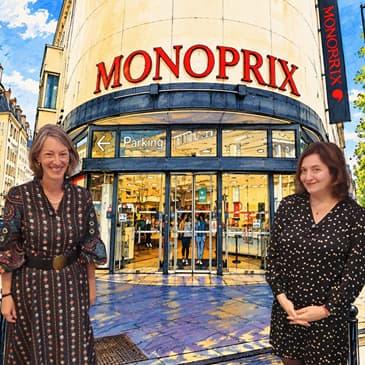
[00:00:45] Muriel Zagha I'm taking you in town to a shopping, well, a shop, a little store or a big store, but in town, crucially. Muriel Zagha Oh, I totally misunderstood. Muriel Zagha No, no, it's good because you've put your finger on it immediately, on the specificity of this store or shop, which is a French shop called Monoprix. Muriel Zagha So that's M-O-N-O-P-R-I-X. Muriel Zagha And the name means mono, one, a single one.
[00:01:15] Muriel Zagha Pri means price. Muriel Zagha So, Monoprice. Now, is that a brand you're familiar with at all? Muriel Zagha Well, I realise now that I'm just confused. Muriel Zagha Don't worry, I'm here. Muriel Zagha I will sort out any confusion. If I asked you to name some French supermarkets, could you think of any names? Muriel Zagha Leclerc Muriel Zagha Leclerc, very good. Muriel Zagha Anything else? Muriel Zagha It's the one called Auchan. Muriel Zagha Yes, very good. Auchan.
[00:01:47] Muriel Zagha That's good. Those are huge brands. Muriel Zagha Very good. But Monoprix doesn't ring a bell for you. I'm sensing that. Muriel Zagha Well, it rang a bell for me in a way that obviously was a false bell because I thought it was an out of town shopping centre. Muriel Zagha Oh, Carrefour. Muriel Zagha Carrefour Very good. Okay. So you do know some brand names and they are big famous French brand names. But Carrefour, Auchan, Leclerc,
[00:02:12] in French, you don't sound the C. They are all big hypermarkets, we would call them in French, Hypermarché. And they're massive out of town supermarkets where you can buy a television and a carrot. You know, you can buy everything you might possibly need. And usually they are massive hangars that contain everything. And in a way they're brilliant. You know, in a way they are a dream because everything's in there. And in another way you think, well, obviously a lot of shops have had
[00:02:41] to die for this to be born. So that's the whole other question. I'm not going to be talking about those out of town hypermarkets or massive supermarkets today. I'm going to be talking about Menoprix. Menoprix is essentially implanted in city centers in France. So there are lots of Menoprix in Paris, but also in Lyon, Bordeaux, Marseille, everywhere. Menoprix is present in more
[00:03:06] than 85% of French cities of more than 50,000 inhabitants. So towns and cities. And they are usually in the town center. So in what we would call the high street in Britain. So they're quite different in that sense from all these other brands that you know, which you drive to essentially. Menoprix is somewhere you walk to. You can drive to it if you drive in your town, but it's designed more
[00:03:34] as a sort of neighborhood shop, which is close to where you live or where you work. I grew up with that brand very much so because I grew up in Paris and in Paris, there are lots of Menoprix. And I'm particularly familiar with the one which is still in existence, which is down the road from where my parents live and where I grew up most of my childhood and young adulthood. And it's a medium sized little
[00:03:59] store. I'm going to tell you as much as possible about the history of the brand, who invented it and what it's like and how it feels to a French person to go to Menoprix. But before I get into that, I'm going to say one thing, which is that I've lived here in Britain for a while now in for about 30 years. And I've become aware of one thing, which is what I would call how class conscious the
[00:04:23] British are about everything. Everything has a kind of class inflection, it seems to me. And in a sort of blithe French way, I used to think, so for example, supermarkets, and you can tell me what you think. But I get the impression that, you know, there's vast difference between how you perceive yourself as a person if you're a Waitrose shopper, as opposed to if you're a Tesco shopper or a Asda shopper. And the ads for these different brands tell you this, that they're
[00:04:53] tapping into different demographics. Is that right? Yes. Although it all then gets inverted as well, doesn't it? So when it becomes clear that Waitrose do really, really bad fruit and vegetables and Tesco's are much better. Everybody departs to Tesco's and uses their club card, which is just so handy. There's layers upon layers of what's actually... It's more complicated. And there's inverted snobbery in some ways, you know, a lot of
[00:05:21] people with a lot of money would shop at Aldi's or Lidl because you get some nice continental meats, and they're not expensive, and olive oil is cheaper, and it's all that kind of stuff. But it seemed to me, and I used to think, oh, in France, it's not like that, you know, everybody shops in the same shops, and everybody shops in all the shops is what I used to think. And there's no very separate identity to the consumers of this particular brand.
[00:05:48] And that, I think I've come to realize looking into Monoprix is not true. Monoprix is a very visible brand. It's a red neon sign. So you're walking down the street in almost any French town or city, and you will see the letters Monoprix beaming at you in a reassuring beacon-like sort of way so that you know that you can go to that store and get some food or maybe some new slippers or some face cream or whatever you might need. But in practice,
[00:06:18] 87% of French people never shop at Monoprix. Partly because they don't live in towns or cities, they live in very urban areas or in the countryside. And partly because Monoprix is very expensive. And in that sense, it's a little bit like Waitrose. You know, it's comparable. It's about 20% more expensive than other supermarkets. So that's a lot. Can I ask for the uninformed? Yeah. What does it sell?
[00:06:47] So when I say it's a supermarket, it is in that it will always have a food hall. It sells foods of all kinds. But it will also usually have a clothing department for men, women and children, and also some homewares. So bed linen, table linen, kitchenware, crockery, and also things like
[00:07:13] cushions and lamps and rugs and things like that. And it started that way. Just to give you a little bit of context of how it began, bear in mind that idea that actually Monoprix, although it's a reference that everyone will understand. So in pop songs, for example, you know, there'll be a reference to Monoprix and all French people know what Monoprix is. But in practice, over 80%,
[00:07:38] 87%, so almost 90% of French people never shop at Monoprix because there isn't one where they live and or because there is one, but it's too expensive. And so they wouldn't dream of shopping there. I hadn't realized that it is actually a sort of special kind of shop. I thought it was a normal shop, but it's not. It's a shop that tells you a particular story. One of the things though I'd like you to explain to me before we get any further is when you said
[00:08:05] Monoprix, you said that meant one price. But that sounds to me like Poundland, where everything costs a pound. But it can't be if it's a supermarket, everything can't cost the same price. It can't. And especially if you have clothing as well and so on. The way it started, and it was launched in 1932, Monoprix. It was launched in Rouen, which is the capital of Normandy and a very
[00:08:34] fine city, not in Paris, in Rouen to begin with. The context for this, and I will explain about the one single price and the Poundland element of it. You're edging towards something really important. So it's the 1930s. What that means is it's basically the depression and the French are really feeling the pinch. So people are very budget conscious in the 1930s in France, and they're looking
[00:08:59] for affordable necessities of life. The other context is that as in Britain, we create all these amazing department stores like Selfridges, you know, the equivalent of that in France. In 1865, the Printemps department store, which means springtime opens. 1867, the Nouvelle Galerie,
[00:09:22] the new galleries. And then in 1895, the Galerie Lafayette, named after Lafayette brilliantly. The Printemps and the Galerie Lafayette are still thriving, and they're still trading side by side on the Boulevard Comartin, on the right bank in Paris. So there are these quite expensive luxury emporia, which are the department stores. But when we get to the 1930s, because of the economy
[00:09:51] having suffered so drastically, people are thinking about shopping in a far more thrifty way. And so there is a man, as ever, there's a person called Max Heilbronn, or Heilbronn, German sounding name. He is an engineer by training this man. He trained at one of the grandes écoles, which is called Centrale, which is an engineering school, which is very prestigious.
[00:10:17] So he's an engineer by training. And then he marries a young woman who is the daughter of the owner of Galerie Lafayette. And through marriage, he becomes interested in that side of French business life. And he says to his father-in-law, you know, you have the Galerie Lafayette, this is great. But at the moment, what you're looking for is something more like a five and 10 cent store type American
[00:10:44] store, like Woolworths in America, covers all the basic necessities of life. There's a general store in a way. There isn't a whole lot of choice for each kind of article, but every article is priced very reasonably. And he says, Max says to his father-in-law, we should do something like that in France. So his father-in-law, who is called brilliantly Théophile Bader. So Max Heilbronn marries Paulette
[00:11:11] Bader, who is the daughter of Théophile Bader. And Max and Théophile are talking about the possibility of creating a new kind of French store, modeled on American models, run British models. But you can probably tell me something about Woolworths and other stores in Britain, where the budget conscious French housewife of the 30s can go and get everything she needs for the household, for her
[00:11:34] family to feed her family without going over budget. And everything will be monoprix. Everything will be one or two. I mean, not everything is the same price. But, you know, all the tinned goods are going to be the same price. All the dried goods are going to be the same price. If you're buying napkins, they're all going to be the same price. You know, it's that kind of thinking that instead of having
[00:11:57] different ranges, each type of thing is priced very competitively and the same. So that's the 1930s concept. And in fact, when the store opens in 1932, it's not called the Monoprix yet. It's called Noma, N-O-M-A, which is short for Nouveau Magasin. So N-O is the first two letters of the word Nouveau, N-U, and then M-A, the first syllable of the word Magasin, Shop, N-O-M-A. So what you have is Noma,
[00:12:25] and I imagine it as a sort of Art Deco, very clean logo, you know, in 1932. And then I suppose he thinks about it and thinks, well, then Noma is very evocative. It doesn't really mean anything. Let's call it what it is, which is Monoprix, so that people know that they go into the store and everything will be cheap and they can find anything that they need and it will all be affordable, one or two kinds of prices that are super affordable. So that's a very novel concept. But you're right, it's not a million miles
[00:12:54] away from the pound store, from a discount store. It's not supposed to be discounted. It's just an affordable store, but it's a new model. And these kinds of shops are called in France at the time, Magasin Populaire. So for the people, there's something sort of semi-socialist about the idea that these are affordable shops for the people. So Monoprix is born of Galerie Lafayette,
[00:13:20] because of course, his brainchild, Max's brainchild is financed by his father-in-law. And the Galerie Lafayette launch this shop, Monoprix Noma, then Monoprix in Rouen, and then they start opening more and more in different cities. And meanwhile, other department stores do the same thing, because it's always the same story. The Nouvelle Galerie open a chain
[00:13:43] of stores called Uniprix, Uniprice. And Printemps launch some stores called Prisunique, Prisunique, P-R-I-S-U-N-I-C, which means price unique, but compressed into one word, Prisunique, which is often shortened to Prisu when the brand still existed, which it doesn't anymore. So they're not really very unique at all by that stage, because they've all called it.
[00:14:13] There's a contradiction there. They're all saying we're the only ones. So just to cut to the chase, because it's not the most interesting part of the story, really. Just to cut to the chase, eventually there was only one in that Monoprix eats the other two. Over the course of time, Monoprix acquires the Uniprix group in 1985. They swallowed up. And then they acquire Prisunique
[00:14:38] in 1997. And then there was one and Monoprix is truly mono. But by then, it's not just one price or two prices. It's become something quite different. By the time we get to the late 80s and 90s, it completely changed its strategy. In the early days, you've got this thrifty 1930s cost-conscious store with a thrifty housewife in mind as the archetypal customer.
[00:15:08] I'm going to tell you a little bit about the evolution of the store and of the brand. And one turning point is inevitably going to be the Second World War. And so I think we should perhaps take a break at this stage. Let's take a break in 1940. And when we come back, I'll tell you what's happening in 1940 with Monoprix. And we're back. They grow and grow. You know, in the 1930s, it's going really well. People love the Monoprix magasin populaire. They love it. The war comes in 1940.
[00:15:36] And at this point, they have 63 Monoprix stores. So it's grown quite a lot from the original single one in Rouen. And the war comes the debacle of 1940 and the German occupation of France. So they've got a lot to lose. They've got a lot to lose. And the collaborationist regime of Vichy introduces some anti-Jewish laws. And as it happens, both Théophile Bader, the father-in-law who owns Galerie Lafayette,
[00:16:05] and Max Herbron, the son-in-law who created the Monoprix brand, are Jewish. And so one of the things that happens then is what's called arianisation of all businesses, of everything in France. And that means removing all Jewish people from their jobs and giving their jobs to someone else who's not Jewish and also taking all their possessions from them. So this happens to Théophile and Max. And their reaction to that is to say,
[00:16:35] we're going to go underground and join the resistance immediately in 1940, which I think is really inspiring. Rather than, oh, well, let's just sit and wait and see what happens and maybe it'll be okay. They understand immediately that this is very, very bad indeed. And this is continuous with the De Gaulle movies we were talking about the other day. It's the clarity that there were people, it's not always easy at a time of crisis and confusion to understand what the right thing
[00:17:03] to do is. You know, we don't know what we would have done, but it's interesting to hear that actually there were people who immediately thought, we're just, we're not going to take this lying down. And so they joined the resistance. Haleborn brilliantly acquires some cool resistance nicknames. You know, they all had code names for each other, nicknames. And so because his name begins with an H, but it's also very distinctly Jewish, he has to jettison it. So he goes by
[00:17:29] Arel, H-A-R-R-E-L or Enquin, H-E-N-N-E-Q-R-U-N. So Arel, Enquin, those are his identities during the war. And he was quite, his activities were secret. So actually there isn't a lot of, I couldn't find a lot of records, but by all accounts, he was a big player. He was an engineer, remember? So he had a
[00:17:55] vision, for example, for large scale sabotage of the railways to really cripple the Germans. And he thought they should wait and coordinate with the allies. And you know, he was thinking in those terms. While he's planning all this, he was arrested in June, 1943 and deported to Buchenwald to a concentration camp. So that's very, very bad news. The nitty gritty of all this
[00:18:21] is fascinating. And again, I couldn't find a lot of information, but the impression I received is that he gets there somehow, as with non-concentration camp type camps, but prisoner of war camps, which were no picnic either, but you know, there were cells within those camps where resistance people helped each other out and protected each other. And sometimes it didn't work and sometimes it worked in his case, in the case of Arel N. Quint, as he was then known. It worked because somehow he
[00:18:51] survived. He was at Buchenwald for a while. He was transferred to various concentration camps. And I mean, the probability would have been that he would have died in one of those, but he didn't. And he managed wherever he was to make contact with other members of the underground resistance. And the long and short of it is that he survives and that he makes a triumphant return in 1945 to Monoprix and to Galerie Lafayette, where he takes over the direction of Galerie Lafayette from his
[00:19:20] father-in-law. And he... Who has also survived in France. Who has not survived, unfortunately. So that's very sad. But Max comes back and Max takes over the Galerie Lafayette and he remains CEO basically until 1971. He brings with him a young guy he met in the resistance who marries his daughter, Max's daughter, Ginette, and who takes over the running of the Monoprix
[00:19:47] franchise. I find it fascinating that you can be this entrepreneur person who then loses everything, becomes a pariah in a completely dystopian turn of events in his country, goes underground, becomes one of the big wigs of the resistance movement. And then at the end of the war, goes back to civilian life and starts running little stores again. It's really... It's so fascinating and it requires
[00:20:14] probably quite a lot of contortions. We've talked about this before, about what it must have been like for these men of action and women of action. Some women took enormous risks during the war to then... To have that adrenaline-fueled experience and then go back to civilian life and that it wasn't always very easy to readjust. Well, you either wanted more than anything else to go back to civilian life or you just couldn't ever go back to civilian life. No, because actually you thrived on the
[00:20:41] danger and the excitement of living this kind of marginalised secret life. In any case, he goes back and his son-in-law is also now working towards developing the Monoprix brand after the war. France enters a period of its economy, which is often referred to as les trente glorieuses, the 30 glorious years from the late 40s, you know, the reconstruction after the war and then the 50s,
[00:21:08] 60s, 70s, where there is tremendous expansion. And that is really the golden age of Monoprix because it remains an affordable store, but it grows. So more and more shops open and it becomes a very reliable affordable brand. The way to describe it, I grew up in the 70s and I remember my grandmother used to shop at Monoprix and I would go with her to buy certain things. She would go and buy new sheets or
[00:21:36] whatever it may be. And then I would also go to Monoprix with my mother, a different Monoprix, to buy food and she would buy me clothes from there. And then when I started shopping for myself as a teenager and I had a bit of money, I remember in the early 1980s, we used to go to Monoprix and buy in the children's department, little kilts for little girls, which we would wear as mini skirts.
[00:22:01] Super cool. So there was an element of coolness to Monoprix then. So three generations of French people at least will remember shopping at Monoprix and finding it, you know, as comfy a brand as John Lewis or Boots or Marks and Spencers, I think, in terms of... Yeah, you're making me think of Marks and Spencers at that stage. You really were, yeah.
[00:22:26] And, or CNA. Exactly. So those family stores really that are designed for, that are transmitted from generation to generation and you know it's a reliable brand. And as a comparison, I remember my very first lesson at school when I started learning English when I was in year seven, the first lesson, I may have said this before on the podcast, but it's worth repeating those
[00:22:52] things because they're important. The very first lesson mentioned Marks and Spencers. So that was one of the words I used, I learned as in my first lesson, it was a conversation between a mother and daughter. The daughter was called Margaret and she was 15 or something like that. And her mother said, Margaret, we're going to go to Marks and Spencers and buy you a new dress because Marks and Spencers is very reliable and the products are very good quality. And that's the Monoprix philosophy as well. That is how people would feel about Monoprix in the fifties,
[00:23:21] sixties, seventies. We can rely on the brand. It's very sad for Marks and Spencers, but that's, I know we're not talking about them, so I won't, but it is sad. No, but, but there are echoes, you know, those things are parent things. There's a kinship there. Interestingly then, all kinds of things happen, which also happen in Britain, which is self-service in the sort of food area happens. You know, in 1950, Monoprix introduces
[00:23:50] little trolleys so people can put their own shopping in a trolley and then pay at the till at the end. Supermarkets, as in larger supermarkets, develop in the 1950s, in the late 1950s in France. And then those out-of-town hypermarkets, so the first Carrefour, the first Auchan, they appear in the 1960s. And that begins to put pressure on the shops that are in cities and towns,
[00:24:17] and especially shops like butchers, bakers, ironmongers, haberdashers, those kinds of shops. They close in their droves because they can't compete with the big supermarkets, the big hypermarkets. There's been much less damage in France than there has in the UK, but you've still obviously had huge damage. So we lost probably 80% of those shops. But there is still some, it's interesting
[00:24:42] actually that we've, yeah, I don't know why we managed to retain more. Is it that people are more attached to them and simply wouldn't tolerate their disappearance? Are you, it's something to do, it must be with the terroir thing, so that you still consume locally, whereas we've lost it all to a massive distribution network. You've lost most of it to that, but not all. No, I think you're right. I think there's been a difference in terms of scale and the rapidity,
[00:25:11] perhaps, you know, at which, at the pace at which it's happened. We found a sort of compromise, I don't know if it's a happy compromise, but we found a compromise between developing the bigger hypermarkets and supermarkets and also retaining some of those traditional shops. So Monoprix is trying to decide while all this is happening, whether they should try and compete with these new bigger, cheaper supermarkets that can afford to be cheaper because they're bigger,
[00:25:40] or whether actually they need to cultivate a separate identity. And they decide to cultivate a separate identity, which is a risky strategy, actually, and an interestingly unorthodox one. It's so interesting, isn't it? I mean, I don't know anything about marketing, but you do sometimes read about that, about the outliers who say, well, actually, we're not going to do what everybody else is doing. We're going to try our own thing. And sometimes it doesn't pay off. It's a catastrophe,
[00:26:09] but sometimes it does pay off. So in the case of Monoprix, they decided to stay in the cities, in the town centers and cities. And of course, that is expensive because the ground rents are expensive. And in order to pay for that, to raise their prices and not just raise their prices gratuitously, although some people would say that's just too expensive and there's no justification, but to develop a sort of identity and atmosphere that justifies those prices
[00:26:37] by offering something a little bit different, a little bit more. I mean, posh is not actually the word because I don't know, you know, getting back to this class bound thing. I'd say to me, Waitrose, John Lewis, Marks and Spencers, they are middle class, middle England brands. And that's why they're so solid. Whereas Monoprix is more urban bourgeoisie and not just the bourgeoisie,
[00:27:07] but urban people who live in cities. So maybe retired people with a bit more disposable income. So no longer the thrifty housewife of the 30s, but younger people, younger couples who perhaps haven't got a family yet, who have more of a budget, upwardly mobile people, ABC1 people in urban centers, which is a very particular thing. There is this notion, it's a bit like the 15 minute
[00:27:33] cities or towns that we're talking about currently, you know, that we want to get back to that. But Monoprix is part of that experience of urban life. You walk to Monoprix, you do your shopping in a very French or Italian way, you do a bit of food shopping every day, or every other day, you don't do a big shop that involves driving out to a place. You have a cute little bag that you use for your shopping and
[00:27:59] a little basket like Jane Birkin, you know, and you do your shopping that way. And maybe you go to a market as well. So it combines with this kind of, it's very much, I mean, it's come to mean, Monoprix, a particular class of urban people, which, who we call the Bobo, B-O-B-O-S. Have you come across that denomination? No, I don't think. So Bobo means, again, it's a contraction of bourgeois bohemian. Oh. So they're hipster. So Sienna Miller.
[00:28:27] Hipster. Yeah. Yeah, exactly. So people who have money and are very middle class or upper middle, but who perceive themselves as quite sort of choosy, they have niche tastes, they travel a lot. They have all kinds of reference points for food, for example, where, you know, they've been to Vietnam and they've been to Korea, they've been to all these places. And so they know that, you know,
[00:28:52] kombucha is a thing. I mean, they knew that a long time before it became mainstream. It's that, it's that sort of thing. So Monoprix begins to change its offer by offering not just ordinary, ordinary products in the food halls, but also quite specific brands that you don't find anywhere else. So it becomes a little bit more like Selfridges food halls, or, you know, there is an
[00:29:17] element of that, or indeed John Lewis food halls, where you'll have some very expensive brands of pasta, Italian brands of pasta that you wouldn't find at Descos. But if you're a certain kind of consumer, you don't even notice the price difference, and you will love having something that nobody else has. And so weird mango-flavored vinegars or whatever it may be. So quite chichi. And it's all packaged in a nice way because it's all about buying it, isn't it?
[00:29:45] We get back to the pharmacy. Remember when we talked about the pharmacy, the Savant de Marseille and the pharmacy, the packaging is really important. It's really important for things to look beautiful. So even their own brand products, as they do have own brand products, Monoprix, are packaged extremely carefully and increasingly carefully. But there's a whole team, there's a really interesting little bit of documentary on YouTube about that, about the team who work on
[00:30:11] the packaging of their food and household items, their own brand. It's really colorful and pop. So it's colorful, but not naff. It has a kind of pop smartness about it, stripes, and often puns. Puns in the description of the product, which I know sounds naff, but is meant to create a feeling of
[00:30:39] connivance with the shopper who understands the joke and thinks it's a little bit of a bonus thing. So I'll give you some examples and they will make you cringe probably because you'll think they're very unfunny. The documentary I watched showed a team of maybe 10 people brainstorming, 10 Monoprix employees who only work on the packaging and the naming of the products and the puns. They have a pun team and they're brainstorming and trying to come up with things.
[00:31:07] It's like a writer's room working on an American sitcom. You know, they're bouncing ideas around and they are brainstorming what the wording is going to be on their own brand packaging of food and other things like tissues and toilet paper, whatever it may be, so that it will include a clever little pun. And they change all the time. That's the other thing is that it is renewed all the time. So it creates, it's very Instagrammable in that sense, because you go to Monoprix and you
[00:31:34] notice new little puns about things and you photograph them. So they've really understood how to capture certain kind of attention for funny, colourful, amusing things. So for example, a packet of brie, the cheese, it will be labelled as brie, B-R-I-E, the name of the cheese, Nobel, because in French, the Nobel prize is the prix Nobel.
[00:32:00] Oh, that is good, isn't it? Yeah. The Brie Nobel. That is really genius. The Brie Nobel. And then another one I liked. So this one, I don't know if they actually chose it, but it was one that they brainstormed in the meeting that I was watching. It's the packet of smoked salmon. And the smoked salmon is smoked with a beech wood. And beech in French is être, which is H-E circumflex T-R-E. But the H is
[00:32:30] not sounded. So it sounds like être, like the verb to be. So one guy says, well, we could have être ou ne pas être, which is like to be or not. So Shakespearean, everything. So this is what I mean. It's, you're trying to establish a sort of complicity with the consumer and also make the
[00:32:54] consumer feel quite clever for getting the joke. And this culminates in an amazing ad that they released, Monoprix released fairly recently in the 2010s, which was, so you know how people look forward to the Christmas ads, like the John Lewis ad is usually eagerly looked forward to. Not by me, but by other people, maybe. Not by you, but by a lot of people, because you know that they're going to try and do something a
[00:33:21] bit different or a bit eye-catching. So there is a Monoprix ad, which is not a Christmas ad, particularly. It was just, I think, a way of drawing attention to this witty packaging that they do of their own brand product. It's an ad that lasts four minutes. So that's very, very long. It's like a short film. And I will tell you the story of what happens in the ad, but I think we should take an ad break, appropriately enough, at this stage. And I'll
[00:33:48] come back and tell you all about the Monoprix ad afterwards. So we're back and I've imagined the advert already. If I tell you that it's very French, unsurprisingly, then what are you going to imagine that it's about, so it's not sexy. We do a lot of sexy ads, but in this case, it's not sexy. It's romantic, which is also very French. And so...
[00:34:15] Are they wearing polo necks and smoking galois in submarines? No, I know they missed something there, especially with the être ou ne pas être smoked salmon, which should be consumed by Cousteau on a submarine. No. So this starts with a little boy who is maybe nine years old or something. And he's at school and he has a crush on the little girl in his class
[00:34:37] and he doesn't know how to approach her. And so what he starts to do is he cuts out words. It's very cool. So she has a little locker. They all have a little locker and he slips little messages, which are strips from Monoprix packaging into her locker. And so they say things like,
[00:35:06] tu me fais craquer, you know, I'm crazy about you, which is part of the packaging for crackers. And so she finds all these anonymous messages and it's great, you know, but she doesn't know who's sending them. And then he's gradually plucking up the courage to talk to her by giving her message directly in the playground. And on the day where he's decided to do that, so you follow him, you know, over the course of time, lots and lots of little messages. And you can see that she really
[00:35:33] loves these messages and she really looks forward to them. He turns up at school, he's ready. He's going to talk to her. This is going to happen. She's left. She's left the school and he goes to her house and they've moved away. The house is being sold. So this is terrible, but we're only three quarters of the way into the ad. So then we fast forward to literally 10 or 15 years later,
[00:35:57] he's a young guy, he's 25 and he's going to his place of work where they have lockers. And as he's opening his locker, he notices that there's a new female colleague opening her own locker and it's her. It's the girl. So what does he do? Instead of just talking to her, he goes home and he does. He shuts up the thing and starts putting more messages. This last four minutes, he's putting more messages in her locker. And you can see that
[00:36:27] she's responding to this. She understands what this is. And then one day he's standing there again, plucking up the carriage to talk to her. She opens her locker, a box falls out of the locker. It contains all the messages he had sent her when they were children and they spill out on the floor. She's kept them all and she takes them quite weirdly to work with her. That is really weird.
[00:36:52] But no matter, we're just going to suspend disbelief and say, yes, of course, she can never be parted from the shoebox full of these colorful bits of monoprix packaging. Everything spills to the floor. And then he approaches her and gives her one final punning thing about milk, which essentially says, I'm not going to go into detail, but it says, isn't life funny? You know, but there's a pun with the
[00:37:16] word milk. She looks at it. They recognize each other. It's fabulous. So that sounds rather mawkish, but it's done really well. And because the French have no sense of irony about love stories, it was a fantastically successful ad and everyone loved it. So this is what Monoprix has made itself into is a place where you used to go with your grandmother, with your mother, you go,
[00:37:43] you take your children, you know. And so not only do they sell food that is more expensive than everywhere else and often more recherche. They also do homewares and clothing. And again, I mean, the clothing is, it's fast fashion. Let's not kid ourselves. So it's very like H&M. They always have new collections and they do a lot of collaborations with designers, but the clothes are really quite attractive. They're cheap-ish, you know, they're affordable, but the colors are going to be really
[00:38:11] nice. And especially the children's wear is lovely and comparable to much more expensive brands of children's wear. So that's another way that they get you. I've got a question about modern selling. And this, again, this was something Marks and Spencer's really struggled with, was moving from the high street into the online world. Oh, yeah. Because famously, M&S was rubbish at selling online and they kept saying, no, well, we're just going to be a shop. And then everyone said, but, you know.
[00:38:41] Yeah, of course. It's cost too much to park in town. So we'd rather you just deliver it to us at the weekend, please. And I assume Monoprix has that problem. So they have been surprisingly flexible about that stuff. Pretty early on, they understood that they needed to have a website where people could order things and have them delivered. And they also offer, so that people will continue to come into the store, things like you do your
[00:39:06] shopping with your trolley, you get to the cash till, you leave your trolley, and they will deliver within the hour to your house. What? On foot. What? So they offer on foot because, again, remember, it's their central urban stores. But why can't you take, that's weird. You buy it and leave it behind. If you have a big trolley full of stuff and you think, oh, I've got lots of, think of mineral water, for example. You know, French people will always buy ridiculous amounts of mineral water and wine.
[00:39:35] It's heavy. Then you leave it there and you pay and you can pay with contactless and your phone or whatever, you know, so it's kind of frictionless. You just walk out and then you go home and within an hour, a person will come with your shopping and bring it to you. So they offer, I should say, they've got into a little bit of trouble here and there with their employees because there's been,
[00:39:59] there have been a couple of, you know, exploitation. So that all appears to be okay now. But, you know, those things always come at a price and the people who pay the price are the people who work in the warehouse and have to do the delivery on foot and that. So I'm not going to gloss over that. That is definitely true. The other thing I wanted to tell you about quickly, because we're heading towards the end, is they've also brilliantly diversified their offer by keeping the monoprix stores
[00:40:28] that sell all the things that they sell and also opening smaller stores still in the cities and in railway stations and places like that, which are just food stores or just beauty stores, very French, just beauty. And these are not called the monoprix, they're called the monop, short. And they, this is what my mother used to, and then she obviously wasn't alone. I thought it was a family nickname, but she used to refer to monoprix as monop in the 1970s. And clearly this was a thing that some
[00:40:58] marketing executive picked up on and said, you know, for those smaller stores, why don't we do the compressed, the affectionate nickname? You know, like you'd say, I don't know, Sainsbury's for Sainsbury's or something. You know, there are these, these nicknames. I don't know if we would actually, but I remember years ago, there was a fashion column in The Guardian by a journalist called Annalisa Barbieri. And she used to call John Lewis, Johnny Lulu's, which I thought was great. She loved John Lewis. She always sent people to John Lewis.
[00:41:26] They do that. And then even more daring, really, and expressive of a sense of confidence in the brand, whereas the logo of monoprix used to be the letter M, the initial M in a lozenge, they changed that to an apostrophe, a red apostrophe, because their color is red, a red apostrophe on its own, because it's the apostrophe at the end of monop. You've shortened the word, you've dropped a syllable. So you show that by having an apostrophe at the end.
[00:41:56] They lift the apostrophe out and make that the logo. So it's almost like, it's like Prince with the squiggle, you know, where he, yeah, quite daring. I mean, again, a lot, I think a lot of marketing people would have gone, ooh, careful, you want to retain the brand name because otherwise people won't know. So you'll be walking down the street and you'll see a sign that just has an apostrophe on it. And that's monoprix. And you know instantly that it's monoprix because it's a lovely red pop apostrophe that is very expressive of the kind of poppiness and optimism of the brand.
[00:42:27] Bit like that. You're showing me Vodafone. Is that Vodafone? Yeah. They have a, something that, that looks like a, an apostrophe. Is it supposed to be a speech bubble? What is it in the case of Vodafone? Well, it's just, yeah. Oh yes, it's the other way up, isn't it? Sorry. No, but you know, and so, and so, and so, and so, and so, and so, and so, and so, and so, and so Manoprix is suffering, has suffered from COVID, from the crisis of the high street. It's not as
[00:42:56] though they're immune to it, but I think because they have a very specific offer and they stick to their guns, they are, okay, so they've closed some stores, but they've opened new ones as well. There's a sense that for once, it's not a story of decline. I'm telling you, because I've told you lots of stories of decline. It's not a story of decline. It's a story of interesting adaptation
[00:43:18] of a brand where they have been quite good at taking risks and adapting and it appears to be paying off because the brand is still very familiar. People feel comfortable with the brand. They like it, but it's worth remembering that it's a brand that is most meaningful to urban people in France and that vast majority of French people never, ever go in the store. And yet it has this aura. And if you're a
[00:43:47] tourist, and that's why I think it's relevant to a lot of our listeners, if you're a tourist and you go to France or you have a place in France, you go to France on holiday often, you will probably come across Carrefour, Auchan, all these big hypermarkets, but also say you go to Paris or Marseille or Lyon or Bordeaux, one of those cities, even smaller cities, Rouen indeed, you will go to Monoprix and Monoprix
[00:44:11] often crops up, you know, on Instagram when people say, oh, do you want to buy some cheap but very cool French gifts for your friends to take home? Americans love those. You go to a pharmacy, you go to Monoprix and you get some beautifully packaged things. So we're back to the packaging. You get some lovely sardines in really fun packaging with a pun in the name of the sardine, you know, so they're part of
[00:44:34] that aspect of quite aestheticized, privileged Frenchness, but it's all part of the mix. And most people, as is the case in Britain, most people will buy some things from Marks and Spencer's and other things from Tesco and other things yet from Lidl. And I think that is also how the French operate. So there you are. There's a place for Monoprix. I think this is fascinating because as you've been
[00:45:01] talking, I can't think of a direct British equivalent. So that was going to be my final question to you is what do you think would be a British equivalent of Monoprix? Well, I can't think. No, and I don't think there is one. I think there's a Venn diagram you could draw where there would be a bit of Marks and Spencer's, a bit of John Lewis, a bit of Habitat and the
[00:45:24] Conran shop even in terms of the... They went bust, didn't they? I don't know. Yeah. So in a way, that is the not them bit of it that I think, well, they've all really struggled. Whereas somehow Monoprix has managed to retain all the good bits of those stores, those individual stores into one thing. So well done them, because that is a bit of a miracle. Le miracle français.
[00:45:52] It does make me want to go because it sounds like a sort of, I mean, apart from the fact that it's massively overpriced and everyone's paying for slogans on packaging. I've been careful to flag that up. I think I'm being honest with our listeners, but at the same time, I would say it's worth a look if you've never been to a Monoprix. The next time you go to France and there is a Monoprix. And of course, some are nicer than others. It's like anything else. But if you find a nice big one that has all the ranges, it's worth a look because there will be
[00:46:19] some nice fun things that you might want to take home. And it's a very particular aspect of French retail. So there we are, Suzanne. Monoprix. Thank you, Muriel. That's brilliant because you've, you've provided multiple services and one of them, which you don't always provide, because sometimes your subjects are things that you get arrested for doing. But in this instance, we could all go to Paris and buy all our Christmas presents and come back in time. Absolutely. Yes. Wonderful.
[00:46:47] So that's really practical. I'm trying to be more practical. Which we love. And less dreamy. Okay. Well, happy shopping or non-shopping, happy thrifty shopping or extravagant shopping to our listeners. And do keep in touch with us. We'd love to hear from you. As I mentioned before, we're getting some pretty hilarious emails from some listeners, which I will, I will relay to other listeners later on because they're just very funny. It's funny,
[00:47:17] the things that you get engagement with. And do follow us on the socials, do subscribe to the podcast. And I look forward to seeing you again, Suzanne, next time for something completely different. Au revoir, Muriel. Au revoir, Suzanne. Au revoir, Suzanne. Au revoir, Suzanne.