Hosted on Acast. See acast.com/privacy for more information.
[00:00:22] Hello, this is Garlic & Pearls with me Muriel Zagha, the Frenchie and my British co-host Suzanne Raine. In this podcast we explore all aspects of difference between the Britishness of the British and the Frenchness of the French and we give plenty of diverse examples of this, we take turns. Today it's a British-led episode presented by Suzanne, so you're going to tell me Suzanne about a really telling aspect of British culture. What is it?
[00:00:52] I've often worried that I'm not bringing enough British culture to you, so today Muriel, I present you with Dystopia. Oh, that is exciting. I love Dystopia. I mean, I fear it, but I love it. So today we're going to travel to Dystopia, but not the one we're living in now. Although…
[00:01:19] I was going to say travel to Dystopia, but surely… Or is it? We're already there. We're always in it. You mean the British tradition, the British literary tradition? The literary tradition. So British artists, and it was actually, I'm cheating a bit, because it was you who suggested to me that this is a literary tradition that we…
[00:01:40] …I just assumed that all countries in the world have a whole load of writers who are writing dystopian fiction, but it turns out that we do it particularly in Britain. Yeah. Then there are sub-genres, kind of Scottish dystopian fiction, for example. So I thought we could explore that a little bit. And I've got two props, actually, here, which I'm going to wave at you. So I see Brave New World by Aldous Huxley. And…
[00:02:10] This one is less well-known. And something more obscure, which I confess I'd never heard of, which is called The Death of Grass by… John Christopher. Well, that's his pen name. So that's new to me.
[00:02:24] These are just some dystopian fiction that I had lying around, but I realise now that I've got quite a lot of it, and not because I'm a collector of dystopian fiction, but because it is a part of our national oeuvre, I suppose.
[00:02:41] So it is just, you know, this is a Penguin classic. This actually weirdly and dystopianly Brave New World I bought in the former East Germany just after the wall had come down. It's actually got a little… it has. Look, it says Deutschmark 11 on the back. So it cost me 11 Deutschmarks, Brave New World. Oh, that's so interesting. Gosh.
[00:03:05] Which is… I mean, you know, I imagine them all reading it somewhere in the East, perhaps illegally. Yes. I mean, genuinely. Yes. Actually, interestingly. Yeah, genuinely. It's amazing, isn't it? Yeah. So that's where that's been. That's my copy of Brave New World. So I'm waving those at you and we're going to come on to talk about those and some other books. But firstly, my Grand Designs Kevin MacLeod introductory thing where I explain why, why.
[00:03:36] Why or why. Why or why. Why or why. Why or why.
[00:04:05] Why. Why. Why. Why. Why. Why. Why. Why. Why. Why. Why.
[00:04:39] Why. Why. Why. Why. What. I think, to change and progress. Yeah, very good. And I think the French response to change is a little bit more instinctively revolutionary, chop their heads off. And ours is like,
[00:05:08] oh, change. What's it going to do to us? Maybe it's all going to go wrong in some way. And that's the artistic expression comes out in these novels. So, you know, and by change, I suppose we can talk about, you know, since the Victorian times, increased population, lots of wars, increased education,
[00:05:30] which created questions about how a society was to be governed. What if people got unruly, for example, the more power that you've given them, the more education you give them, the more trouble they cause. So it is genuinely, I think, held that the dystopian novel is one of the most significant sub-genres of the British novel to emerge in the 20th century, particularly,
[00:05:59] but actually also some of the seminal works. Some of the works which then shaped the other ones that came in the 20th century are actually Victorian. And there is an overlap with science fiction. How would you define the difference? You are a literary critic, so you could, I'm going to, this is, I'm going to lean on you for some definitions of the difference between those two.
[00:06:23] Okay. I think science fiction is to do with, so I'm thinking immediately of Jules Verne, although, you know, he's not British, but, you know, he's our sort of equivalent of H.G. Wells, maybe. So somebody who was genuinely very interested in science, Jules Verne, and in the developments of science in his own time, and who liked to imagine how life would be
[00:06:52] in the future if those developments continued apace and how people's lives would be affected. And I suppose then in the 20th century, it becomes about space. It becomes about space, doesn't it? It becomes about other planets and exploring space and then imagining other worlds. And you get into a sort of Star Wars, Dune universe where you imagine these worlds. And dystopia to me that's specifically to do
[00:07:20] with society being disfigured. It's not about progress. It's about things going badly wrong. And it's about looking at the society where you live and imagining how much worse it could get, sometimes because of progress, you're right, or great changes that seem unwelcome or dangerous.
[00:07:46] Dystopia is the opposite of a utopia. Utopia being a sort of ideal paradise of a society, just to be very sketchy. And then a dystopia is a hellish version of society. And sometimes it does resemble the society we're in. But it's perhaps less interesting, although there are technological elements sometimes in dystopia, I think, or about technology breaking down often. It's not as
[00:08:14] interested in science, as science fiction, which is more dreamy, and maybe more optimistic by and loud. Is that right? That's right. You're perfect. It's perfect. I think science fiction foregrounds the science, whereas dystopia has science fiction-y elements, but it foregrounds the societal effects. The definition that I'm using comes from Aldous Huxley, author of Brave New World. Fab. Yeah, great source.
[00:08:41] Yeah. It's from the horse's mouth, really. But he said, and he was reflecting, actually, how one of the things that he failed to anticipate in Brave New World as a scientific invention... So he wrote Brave New World in 1932. And it was only 13 years later that the first atom bomb was dropped. But Brave New World isn't about atom bombs. And he wrote in his foreword, about which I will
[00:09:06] speak more in a little while, he wondered to himself why he hadn't put any nuclear stuff in Brave New World. And he realized it was because he's not writing about technology per se. He's writing about what it does to human beings. So he said, the theme of Brave New World is not the advancement of science as such.
[00:09:29] It is the advancement of science as it affects human individuals. The triumphs of physics, chemistry, and engineering are tacitly taken for granted. The only scientific advances to be specifically described are those involving the application to human beings. The sciences of matter can be applied in such a way that they will destroy life or make the living of it impossibly complex and uncomfortable.
[00:09:57] The people who govern the Brave New World may not be sane, but they are not mad men. And their aim is not anarchy, but social stability. So he's basically saying, you know, yes, there's a whole load of stuff in Brave New World, which is about inventions and looking 600 years into the future, which is when it's set. But actually, I'm looking at what it's doing to us as a society. And so this is why I think it is
[00:10:26] totally legitimate to say this has evolved from a set of circumstances in Britain that you had also in France, but you responded to them differently. And Jules Verne is the crossover guy. So he is often the French person who's cited in the sort of the long de brettes list of dystopian writers as being somebody, but he was more technical, wasn't he? He was inventing submarines and things all the time. Oh, he loved technical stuff.
[00:10:56] But one of the themes that seems to come up quite frequently in British dystopian fiction, and I would reflect that it couldn't come up in French, which is maybe why, or maybe again, maybe it's a conversation between the two, is they often take place in a totalitarian state when order has broken down and the monarchy has been removed. And in some cases, the monarchy and the aristocracy aren't there anymore. And that is the precursor for the societal breakdown.
[00:11:26] And that's a bad thing. Oh, I see. Yeah. So I wonder. It's a common theme. It's a breakdown of law and order requires there not to be a king or queen anymore. Yeah. Or the aristocracy to guide us. Yes, that's very interesting. Whereas, of course, we actually achieved that in our reality in France. Yes. And it's been dystopian over there ever since.
[00:11:53] Yes. Why should we write about it when we have created it in real life? We can all enjoy it every day. I am now wondering, because one of the people who comes up really early on is Mary Shelley. And obviously, 1818, Frankenstein was produced. Mary Shelley's warning, the modern Prometheus.
[00:12:20] And again, that immediately comes after Waterloo. So there is chaos on the continent, political upheaval everywhere. And Frankenstein, you know, already he's a warning against actually just chaos, but also the expansion of science without a moral context. So we're already having sort of anti-industrial
[00:12:46] revolution stuff going on, really. I'm at risk here saying this sort of stuff that someone's going to say, no, no, no, that's not what it is at all. But no, I think that makes sense. Makes sense to me. Yeah. And also in the pre-Victorian era, suggesting that a scientist can take on God by creating human life. Of course, that's all very shocking. And I mean, that's what artists are there to do. That's Damien Hirst, but in 1818, I suppose. So anyway, and then, you know, Jules Verne,
[00:13:16] H.G. Wells, you're exactly right. And I think H.G. Wells, really interesting for me was War of the Worlds, which was the alien invasion. And what I read it very recently, actually, and what I think is utterly brilliant about it is the way that it is set in southwest London.
[00:13:42] In a really, I love those books that if you, they made me reach for the map. I'm almost the old A to Z because it's southwest London before the M25 got built. So it's very recognisably areas around Woking, the object that they first think is a meteor that then turns out to be the aliens. It lands on Horsall Common, which is near where the narrator lives. And then, you know,
[00:14:07] the Martians emerge. They initially struggle with the Earth's gravity, but then they come out with their tripods and then they go around and destroy most of Woking. And so you have this brilliant, but I think that's why dystopia, that's why British dystopia works so well. And you can come all the way from that to 28 days later. Yes. And so it's that image of London or its suburbs in flames,
[00:14:35] aliens walking around, people turning on each other in different ways. And there's a wonderful bit on Putney Hill. He encounters an artillery man who's planning tactics for how humans can continue fighting the Martians after they control the world, you know, on Putney Hill. So we can all visualize that from the buses. And, you know, he goes back to Woking, finds his wife. There's a whole load of stuff that's been
[00:15:01] written about invasion literature at this time, which was the height of imperialism, colonialism, sort of Victorian era of also of sort of superstitions. And it was all just starting to unravel in different ways. So I think something really original that H.G. Wells was doing, actually, using alien invasions as all sorts of
[00:15:29] metaphors, I suppose. In 1933, H.G. Wells explained his approach where he said, my early and profound and lifelong admiration for Jonathan Swift is particularly evident in a predisposition to make the stories reflect upon contemporary political and social discussions, adding, the war of the worlds, like Time Machine, was another assault on human self-satisfaction,
[00:15:59] being both consciously grim under the influence of Swift's tradition. Hmm. It is social and political commentary in a way, isn't it? Yeah. Yeah. Which we should value for what it is. So one of the amazing things about dystopian novels is how interpretable they are. Yes. So they are stories in their own right, but we read them and take away from them
[00:16:28] how they map across to the society that we're in today. So you won't have read because it's a lesser known book. But Mary Shelley wrote not only Frankenstein, but in 1826, so eight years later, she wrote a novel called The Last Man, which was set in Europe in the late 21st century, ravaged by the rise of a bubonic plague pandemic that resulted in obviously the near extinction of humanity.
[00:16:56] And she basically weaves in her husband and Lord Byron into the whole thing in a way that they drown at sea because they actually did. And so you have, again, you have loaded boats with refugees sinking. You also have the utopian Adrian Earl of Windsor, son of the last king of England,
[00:17:22] who leads his followers in search of a natural paradise and dies when his boat sinks in a storm. That's the British terror of losing our king, I think is so. And then various aristocracies. So she goes all, you know, Percy Shelley and Byron, they're the aristocracy represented by Lord Raymond, who leaves England to fight for the Greeks and dies in
[00:17:51] Constantinople. And she expresses, she calls it the loss of her community of the elect. Oh, the British state becomes a republic. It's a disaster. It's dystopian. Of course. A republic, you say. Terrible thing. So at the time, really, really unsuccessful. Then it got discovered in the 1960s.
[00:18:15] And now the idea that you have 21st century Brits with a pandemic, freak weather events, this daily arrival of vessels from the East crowded with immigrants, you know, it's interpretable, I suppose. So Muriel, we're going to take a little tiny break, which is going to be for everyone's edification. And we're going to return with a deep dive into the brave new world. Are you ready for that?
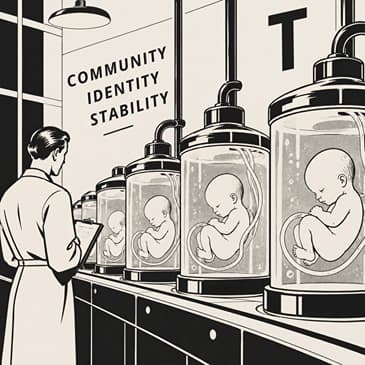
[00:18:44] I am full of suspense. See you soon. So Muriel, we're back. Are you ready for the world state? Yes. Full of genetically engineered, psychologically conditioned, people pacified by constant consumption of a pleasurable drug called Soma. I've never been readier. Are you ready for community identity stability?
[00:19:14] Yes, it sounds great. Great program. Where do I sign? Because that is the motto of the world state. They are the vision and purpose, the values of the world state. And I have to say, this is, Brave New World is being held as held up as being one of the most prophetic of the dystopian novels. And it really begins introducing us to the world state and its
[00:19:43] core values of community identity and stability. And I can't help but think that every corporation Sounds familiar. Sounds very familiar. Anyone who's been on a management away day will actually have said those words and may also have them in a shield logo, which is what they've got. But also people say that it's prophetic because of the number of things that it foresees as plot devices. So in particular,
[00:20:12] test tube babies in this Brave New World, human beings aren't born. They are essentially created in massive demijohns in a 34 story high building skyscraper. Also, I mean, the skyscrapers already existed, but in this world, London, it's very, very much like War of the Worlds rooted in London, but it's a London of skyscrapers, which at that time, it wasn't. They have private jets,
[00:20:41] they have helicopters that take them from A to B all the time. So many of the cultural features that he was imagining in 1932 really came into existence. And the one that really strikes you as you read it is the dominance of the mass media. So, and the idea he's talking about enslavement through pleasure.
[00:21:09] That's the kind of central motif of the book. And at the time, it feels innovative. What he said, or I think what others have said subsequently is that that is actually a more threatening prospect than the kind of brutal oppression in 1984, the sort of Orwellian dystopia, which is totalitarianism. Whereas this one is people doing it to themselves through
[00:21:36] brainwashing and addiction to pleasure. So the desire for happiness at all costs, which starts really to, when you read it, you think, oh. Yes. Oh, indeed. I mean, I just, as a little aside, I was reading an article about young people, you know, young people, I suppose about the way in which in the West, in France is the same problem,
[00:22:01] and in Britain as well. A lot of young people live these completely atomized lives where they are really chained to their phone and are looking into the screen of their phone as in a mirror, but are not really interacting with others where they have their meals delivered. They order their meals online, their meals come to their house. There's something very regressive about that, like regressing to the womb almost, you know, you're being fed in your home. You don't have to
[00:22:29] prepare food for yourself. And you're streaming things, watching things on demand the whole time. There's endless supplies of entertainment. We often say this, actually, you and I, when we talk about watching things on television or catching up with stuff, there's too much stuff. There's too much to watch. So you're never going to be bored in the old-fashioned sense of the word, because you're always going to be able to entertain yourself with something on screen. And you anesthetize yourself in that way,
[00:22:56] with takeaways and entertainment on demand. So it's all come to pass. And it stifles creativity. So one of the characters, Helmholtz Watson, who writes brainwashing slogans, basically, and he longs to find a more creative way of expressing himself through his writing, but he doesn't know how to, because of course that's an original thought that he's having. And they've all been bred not to have original thoughts. So that's why he's
[00:23:24] struggling so much with it all. And you can see how actually we're all being deprived of our ability to have original thoughts because we're spending all our time on Instagram. So anyway, the point is, you don't need me to draw the parallels. You can draw them yourselves when you read it. But Huxley's great insight was to see that a world of enjoyment is a stronger threat to human freedom because we're doing it to ourselves. And so you don't have the resistance in the same way that you
[00:23:54] would do if you were being oppressed, I think. He argues that ultimate totalitarian control is achieved not through fear and violence, but by engineering a population that loves its servitude, that's brainwashed into it. And then you have these wonderful lines in it. So one of the characters is Lenina, Lenina Crowne. A number of them have names that are suspiciously Soviet,
[00:24:23] but Lenina Crown is having a relationship with Henry Foster. And he says, everybody's happy now. And she says, yes, everybody's happy now. And that's because they'd heard the words repeated 150 times every night for 12 years through hypnopedia, which is how they're all educated. So they're all in their demijohns. And then when they're children, they're being played this stuff that Helmholtz is
[00:24:49] creating. That's how they think. It's very clever. There are some other themes that I'm going to pull out because they're so interesting and not unique to this book, I think unique to British dystopian writing. The first is about consumption. So there is something about, you know, gluttonous behavior. Again, it goes back, goes right back to the industrial revolution. Some of the phrases,
[00:25:17] the hypnopedia phrases that they're repeating in Brave New World are ending is better than mending. Because in order to have constant economic growth, people need to be encouraged to throw things away rather than fix them. And we were talking only earlier, weren't we, about how our producer, Matthew, fixes things, fixes your coughing machine, whereas you would have just bought a new one. Absolutely. But he knows how to take things apart and fix them. And that also takes us back to our
[00:25:46] episode about wheelie bins and our disposable society where we put bits of plastic in bigger bits of plastic. And then we replace things instead of finding more durable ways of consuming things. Yeah. So the dystopian fear in Brave New World is under consumption. So the more stitches, the less riches. That's what they get told. Because if you mend your clothes, you're not buying new ones.
[00:26:13] Again, I'm not going to comment. The other thing that they do on the same lines is they are against simple games, simple ball sports, for example, because that just needs a ball and you use that until you use it, which in my case is frequently, but some people can manage not to lose them. But you have a dog. That's why.
[00:26:36] Now they've got, for example, they play Raymond's Surface Tennis. They're driving through Shepherd's Bush where 2000 beta minus mixed doubles are playing that. Who knows what it is. And then they have something called Escalator Fives, which is played on courts. They have a double row of Escalator Fives courts lining the main road from Notting Hill to Wilsdon. So again,
[00:27:03] brilliant. Just like War of the Worlds, you can imagine the road from Notting Hill to Wilsdon, except that everything that was there has been replaced by Escalator Fives courts. Don't even know what that is, but sounds terrifying. There's this wonderful bit where Henry Foster and Lenina Crown go by helicopter to Stoke Poges to play obstacle golf, which is golf with obstacles.
[00:27:29] So it's all about technologifying our games in order to make us need to have more paraphernalia, more consumption everywhere. So that's theme one. The second theme, which we've talked about a bit already, is branding. So everything is advertising. Community, identity, stability, the world state's
[00:27:54] motto. The brainwashing, which they're calling hypnopedia. So while you're sleeping, the stuff is just being repeated to you again and again and again. So again, I don't want to labour the point, but it's a bit like an algorithm, isn't it? It's slightly. It's just telling you the same stuff. Yeah. And the echo chamber, we call it, don't we? Where you hear the same mantras and reinforcing themselves. That's that. So he's got that. Because it's Britain,
[00:28:22] a dystopia wouldn't be complete without a whole load of stuff about class. Of course. And I don't know, is that, do you think that's peculiarly British? I think it's certainly more British than French. I mean, we've come across this before. It's not that we don't have a class system in France. We do. And people are aware of class differences, but I don't think it's a focus in the same way, a sort of visceral focus, I want to say,
[00:28:49] in Britain, where, ah, I don't know why. I mean, we've, you know, we've walked around it a few times. So it's in dystopia as well. But as I recall, in Brave New World, those designer babies, if that's what we want to call them, but the babies are pre-programmed to be a certain class. Is that right? They're pre-programmed to be alpha, beta, gamma, delta and epsilon. And they all wear,
[00:29:14] so depending what you are, you wear a different colour. And they are pre-programmed to be happy with the class that they are. Right. Yes, that's key. And to have the right amount of intellect to fit them for the tasks that they're being designed to perform. And the echoes that they draw out from the time is, of course, the Indian caste system.
[00:29:39] So they call it caste, not class, which, you know, I suppose the Indian one is more marked than the British one, maybe, whereas possibly slightly more fluid, but only if you really understand real nuances about British society, which are tricky. But you have this evidence through the colours of clothes that they wear, the kind of jobs that they do, the intellect, the way that
[00:30:06] their brains have been trained while they're being in their demijohns. But also, you then have indicators of it. So when Lenina Crown and Henry Foster are playing obstacle golf in stake poches, when they're returning back to central London, the lower caste who've been working at the obstacle golf course, they have to use the monorail. And they live in suburbs in giant residential barracks.
[00:30:33] And they then have a dividing wall between them and the houses that are reserved for alpha and beta members of the obstacle golf course. And obviously, the alpha plus people, they can just get their helicopter and fly home to their house in Westminster, which is what Lenina and Henry do. So you can see already, and interestingly, of course, Aldous Huxley, he has given us a series of
[00:30:58] heroes and heroines who are all in the alpha class. So you might note that as well. But anyway, so that's the next, that's the other theme. And then the one that I think you're going to like most, can you guess what it is? My final theme for you? Is it that drug thing that they are on? I don't remember exactly, but there is this sedative or
[00:31:27] station thing, SOMA. It's SOMA. It's a hallucinogenic recreational drug. Right. But that's not my theme, although it is a, it is an element of the theme. It's a very non-British theme. But again, it's a theme in British dystopian literature and films. I don't know what is it, was it? Okay. I think what we should do is have an advertising break,
[00:31:54] during which all our listeners can try and think of the special theme. And then we're going to come back and we're going to, I'll reveal. It's a bit racy. Muriel, before the break, I asked you to think about something quite un-British that might be weirdly manifesting in a dystopian society. What might that be? Something quite French.
[00:32:21] So is it either gastronomy or an interest in romance? It's sex, Muriel. Sex, even. Well, one of the things that really struck me when I was reading Brain New World is it's full of orgies. It's got young children. It is, isn't it? Engaged in sexual play, centrifugal bumble puppy, whatever that is. It's all about sexual experimentation.
[00:32:51] And I think, again, this isn't the first British dystopia where people behave in a sexually liberated way. In fact, again, there's a film, you haven't seen this film called The Lobster with Rachel Weiss. And it's a man who, it's all very complicated, but basically it's a modern one. So it's derived. But the plot is you have to go to this sort of, I don't know, special
[00:33:21] hostel. And if you can't pair up, then you get turned into an animal. He chooses to get turned into a lobster, you know, but it's all about finding a mate. It's like Big Brother House or Love Island. But, you know, Aldous Huxley, writing in 1932, has written a book that's entirely about sex without romance. Right. Huge amounts of promiscuous sex.
[00:33:48] Yeah. Yeah. Yeah. Which, of course, again, you know, looking around, this is something that, you know, we live in a very different society from the one Huxley lived in, but in a way. Oh, yes. He foresaw. Yeah. He foresaw something, the sexual revolution.
[00:34:11] So in this amazing world with the special themes of community, identity and stability. That's the one. Infidelity and drug taking are critical pillars. Of society. Yeah. Of that community and stability. So you can't have family. Family is a band because they're a source of unhappiness and tension and being in love makes you unhappy.
[00:34:39] But what you can have is casual sex as long as you don't form permanent bonds. Or you can go to the feelies, which is their version of the movies. As long as you don't have any individual creativity, you can take the drugs as long as you don't in some way do anything other than have just pointless happiness.
[00:35:02] And for me, quite disturbing, this idea that the young children are encouraged to experiment with sexual play because that's somehow good for them. So I think that's quite odd. And yet... Yeah. So I suppose with the thing about the children is because the conditioning can't
[00:35:27] start early enough. So if that's what you want people to be like in your dystopia, then you condition the children. And of course, they're not protected by family because we've got rid of that. So one of the characters... There's three characters, really, all of whom have a flaw. But the flaw is that they can see above or that they're different from how they're supposed
[00:35:51] to be. And then Lenina Crown, who we talked about, she's a nurse at the Central London Hatchery and Conditioning Centre, which is where all the human beings are made. Babies are made. Helmholtz Watson, who's a sort of writer and a creative scientist, and Bernard Marx, who's a psychologist. And they all got weaknesses in the new system because Bernard is too short
[00:36:19] and weird. He looks like a kind of delta or an epsilon, so he doesn't fit in. Lenina's flaw is that she forms attachments. So she wants to have a relationship with Henry Foster. But that's not done. She's like an exclusive relationship. So one of her friends, Fanny, says to her, I think you should start seeing other people because otherwise people are going to think you're really weird because you've only been
[00:36:45] going out with Henry. That's just normal. So again, this is the 1930s where great intellectual Aldous Huxley, which he was, is imagining a future world where people can be more... they can take drugs and go to orgies, which is what happens on multiple occasions in the book. Gosh. Yeah. I know. Gosh.
[00:37:08] But this is, just to underline again, this is a dystopia. So this world where people take drugs and have random orgies is a terrible fallen world from his point of view. Good point. Oh, if only it could be like that. He's saying... Good point. You know. Yes, but in a way... This is a dehumanizing world. Yes. But it's like, say, what happens is, what I'm saying, I think, is what happens for
[00:37:35] British people when everything goes completely awry and sexual experimentation is one of them, which I would argue is not the same as you would have in France. You'd have a different response to that. Agreed. Agreed. Agreed. I'm just going to say, in passing, I did look for French dystopia fiction. And there isn't a whole lot, actually. I mean, more recently, yes, there's been the influence
[00:38:04] of British and American fiction, but there isn't really the same tradition in France. And I think you're right. I think it's because we are, we've created our own utopia, dystopia, depending on your point of view. And also because I think our imagination, imagination, that we do have imagination, works in different ways. So French fiction is interested in different things. But there is, I mean, there are a couple of examples.
[00:38:28] One is a novel called Ravages by René Barjavel. And that's a wartime Second World War novel that was written in 1943. Basically, the premise is technology has gone too far. So actually, quite a British sort of idea. Technology has gone too far. People have, you know, it's hubris. People think they've conquered God, nature. And then things begin to break down. So I think what happens is
[00:38:54] electricity fails. The grid fails completely, which is often the starting point of a dystopia or a sci-fi type thing. And so the country goes into chaos. And, you know, there are floods. It's like the Paris flood everywhere. And people revert to horrible, barbaric behavior. There are food shortages, famine, everything, you know, violence. And one man takes charge, a sort of providential leader.
[00:39:20] He takes charge of the survivors. He leads them southward to where the climate is better and they can grow things. And they go back to an agrarian society in a sort of post-apocalyptic way. And that society is also defined by polygamy. See? Yeah. So the French go, you know what, we solve every problem. And that is the happy end of this
[00:39:44] dystopian novel is now we're all working the land and we're polygamous and it's great. And that's how things should be. So this, I think, confirms what you're saying. Sorry, go on there. You didn't mean to interrupt with my polygamy utopia. While I was reading this, so Lenina and Bernard are developing this relationship. And the thing that Lenina finds astonishing about Bernard is that he wants to do things with her
[00:40:14] in private. And she's like, what on earth can we do? And so she said, she suggests, why don't we go for a swim at the Torquay Country Club followed by dinner at the Oxford Union, which of course they can do because they've got helicopters. So I think it's lovely because, again, just like War of the Worlds, it's set in Woking. You know, it's set in the Oxford Union. It's rooted now. It's rooted in reality that we know. Yeah.
[00:40:41] And which is what makes the dystopia so much more, it's not set in another planet like June or something. It's set at the Oxford Union, but everybody's promiscuous. Oh, I can't imagine. So Bernard said, I don't want to go to the Oxford Union. There'll be too much of a crowd. And then she says, what about a round of electromagnetic golf at St. Andrews?
[00:41:05] And he says, no, electromagnetic golf is a waste of time. And then she says, Lenina asks, what is time for if not to be wasted? And Bernard brilliantly says, why don't we go for a walk in the Lake District and we could climb Skidor and walk for a couple of hours among the heather alone? Isn't that lovely? Alone. And she doesn't get it.
[00:41:33] But Lenina, she's like, why on earth would I want to be alone with you? And he said, well, we could do talking. I know. Talking. What would we be talking about? And then there's this bit, that's a little exchange. And in the end, she persuades him against his will to fly to Amsterdam to see the semi-demi finals of the Women's Heavyweight Wrestling Championship. I mean, how dystopian.
[00:42:03] Yeah. And he says, okay, if that's what you really want. Yes. So she needs entertainment and crowds. She does. But she also does want a human relationship. So she has that flaw. Helmholtz wants to create a book of his own. And Bernard is just dangerously individualistic. Anyway, the
[00:42:27] long and short of it is, read the book, but they end up Lenina and Bernard. Lenina goes on a big date with Bernard to the Savage Reservation in New Mexico, which is where people who don't live like this live. And of course, it's also a weird dystopian world. It's not that everybody's happy in the Savage Reservation. And then it immediately becomes super complicated because they meet two
[00:42:55] people there, Linda and her son, John, who are Europeans who've ended up in the Savage Reservation in New Mexico. And it turns out that, of course, John is the son of the director of hatcheries. And the director of hatcheries has had a physical, you know, a relationship that's produced a child, which is all totally banned and weird.
[00:43:20] Forbidden. Forbidden. They come back to the UK. John is like a creature of, I mean, he's just, he's, he's stuck in neither world, you know. And is he a bit like Tarzan? I mean, in what way is he, is he a sort of, yeah, he is. Yes. He becomes a hit with London society because he had a strange life on the reservation. Bernard becomes very popular because he's the guardian of the Savage who is brought back.
[00:43:47] He tours the factories and the schools. And of course, John becomes incredibly disturbed by the world state. He's sexually attracted to Lenina, but he wants more than sex. He wants... Oh dear, this is awkward. You know, he wants like mental company. He wants love. Yes. And so he gets really confused. So he says, I don't want to have sex with you. She can't understand that because she's programmed that everyone's promiscuous. It's all about
[00:44:17] sex, basically. I'm not going to go on and on all about this, but John ends up in this debate with Mustafa Mond, one of the 10 world controllers about, you know, what is the right way to organize society. Mustafa Mond says, social stability has required the sacrifice of art, science and religion.
[00:44:45] And John says that without those things, human life is not worth living. So, you know, blah, blah, blah. In the end though, John leaves and he retreats to a lighthouse in the countryside where he gardens and attempts to purify himself by self-flagellation. And then what's... I mean, this is mad, but this...
[00:45:10] You see, the next thing that happens though, I think is so... Again, it's kind of got paparazzi written all over it because they see him doing this and reporters descend on the lighthouse to film news reports of him. And then they... People just come and they demand that he starts whipping himself. And Lenina comes and she approaches John with her arms open and he
[00:45:36] brandishes his whip and it ends up with this kind of massive orgy. And then, I mean, which John also joins in. And then the next morning he wakes up and he's just overwhelmed. I mean, it's just awful. So he hangs himself. Self-disgust. Hangs himself. Yeah, well... So, you know, the man who had been free is also not able... You know, he's... Yeah. What I'd like to sort of end on, and I do want to bring in briefly the two others, the
[00:46:04] death of grass and a Scottish one. Huxley wrote it in 1932. Yeah. In 1946, the year after the end of the war, he wrote the foreword to the book. And he says at the end of it, John dies in maniacal self-torture and despairing suicide. I mean, he starts off by saying, you have to learn to live with imperfection. And I could go back and rewrite
[00:46:32] the book knowing what I know now, but I think that I shouldn't. I should accept it for the work of art that it is that I wrote it in 1932. But I would like to comment. And he said, today I feel no wish to demonstrate that sanity is impossible. On the contrary, though I remain no less, sadly, certain than in the past that sanity is a rather rare phenomenon, I am convinced
[00:46:56] it can be achieved and would like to see more of it. And he thinks that instead of just having the sort of utopia dystopia on the one hand and the savage world on the other, he should have created a community of exiles and refugees who could create a world in between where, this is his words, science and technology would be used as though like the Sabbath, they had been made for man,
[00:47:24] not, as at present and still more so in this book, as though man were to be adapted and enslaved to them. So this again, you know, this dystopian idea is that you've gone so far with your scientific advances that you've lost control of what it's doing to you. I don't know. I don't know. And then he says, just a little bit more, he says, for the last 30 years, so he's writing in 1946,
[00:47:53] there have been no conservatives, there have only been nationalistic radicals of the right and nationalistic radicals of the left. The last, this is a political point he's making, the last conservative statesman was the fifth Marquis of Lansdowne, some aristocracy for you. And then he raised a letter to the Times suggesting that the First World War should have been concluded with a compromise as most of the wars of the 18th century had been. And the editor of that once conservative journal refused to print it.
[00:48:24] The nationalistic radicals had their way with the consequences that we all know, Bolshevism, fascism, inflation, depression, Hitler, the Second World War, the ruin of Europe, and all but universal famine. And then he talks about what he basically saying, he regrets not having included nuclear energy, but he says, look, if this happens, if we develop these new technologies, all existing patterns of human life are going to be disrupted.
[00:48:53] And we're going to have totalitarian governments, mass producing economy, predominantly propertyless population. And then he says here, a really efficient totalitarian state would be one in which the all powerful executive of political bosses and their army of managers control a population of slaves who do not have to be coerced because they love their servitude.
[00:49:19] So that's his core theme really is how you get people not to realise that they've lost their free will. Yeah. Well, let's not be too dark. But certainly, I think his warning should be heeded because we are in some ways halfway there or partially there. I think not completely there. But certainly,
[00:49:47] there is a sense that technology, the technology we live with. And so I don't know enough about AI, I'm not going to get onto AI, but I suppose there is this sense with AI that we are sort of playing catch up with something that is developing rapidly. Nobody quite understands what it is. You know, I was talking the other day with someone who works in sort of information technology, and she said, actually, nobody understands how algorithms really work. So we can't really control
[00:50:14] them. So that's, that's worrying. But I remember in the early days of even before all that, which is where our future lies, I guess, we don't really know what the next 10 years are going to bring, for example. But the beginnings of Facebook, so I was very slow, I was a very late adopter of Facebook, because I'm basically a Luddite, and I take ages to be persuaded to, to, you know, embrace something. That feature of Facebook where you can, and you can still do that, I think, but where you could
[00:50:45] register where you were, you know, your location, so that with Facebook, it was very easy to track where you were. And now, of course, Snapchat, for example, is an app that is designed in part to help you track your friends and find your friends. And I suppose, you know, when we were younger, the idea that you could find your friends and get with your friends wherever you're in town,
[00:51:09] or whatever, that sounds like a lovely utopian idea. But there is, I think, something really dystopian, really worrying about people volunteering this kind of information all the time, and sort of, as they say, frictionlessly. So unless you opt out of that, it happens automatically, pretty much, on a lot of these apps. And people seem unable to imagine, a lot of young people in particular,
[00:51:35] who have grown up with these technologies and ways of being in the world, the joys of privacy. You know, like the character Bernard, who wants to have a private date. Bernard Marx. Bernard Marx, who says, I just want to be alone with you and go for a walk with you in the Lake District, in nature, away from where there won't be any Wi-Fi and we won't be tracked by our Snapchat map friends. But Lenina Cram would have had Strava.
[00:52:03] She would. And so I find that really, because I'm a 20th century person, I would say, be a bit more 20th century and try and cling to the pleasures of anonymity. You know, for example, I mean, as I live in a big city, I like, I love running into friends by chance. I think that's a wonderful thing. But it's nice when it happens by chance or by design, by which I mean, I arrange to meet you for tea at this particular place.
[00:52:32] I don't particularly want to be tracking my friends or be tracked by them. I find that really disturbing. But I think for quite a lot of people, it's normal now. And they don't really think of it as an intrusion of their privacy. Can I finish by mentioning two others? Because I held up at the beginning. So I've massively over-promised and under-delivered on the death of grass. Tell me about the other one, which I know nothing about. We have no time now, so you're going to have to read it.
[00:53:02] Death of grass is a later one. And it again is post-Second World War, published in 1956 by John Christopher, whose real name was Sam Ud. And he's from, he was born in Lancashire in 1922. The plot is a virus that is wiping out grass and crops. And it starts in Asia and it causes mass starvation and riots. But everyone thinks, don't worry, Europe will be safe. We'll find a countervirus.
[00:53:30] And then, of course, the government turns out that it's been lying to people and it's much worse than everybody realised. And the deadly disease makes it to Britain. Society descends into barbarism. And the plot of it is our hero, John Kustance, I suppose that's how you say it, trying to get to his brother's farm in a hidden valley, which is, of course, what we all secretly wish we had for when things get really bad, is a farm in a hidden valley somewhere.
[00:53:59] So it's humanity tested to its limits. But this has a, the version I've got has a forward by Robert McFarlane. And of course, I bought this shortly after, I think I bought it in 2020, when everyone re-upped it because they said, right, well, plagues, pandemics, it can happen. This is what happens when the, and it was, it foresaw a series of crop diseases and things like that.
[00:54:27] But we all know that, you know, we're, we're sort of constantly fighting foot and mouth, SARS, avian flu, all of that. So that's kind of death of our food, really. And then how that makes us behave. And then the other one, which I just want to flag, which is a much earlier one, it's 1936. So just after Brave New World. Yeah. Is a Scottish dystopian novel called Wild Harbour by a man called Ian McPherson.
[00:54:55] And it's set in Scotland, but in universal future war. And it's a married couple who are faced with bombs, bacteriological warfare, poisonous gas, and they're pacifists. So they just don't want to be part of it. So they decide to leave their home. They really plan. So they put everything in the car that they think they need to survive for a period of time.
[00:55:21] And they drive up into the hills in the middle of the Cairngorms, actually very close to Darwinie, for those of you who want to follow it, just off the A9, just off the old A9. There's always an A-road connection. There is an A-road. You can tell where the old A9 is. And there's a hill up behind there. And they go up there and they find this sort of massive overhanging rock that creates this sort of cave area inside.
[00:55:51] And they live there for kind of a seasonal rotation. They're called Hugh and Terry. And they fend for themselves. So Hugh hunts deer. Terry cooks things. They mend things. They brought what they need to survive for a while. So it's kind of Bear Grylls, but dystopian future war. And the good life, but not in servitor. Exactly. But it's complicated.
[00:56:21] And then, of course, the war gets closer and closer. And even though they're in a remote part of the Scottish Highlands, they do need to get food. So they go into the local villages. They find sacks of potatoes. And then they start to realize that they're encountering other people. And then it doesn't end happily. Oh, dear. Forces of random and meaningless violence. The reason I'm saying that is because, again, it's not science fiction.
[00:56:48] It's future world and how would you survive if you didn't have, if the society broke down. And do you think maybe that this emphasis on how would you survive is partly to do with being an island? That maybe quite a lot of that fiction comes out of being the British Isles. And this idea that you're surrounded by water. And so that the resources that are there for you.
[00:57:17] It's just a thought I've just had, actually. Interesting. Whereas France is part of a bigger mass. We don't feel the same way in terms of, I mean, of course, limited resources are limited resources. But I don't think we have the same slightly sort of survivalist insular mentality that more or less consciously British people have had for a long time. That's an interesting thought.
[00:57:43] And it's one we're going to have to end on because I've been going on for some time about dystopia now. No, well, I think that's great because you've opened so many avenues of thought as so often with your meditations on things. I knew in my bones, as it were, that dystopia was British thing a lot more than it was a French thing. I still don't quite understand what the French do instead of dystopia. So we'll have to look into that another time. But thank you very much. And I will look up those books you mentioned.
[00:58:12] And I want to reread Brave New World now. So thank you very much, Suzanne. That was brilliant. And really, really fascinating. Listeners, if you enjoyed this dystopian episode of our amazingly utopian podcast, then do tell your friends, you know, think of maybe emailing everyone you know and telling them how wonderful this episode was and sending them a link. And if you don't want to do that, then you can leave us a nice review or a nice comment. We'd love to hear from you. Don't forget to subscribe. Welcome.
[00:58:41] And we look forward to seeing you next time for the next episode for something completely different. See you soon, Suzanne. Au revoir, Muriel.