Hosted on Acast. See acast.com/privacy for more information.
[00:00:21] Hello, this is Garlic & Pearls with me, Suzanne Raine and my friend and co-host Muriel Zagha. And this is the podcast where we explore what makes the French so French and the British so British. And today, Muriel, this is a French episode. I know that you've got a helper and we also have a map.
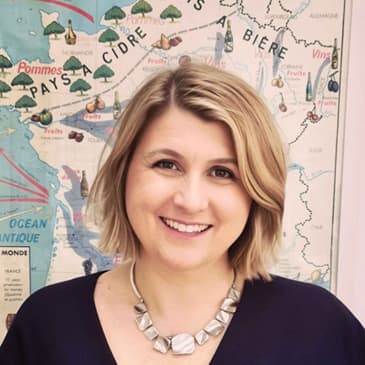
[00:00:46] Yes. Today, it's a French Essime, a French Essime episode. We're going to talk about le terroir, which is a French idea and to help us understand it a little bit better. We have a wonderful guest who is the brilliant food writer Charlotte Fauché Boyd. Charlotte Fauché, welcome to Garlic and Pearls. Thank you very much for having me. We are thrilled to have you. Charlotte Fauché, you are a connoisseur of French food and you are specifically
[00:01:13] for the purposes of this episode, the author of a fascinating book, I found it utterly engrossing, called Amusebouche, which would have been an alternative name for our podcast possibly. Amusebouche, how to eat your way around France. And this is why I think this is one of those books that begins with a map. So you have a very helpful map of France and French regions at the start of the book. And then for each chapter where you're traveling around the map, there's a smaller map of the
[00:01:43] region with the towns that you mentioned. And your book is a travel guide, I guess, but seen through the crucible of regional gastronomy. And it's amazing. It's full of discoveries and surprises to me. And I am French, but of course I'm Parisian, so I'm very ignorant about the rest of France. And I do admit it freely. So I need you. I need you and people like you to guide me. It's amazing how many
[00:02:09] places you've been, Carolyn. Actually, can I just say, chapeau, you've been everywhere. Well, there are a few gaps if I had to do a coloring in exercise. There's room for one more book where you go to the forgotten places. And you're going to introduce us to some real examples of mouthwatering examples of French
[00:02:34] terroir. So terroir, should we maybe, before we launch into the list, would you like to give us a tiny idea, Carolyn, of what terroir means, that French word? Yes. So it's difficult to explain because we don't have an equivalent in English. So the British or Anglophones use the word terroir, but they also maybe feel a bit pretentious saying it,
[00:02:58] but it's such a, it's actually literally a down to earth word because it's about how things grow. It's about, it's most often applied to wine, where it's a lot more easy to kind of explain, but it's how the soil type, the topography, the weather, the landscape, all of these things
[00:03:22] influence the way a food is produced or grown. So I found everywhere I went when I was writing the book and for years before, when I've been writing about France, just found it such an interesting way to understand how the food that is on your plate came to be on your plate in that region of France, because it's so linked. And what I wanted to do with the book was to show people that if they
[00:03:50] looked out of the window of the restaurant, they could actually understand why that food was on their plate. And that's why they were eating it. And also why it tastes the way it does. Exactly. Because the... How it influences flavour. For example, I mean, we'll get onto this, but what cows graze will flavour the milk, which then produces a particular kind of cheese. That's just one example. But so before we go into your
[00:04:15] list of foods and of examples of terroir, I just wanted to ask you what, I suppose, what led you to explore French food in that way? Was there a kind of foundational experience, something you ate as a child maybe, or was there a decisive moment where you thought, this is for me and French food is what I want to pursue? Or is it just the habit of a lifetime?
[00:04:41] I think, yeah. I think when you've been writing about France as long as I have, you start to realise how woven it is into every single thing that you're learning about. So when you use food as the lens to look at history and landscape and tradition and even modern trends, you start to understand
[00:05:05] France in a different way. So it all kind of knits together and your understanding gets a lot deeper. And I think for British people where maybe those things are separated from our food, our history is coming back a lot more now in the last few years, but our history and our culture and our traditions are quite separate to our food a lot of the time. And so to see it so
[00:05:31] closely woven together, I really thought that needed a way to explain to people how to see France in a different way, really. Well, so that's interesting also in terms of our, not to bring everything back to garlic and pearls, but at the same time, this is where we are. Suzanne, our very first episode that we released was about pickled onions. Right. So we started with, I would say what the crown jewel of British,
[00:06:00] British gastronomy. It's not pickled onion monster munch. No, but we do. It's interesting that actually we did start with a food and we started it with a British food. So we, I think have a feel for, for that, for where, where familiar foods come from and the curiosity as to, you know, how it came to be. Okay. So, um, you quote a brilliant phrase from
[00:06:25] the, the gastronome, uh, Brias Savarin. He says, the discovery of a new dish does more for the happiness of mankind than the discovery of a star. And I think that's so French. So your first star, you have selected 10 stars of French terroir. 10 stars of French terroir. Your first star is Comté cheese, which I think will please Suzanne because she likes that cheese. Well, how did you know that? I do like that. They sell it in Tesco's.
[00:06:55] So, so, so Carolyn, Comté cheese. So that's made in Comté. So where is Comté is, French Comté, where is that? So that's in the far east. So not as far as Alsace, but the, the area that sort of nudges up against the Swiss border, um, in between Burgundy and Switzerland, really. Um, and the mountains there are, they're more like a plateau actually. Um, they're not like
[00:07:21] the Alps, which is sort of, if a child was to draw, uh, mountains, they'd be like triangles. Um, pointy. Yeah. The Giro mountains are much more kind of flat plateau with gorges in between. So even before I'd eaten a bite of Comté, I could see in the landscape how Comté was made because it has these huge prairies where the Montballier and the Simmental cows graze. And in order to make
[00:07:49] one wheel of Comté, which is 45 kilos of cheese, they're huge. Um, it takes the milk of 20 cows, which is 400 liters of milk. So in order to produce that milk, the cows have to eat huge amounts of vegetation. So they'll, they'll graze on, on these prairies where there are sort of 500 different types of plant, um, in any sort of one plot that they'd be grazing,
[00:08:13] there's about 130 different plants, um, so like daisies, meadow sage, gentian, um, and all those flavors feed into the, into the cheese, the milk, and then therefore the cheese. The amazing thing about Comté as well, which is probably the same as a lot of cheese, but cheeses, but because no day is the same, no cow is the same, um, from day to day, the, the weather will be
[00:08:39] different, the landscape different, the plants that they eat, every single wheel of Comté is, is unique. And that's amazing if you like Comté, because you can just keep trying the ones you like. But if you find your favorite, that's it, it's gone. Do they have, um, vintage as well? So it's aged, so you have a fresh one and then a less fresh one that is therefore more distinctive and then a really hard one.
[00:09:05] Yes, exactly. So there's, um, there's young Comtés and a more aged Comtés at different, different levels, like 12 months, 18 months, um, and up from there. So I saw some, I was in France last week and I saw some in an aging cellar, um, and they were like three years old, which sort of come out, come out at Christmas. They'll be very, um, sort of crumbly then. Oh, delicious. This is like Samuel Pepys burying his, uh, Parmesan cheese
[00:09:32] at the time of the Great Fire of London. That's, that's fantastic. So that, that gives us a, already quite a good feel, I think, for what, what terroir is and what it does. And I suppose it's also to do with local traditions. It's not just the landscape, it's also people in the landscape who make the food in a particular way over sometimes centuries of tradition. Exactly. And, and the beautiful thing about Comtés is it's a really good example of,
[00:09:58] of a cooperative. Um, when people are living in these places that are really inhospitable, especially in the winter, um, they need to gather together and group together to produce their food. So that's why, um, all the farmers would put their milk into a, into a farm called the fritiere, which is the name for the sort of dairy. Um, and they would pull their milk and that's how they would get, you know, a share of each wheel of the Comté or a wheel each at the end. So, um,
[00:10:26] there are specialists in those fritiere who are really trained to, to age the cheese. There's amazing technique where they, they tap the cheeses to find out if there's any faults in them and they can feel it in their wrist. If there's any fault, they're so well trained that, um, they can feel it in their wrist. So, so that's, if there's a kind of hollow bit somehow, if there's a crack or something. Yeah, exactly. Isn't that astonishing? Yeah.
[00:10:54] It's amazing. And when you go to these aging cellars, there's two really big ones in the region. One's called Fort de Russe and one's called the Fort St Antoine, and they're like cathedrals of Comté because there's like hundreds of thousands of wheels just piled up, not piled, but on shelves that are turned by robots now. I really want to go there and be in the cathedral of cheese. Yeah. So that's, that's a fantastic story. Let's move on. You know, we, we love onions on garlic and
[00:11:21] pearls. You have another star of terroir is the... Oh, this is my favorite story. Right. So these are, we're getting to the onion journey, johnnies. The onion johnnies. So tell us about that and where, where are these onions grown? So Roscoff, if anyone's ever been on the ferry from, from Plymouth, they will land in Roscoff, which is over the, over the channel in the north of Finistere, in Brittany. And this is,
[00:11:48] this area is very famous for its pink onions. And in fact, it's really famous for a lot of its vegetables because it's quite a gentle climate, even though Brittany is sort of the wild west. It's, you know, parts of its coast are really beaten by the sea. The Gulf Stream passes this part of Finistere. So it's quite temperate and makes it really perfect for growing vegetables. So including
[00:12:16] the onions, whereas actually a lot of Brittany's landscape and soil hasn't, isn't really that great for growing, which is why buckwheat became taken on so much because that grows really quickly. So yeah, so the Ruscoff onions. So back in the early 19th century, it was much easier for the farmers to take their special pink onions across the English Channel than it was to take them to Rennes or
[00:12:43] Paris by road because the roads were, it was such a remote outpost. And that's how we, we got to know the onion johnnies as British people. So Parisians, I mean, Muriel knows, knows about the onion johnnies, but a lot of Parisians have never heard about an onion johnny. I learned, I learned from your book, Carolyn. I was completely unaware of the onion johnnies. So why are they called that? So they would go door to door selling their onions. You know, it's the 200th anniversary,
[00:13:13] in a couple of years, because they were the first people anyone had really seen from overseas, actually, especially in that era. And it was quite unusual for them all to be called Jean, Jean Christophe, Jean Michel, Jean Pierre. So, so they all became, they were the johnny, the johns, the johnnies. So they would go over to Britain and, and it was, it was the British that called them the onion johnnies. Yes, exactly. It started in Wales, because Breton and Welsh are quite similar languages. And so they
[00:13:42] could barter, the language, the numbers are very similar. So they could barter with the, with the cost. And then they went all the way up to the Orkneys. It's an extraordinary story of how, how French culture kind of infiltrated Britain, really, even Winston Churchill had his, had an onion johnny come by his house. Is that where we get the image of the Frenchman with a string of onions around his neck? Exactly that. And the stripy top and the beret on the bicycle.
[00:14:12] Yes, exactly. So the onions on the bicycle. Yeah, that's right. So onions around the neck, to most French people, it's like, what on earth? I've never understood it until I read you. So that's how they presented themselves to us when they came here, laden with onions. Well, originally, they had them on poles, which became too heavy, and then they switched to the
[00:14:37] bicycles. And then as it became really quite a big operation, they would be like lorries full of them taken over with the bicycles and everything. And then in fact, it, it leads to the founding of Brittany Ferries because when we joined the single market in 1973, the farmers in Northern Brittany decided that they would charter their own boat and, and sell to the, to the English over the,
[00:15:06] over the sea. Because again, it was, it was a great opportunity, quite entrepreneurial. Amazing. What a lovely story. It's great. I love these stories of origin. It's lovely that you've, you've brought us together through the onions, because as Muriel said, that was the first episode that we did because onions are, you know, the French are known for being onion eaters, but we eat a lot of onions too. And, and always have because they're preservable.
[00:15:30] And I, last, the last two years, it's been a disaster, but I grow onions and I do always plait them and then I hang them up. And, and I assume that that plaiting is also something that, I don't know, did the French bring that here? Were we already plaiting our onions? I don't know. I don't know, but that preserves them. So that meant means that they're kept. Yeah. So you get those sort of stalky bits, which have dried out and then you use them to plait, and then you, you do it one way up and then you invert it and they all hang.
[00:15:59] Part of the reason they, they grow so well is because they use seaweed in the, in the fertilizer. And that's why the terroir of Northern Finisterre is, is quite special as well, because they use different ways to, to fertilize the soil. But then that also brings us to the, the Ile de Noirmoutier where we can talk about Le Bonote, which is this amazing potato that grows only on the Ile de Noirmoutier, which is down the west coast, just south around the corner
[00:16:27] and south of Brittany. And these are delicious potatoes and they only grow for two weeks in May. Okay. And so they've got sort of, they're like new potatoes. They've got like a papery skin and that's, but they're fluffier, whereas our new potatoes are quite firm. But the terroir in, on the Ile de Noirmoutier is never drops before, below freezing. There's quite temperate again,
[00:16:52] like Northern Brittany. They use the seaweed to fertilize. And yeah, so there's this, Bonote, which were traditionally grown up until the Second World War, I think. And then they sort of phased out because they're really difficult to harvest. They don't separate from the stalk like a normal potato would. So a tractor can't sort of turn the soil and collect them. Yeah. So you have to do it by hand, do you?
[00:17:18] Yes, exactly. But the, the farmers in, on the Ile de Noirmoutier turned this to their advantage. This is, this is where these cooperatives really come together and can do quite inspiring things together. Like I was saying about Comte cheese, the people coming together. But in, in 1995, they decided they would market the Bonote again. And so they harvested them and they sent them to the,
[00:17:43] the famous auction house in Paris, Drouot. And they auctioned a basket of Bonote and they sold them for 15,000 francs, which is, which is how they became known as the world's most expensive potato. Fantastic. Yeah. Who did they sell them to? That's a question. An eccentric potato lover and dandy.
[00:18:11] So in the chapter about the Bonote potatoes, you, you start that chapter with a brilliant question, which is something about the little, do you want to tell us about the little moan? Yeah. So you know when you take the taste of something that's, that's utterly delicious and just go, oh. Well, I'd never done that for potato before. Because I mean, yeah, I love chips, but
[00:18:35] it's not, it's not the kind of thing that makes you groan and pleasure, is it? But yeah. It's pretty special potatoes. Yeah, they're really, really tasty. And they're just so, they're so special because they're, they only, they only grow for two, two weeks in May. So they have this big festival, the cooperative puts out big trestle tables in their, their base. And everyone has a big feast
[00:18:59] of sardines, which are traditional from, from the coast of Bondi and, and the Bonote potatoes. And then they all go and have fun harvesting them. Perhaps this is the time to introduce our first ad break, and then we'll come back and continue this exciting story of terroir. I'm going off to get some snacks. Yes. And we're back. So there is that whole scene as well, isn't there, of, of food festivals
[00:19:27] and seasonal celebrations. And, and I think this is the sort of thing that also goes on in Spain and Italy, but perhaps less so in Britain, Suzanne, would you say, have you been exposed to a lot of this kind of massive, well, you know, collective celebration, not necessarily massive, but local collective celebration of a particular food? For example, I'm just wondering, you know, Melton Mowbray pork pies. I've thought about this a little bit.
[00:19:54] Because I think we have to, so, so I think we have, cheese is an, cheese is an area where, despite a massive dip in the 50s, 60s and 70s, we have reborn our own sort of, we don't call it terroir, but we do have a cheese terroir. And we do have, we do have equivalent things, not as fine, probably, but equivalent. Just as fine, Suzanne.
[00:20:19] Just as fine. And we have, you know, we have obviously different parts of the country, which have lots of orchards, have apple months and things. Other, I mean, Kent, for example, has all sorts of seasonal produce that it grows. So it's not that we don't do it. But then I think there is a distinction, and we might come onto this or not. There's a distinction between
[00:20:45] particular kind of food which grows or is immediately drawn from an animal that is reared in a certain place versus recipes particular. So I was thinking, you know, this is the Bakewell tart, which was a sort of cooking accident in the 1850s, which then became, you know, or the melted Marybrew pie. They're just another way of making a pie. And that's very different. It is different. Yes.
[00:21:13] So, of course, Caroline has recipes in her book as well. So the two things kind of walk hand in hand. Let's move on to the next cluster of foods. So firstly, the piment des espelettes, and then we'll move on to pre-lentils, the lentils from Auvergne. And then there's an amazing cluster of recipes and cheeses where we have the truffade and then we have salers,
[00:21:39] cantal and laguiole cheese, and also aligo, which is another dish. So Caroline, over to you. So take us to the Basque country first for piment des espelettes. So we know the Basque country, Suzanne, because we know it from Berets. You know, we did an episode about Berets where we talked about the Berets Basques, but this is about spicing. This is about a French approach to spicing. Yeah. We're not very spicy as people, actually. No, exactly. And this is a really interesting example of how a terroir has adopted a product,
[00:22:09] because it comes originally from Mexico when it came over in that era. And it took to the landscape in the Basque hills, which is sort of foothills of the Pyrenees, particularly well. And so they're sort of grown alternately with black cherries. The farmers will grow black cherries in the spring and they'll harvest the piment des espelettes in the autumn.
[00:22:36] It's these amazing sort of lumpy hills. They're very sort of sharp peaks, but small. Yeah. And when you're driving through them, you'll see the, especially in the autumn, you'll see them drying the piment des espelettes with this small chili pepper in their sort of farmyards. And so the sea air from the Basque coast influences them growing there. And there's a
[00:23:01] wind called the haise hegoa. That's a Basque word. I'm not very fluent in Basque. Yeah. Which means the south wind. So this combination of the landscape and the sea air and the breeze makes it ideal growing conditions for this piment des espelettes. And yeah, like I said in the book, the French aren't really one for chilies like we are. We love our curry and we like our sort
[00:23:26] of strong spices that way. But piment des espelettes is the one they really love. So chefs throughout France will have it as a seasoning, really. It's used in the same way that we might use cayenne pepper. It's quite capricious because if you add it to the recipe too soon, it loses its flavour. So you have to add it at the end. So it's quite a nice thing to have to sprinkle even just on like scrambled eggs or an omelette or something.
[00:23:50] It's quite a gentle heat. It's sort of, if the Scoville scale was out of 10, then it would be like a nice gentle four. So it's not going to blow your head off. I think even I can manage that. So then we move on to the humble lentil, but actually it's not so humble. It's very special. The pre-lentil is something, it's the aristocrat of lentils. It is. And this is really interesting in terms of how the weather affects a terroir. So they grow
[00:24:17] in the volcanic region, right in the centre of the Auvergne, which is sort of mountainous, but the mountains were originally volcanoes. You can even see like the slump in the top is the crater. And they grow at sort of an altitude of like 600 to 1200 metres above sea level. And there's this thing called the Fuin effect. I'm not sure if I'm saying that right.
[00:24:40] It means that the mountains make the air very dry. And that stresses the lentils so that they don't grow. Poor lentils are stressed. And it means as they're growing, they're sort of deprived of water. And that stops them ripening. And that means that their skin stays quite thin. So if you think about
[00:25:04] people living up the mountain in days gone by, a lentil that they didn't have to soak, that grew on their landscape was quite an advantage. So it's no wonder really that they adopted this one as being a local speciality. And it shows how the weather is so important because if you grow the grains elsewhere, they develop that thick skin because they haven't had this process.
[00:25:31] Exactly. So you really need all the components to produce this very special lentil. And then you describe in your book that there are so many ways that this lentil can be then made into cakes and... That's right. They ground them down to flour and yeah, lentil biscuits and salads and... Unbelievable. Yeah. Again, I had no idea that it was so versatile. Versatile, yeah.
[00:25:58] Let's move on to number six of the terroir stars, which is the truffade. So truffade is a potato dish. Is that right? Yes. So cheese and potato. Cheese and potatoes. And the cheese in particular, it's tomfresh, which is made at the same time as l'aille, salers and cantal cheese. Cantal. Yeah.
[00:26:24] So these are all cheeses made in Occitanie, so in the... So Massif Central as well, so... Massif Central in the middle, but then also south of that. Aveyron is in the Occitanie and that's where they make l'aille. Okay. And then over in Rhône Alpes where they make cantal and salers. Okay. And so these are cheeses that people who go on holiday in France, know France well, might be familiar with,
[00:26:49] but they're not as familiar, I think, to a lot of people as Comté or Gruyère or those kinds of cheeses or goat's cheese. And they are... I mean, I suppose Lancashire is not a million miles away in terms of texture, cheddar. No, they're quite similar to cheddar, the process. Yeah. They're much more kind of acidic, but they're the cheeses and the truffade is with the curds, which is the tomfresh is made with the curds before it becomes a cheese.
[00:27:18] So the story, again, is similar to all of these foods is that when you're living up a mountain with your cows... Which a lot of people do. You have to be quite resourceful. Yeah. So there's these huts called bourron huts, and that's where they would take their cows up to the summer meadows in the summer. And that's where the cows would graze on the summer meadows again. And again, there's huge variety of flora there because of the volcanic soil, which makes it...
[00:27:46] If you go in spring, it's so beautiful. There's all these wild narcissi and it's just extraordinary scenes. So they would take their cow herds up, make the cheese to take back down the mountain at the other end of the season. But at the same time that they were living there, they would use the tomfresh to make truffade or aligo, which is the one with mashed potato. And it sort of pulls out in long ribbons because tomfresh is quite stretchy cheese. And they would... That's what they would eat over the season.
[00:28:16] What I loved about writing about this story as well is how the cows are such an important part of the history. We like that, yeah. Because Saler's cows, which are the ones that would be with truffade and contale cheese and Saler's cheese, they're really a capricious breed. They've got big... They're brown coat, really fierce-looking horns.
[00:28:43] And for Saler's Tradition, which is the most rare version, there's only nine farmers who make this version because they won't be milked. They won't give over their milk unless their calf is next to them. So they let the calf feed for a little while. Some of them sprinkle salt on their back so that the mother cow licks the salt off. And it lets the farmer after that have the milk.
[00:29:10] So it's this extraordinary story of man kind of taming this landscape, taming these really wild cows. Even when they were sort of coming into the milking shed when I was there, you could tell they had like a bit of attitude. It's like, who are you? They were looking at me. What are you doing here? Noble animals. It's great that there is this protocol that's been negotiated again over the centuries between man and cow.
[00:29:38] How can we come to a compromise where you let us have the milk? Absolutely. It's wonderful. And again, the role of the cooperatives and there's a cooperative called Jeune Montagne, Young Mountains. Yeah, that's for the Laialges. Yeah. And they saw how farmers were struggling in the 1970s to make a living from the land and they were all leaving. They were going to cities, which is still a problem really.
[00:30:04] But they formed the cooperative to support the local farmers, brought that. This was the Obrac breed of cow back into production and cultivated that, nurtured that. And now it's one of the most successful cooperatives in France. You can buy their Allego in the supermarket anywhere in France. Yeah. And you know where it comes from. That's even like in a ready meal pack. You know it's come from those towns. It still has provenance. It's very reassuring.
[00:30:32] It shows that it can be done, but it takes will. Yes. And they're really innovative. They're called Jeune Montana because they were young farmers. And they're all a bit older now. It's a wonderful story. So I think we should move on from sort of hot cheesy things to something raw. But maybe this is the time to take an ad break and then we'll come back. And we're back on garlic and pearls and something raw, specifically oysters.
[00:31:01] Suzanne, remind me you don't like oysters as a kind of fruit de mer. Actually, I ate some battered oysters the other day, which I'm not sure if that's a British thing or not. But we've talked about them a number of times. And do you remember the episode on PIMS where PIMS wouldn't exist were it not for the British sort of ravenous consumption of oysters and the oyster bars and the need to have something that went with them? Oh, I didn't know that. And then, yes.
[00:31:28] And then, of course, the terrible demise of the oyster, which is not unconnected to everyone eating a lot of them and drinking PIMS. So, you know, there's – which I know you had the same in France. Yeah. I mean, they're a precious thing and we mustn't over eat them and over sort of harvest them. So, tell us about your first oyster, Carolyn. Where did you have – So, I was in – oysters are quite a big thing in Paris, actually. There's a lot of the Belle Epoque brasseries.
[00:31:57] So, big towers of seafood platters and oysters will be on there. So, yeah, I was newly engaged. I was there in Paris with my fiancé. I think it was my birthday weekend even. And we had a big seafood plateau in the Café de la Paix, which is right next to the Opera House. And, yeah, the flavour just transported me to the coast. And I felt the virtual wind in my hair and the salt in my nostrils.
[00:32:26] So, that's terroir in the sea. Yes. And you would think that all oysters are therefore the same. But actually, you will find a difference in the flavour very subtly. I mean, it's still got quite – it's still sort of taste of the sea. But according to where they're grown. So, I love having them in Concal, which is in Brittany. And there's this amazing oyster market on the seafront. And you have a plate and you throw the shells back onto the beach to stabilise the sand.
[00:32:56] When the tide's low down, you could see all the racks for like, you know, almost – I think it's a mile out to sea. You can see they're more growing there. But if they grow in ponds – so, there's a lot – they grow a lot of oysters down in the Mediterranean, in the ponds in the Languedoc, which are called Atong. And so, that will change what the oysters sort of feed on. It changes the temperature.
[00:33:23] And so, if that kind of changes – and there's different kinds of oysters as well. So, all of those things will influence the flavour of an oyster. So, people will have favourites from maybe the West Coast. Arcaichon is one really famous area for them. Or down in the south, in the Zetong. They grow them in Corsica. Normandy Coast has them as well. Are they different breeds of oysters?
[00:33:52] So, we had, for example, in the UK, we had the native oysters in the UK. Okay. And I think they were the same as the ones in Brittany. But I imagine then in other parts of France, they then become genetically different. They become bigger, fatter. Yeah. So, you might be thinking of the Bellon Oyster, which is the original one, which became quite endangered. And they can be huge. Some of them have got the nickname of the horse's hoof.
[00:34:20] Because they're immersive. And they're quite bitter. Like, I tried one of those when I was there. And I've – yeah, quite metallic and bitter. Whereas other ones might be a bit creamier. So, there's a guillardot, which is down on the West Coast. And they're sort of a bit more creamy and plumper with a lot of minerality. Some of them have got, like, sort of a hazelnut nuttiness.
[00:34:49] Or creamy, you know, the ones from Normandy are sort of creamy. Or different sort of ways of being briny. That's what I love about the Concal ones. You just feel like you're eating the sea. That's what I like best as well, I think. Just the directness of that. Yeah. And so, while we're on the sea or eating the sea or, you know, inhaling the sea, we continue to travel down your list of stars of the terroir.
[00:35:18] And we travel down to the magical south. We talk about the south. Or I talk obsessively about the south of France on this podcast because it's such a wonderful place of dreams. And so, first the Riviera and then Corsica. Then we cross to the island, the Île de Beauté, the Isle of Beauty. So, firstly, lemons in Menton. Menton is next to Nice, more or less, on the coast, isn't it? It's sandwiched between Monaco and the Italian border. Yeah, the other side of Monaco to Nice.
[00:35:48] In your book, I learned that they've been cultivated in Menton, lemons, since the 14th century. I hadn't thought that there was a beginning. You know, I thought lemons had always grown there. But actually, it was a decision. Yeah. The thing about the terroir in Menton is that there's the cliffs that are back behind the town, which are really, really steep cliffs, which warm the environment. And then you've got the Mediterranean, which brings the humidity.
[00:36:17] And that combination, on a very narrow stretch of land, really, made it perfect for growing lemons. So, what I loved about when I was there is you see a lemon tree in people's back gardens. I mean, I struggled to grow a pot of basil in Argon. You know, I might stroll out to get a bay leaf. But, I mean, imagine being able to walk out and to get a lemon from your garden. It's just like a tree country. True.
[00:36:42] So, they celebrate their lemons for two weeks in February with this amazing festival where they create these big sculptures out of lemons. But they don't use the Menton lemons for that because it would be too wasteful. They have to get them. They ship them in from Spain and then sell them off for jam. But there's all these floats and the can-can and amazing sort of carnival atmosphere. And they open up the private garden seat to explore. And it's just a citrus town, really.
[00:37:12] When you walk down the street, there's bitter oranges growing in the trees in the street. I went to one of the botanical gardens, lots of botanical gardens there. And there was just a whole hedge of kumquats just as I walked in this huge basket of them next to the reception. Yeah, and like I said, it's such an amazing scene when you're used to just, you know, struggling to grow a carrot. Yeah, it's very exotic, actually. It's nice to be reminded occasionally of a different climate.
[00:37:41] Yeah, exactly. We did an episode about marmalade, didn't we, Suzanne, where we talked about Seville oranges and so citrus, how precious that is. And to be able to preserve it. And then we did an episode about Orangina. Oh, yes. I'm going to ask, because you're not the only country that grows lemons, what makes these ones distinctive? So the Montan lemon has a very thick peel that's quite edible. So you can, it's not that bitter sharpness that you get with other lemons.
[00:38:11] So you can preserve the peel, eat the peel, and you can use the whole thing. So that makes them special. But there's only 30 growers left because it being the Côte d'Azur, the real estate has sort of crept in and threatened a lot of the groves. But there's a big movement to kind of protect those growers and make sure that they can continue. So you can go and visit quite a lot of the gardens and see them in situ.
[00:38:39] You talk about a big movement to protect the lemons. I wonder if the French are perhaps more determined to resist the encroachment of, I suppose, the industrialization of food, Suzanne. I think this is something you've said before in the past, that you feel that although Britain has a lot of amazing foods, both foods that it grows or animals that it rears, and also dishes and recipes and traditions and all of these things,
[00:39:08] that people are perhaps less willing to take a stand on their behalf than perhaps the French. I often think when I'm walking up, you know, one of these amazing streets in any given French town where there will be a cheese shop, one or two boulangeries, a butcher, that if that was taken away, people would riot. And I know we do riot about a number of things, but I think people would probably take to the streets if you took the food away. I think there's a sort of powerlessness.
[00:39:38] I feel a powerlessness in Britain because somehow we did used to have the local market, the local butcher. I mean, you know, there are, the further you go from London, the greater the chance that you still will have a local butcher and a local baker. And it's not that they don't exist. But I think there's something about really efficient food distribution in a way, which we've done,
[00:40:03] and massive supermarkets, which have got that, which makes it really hard for the local market or the local baker to carry on, unless you are still quite rural and the butcher is thoroughly embedded in the local scene with the local farmers, or you're Jeremy Clarkson, so you're starting it all over again in a way.
[00:40:27] But we have, I think that marrying up of agri-tech, huge agriculture plus distribution networks is quite deadly for a lot, unless you get yourself on the list. And then suddenly your Cumberland sausages are in every supermarket in the land, and then you're still not connected to your terroir in the same way, are you? You're just a brand, maybe. I don't know. Yeah, I wrote about this in The Guardian a couple of years ago,
[00:40:53] about how the French are so good at protecting their foods through all different kinds of means. So we've talked about the brotherhoods before, so they're one factor. There's the AOP and AOC, D'Origine, Protege, PDO. What are those? Just explain briefly. So, yeah, so in fact, you can see recently in British supermarkets, I've noticed they've started putting PDO on some of the cheeses, and that means protected designated origin. Right.
[00:41:22] In French, it's Appellation d'Origine Protégée or Contrôler. And it means that the producers have to follow a certain, it's called a cahier de charge, and it's just like a rule book for how they produce it. And if they step outside of those rules, then they won't be allowed to be listed with the AOC. So it's kind of like a quality control, really. And sometimes it works, sometimes it's actually got too big,
[00:41:51] and some people feel like their artisanal techniques are sort of not being allowed to thrive because the cooperative has got so big that's doing the AOP. And it's streamlining too much. I mean, that's a balance, isn't it? Yeah, exactly. So it's, yeah, it's fascinating. But it is interesting. It is still a difference in terms of the infrastructure and a sort of ecosystem in France that is still sort of managing to maintain all these foods. Whereas, as you say, in Britain, I mean, I agree with you, Suzanne, there's a sort of perhaps a defeatism about it.
[00:42:20] It's possible that it is also restarting. I mean, would we say, can we be a bit optimistic about the, that there are people in pockets here and there who want to preserve their foods, who are trying to find ways, but you are pitting yourself against these giants. And it must be extremely difficult. Yeah, there's a campaign at the moment to protect the Glasgow mourning role. Right. Because it's a really... Good example.
[00:42:47] A really much loved food that everyone has. And just because it's not sort of a big, posh product doesn't mean that it doesn't need protecting. No, well, everything needs... Well, so this leads us very naturally to the humble chestnut in Corsica. I mean, I love chestnuts. And we did talk about chestnuts, Suzanne. It was the marron glacé, you know, which is a very particular way to treat a chestnut, to turn it into a marron glacé, which is an expensive delicacy for Christmas
[00:43:16] that we make and Italians make as well. So the humble chestnut, Carolyn. Yes. And that's subsistence economy again, isn't it? It is, exactly. Very poor communities trying to survive in a very harsh environment. Absolutely. Yeah. So Corsica is very mountainous and chestnut trees thrive at around 800 metres above sea level. And so that's where a lot of the villages, when you visit, that's where they're based because of the chestnuts.
[00:43:46] And that's, again, when you look at... When you know that and you look at the landscape in Corsica, it just suddenly you think, wow, food meant that village was built there. In, like, we've talked about the marron glacé and in the Ardèche, there's the sort of creme de marron, which is a lovely ingredient. Delicious. But they use the chestnuts a lot in Corsica for flour.
[00:44:13] So they dry them and then grind it into a flour, which became the main staple product, really, like, so for their breads and everything. The Corsican cuisine is very... It's much more of a winter cuisine, whereas it's not really the time people go to Corsica. It's quite hard to get there in the winter. But because they had time in the summer, they were moving their flocks up to the pastures and down to the coast. But in the winter, they had time to make the charcuterie. They had time to dry the chestnuts.
[00:44:44] And so Corsican cuisine is really quite wintry. There's a really famous cheese that they love and they put in everything called broccio. And that's only available between October and June. So sort of people going on their holidays tend to miss out on that one. Pulenda is the sort of, like polenta. Like polenta. Yeah, that chestnut flour. Instead of maize. Yeah, exactly. So they'll stir it into this sort of very thick paste. And they even have a tool for that.
[00:45:13] Like you would have a spirtle in Scotland for porridge, which is called a polenda ju, which just means the thing we stir polenda with. And that's what they would serve with the different cuts of charcuterie. Charcuterie in Corsica has a sort of timeline as well. So they'll eat this particular one in this month because it would be freshly made then. And then the ones that could be kept and aged as the winter goes on,
[00:45:42] they'll get eaten later on in the season. So it's quite cyclical. And when I was writing the book, I found Corsica, I mean, there's traditions and things we can understand all the way through France all the time. But Corsica was just such an amazing example of how they still eat the food that they've always eaten. It just felt so tied to their sort of peasant cuisine.
[00:46:09] And I just, yeah, I just loved how present it was when you really dug down. And it meant you could really understand Corsica because it's a very touristy place. I think the population goes up like tenfold in the summer because everyone just rocks. They have to bring in a lot of the food to feed all the holidaymakers. But when you find the actual food made on the island, you find like the real Corsica. So that's why I love rubbing that. So like honey as well then? So honey, yeah.
[00:46:38] Or honey's rather. Honey's, yeah. Because actually it's different. The Corsican honey has an AOP status, but there are actually six different ones that count for that. And what's really interesting is that they have such different flavour profiles. There's one that's called the Miel de Miette de Maquis, which is really dark and sort of quite bitter. I had a jar of it in the cupboard and one of my kids took it out thinking that it could add it to yoghurt.
[00:47:07] And they were like, this is disgusting. But it's just if you're not used to it, it's not like the honeys where you know it. Yeah, it's not honey as you know it. Honey is so consistent really as we know it in Britain. But this is also, again, a story of terroir, whether it's Corsica or anywhere in France. I always buy a jar of honey because it belongs to the landscape wherever you buy it. And you'll find it in the market and you'll find it in the sort of farm shops and things.
[00:47:36] I even found one near the Gerande salt marshes that was honey from the plants that grow in the salty environment, which I just found fascinating. That sounds really nice. I'd love to try that. That honey can be made in all sorts of ways. And when there's no flowers, they'll make it from the pine trees. So you'll get like pine tree honey. That's a quite dark, bitter one.
[00:47:59] I had some very, very dark, bitter German tree honey, actually, which is thick, treacle and stuff. Yeah. So in the manner of Desert Island Discs, which this isn't, if you could only keep one of those 10 foods, Carolyn, to eat every day of your life on the island. On our island. On Corsican Island, preferably. Probably as good. Then which would you say is your favourite? I think I'll have to go for Comte.
[00:48:29] It's ready to eat. See, I would go for Comte as well. Suzanne, which one? France's favourite cheese. Yeah. So. I would go for the one which is, I can't remember the name of it because it was a complicated name, but the one which is potatoes and cheese all mixed together. Oh, the truffade, yeah. That is a million itself. That does sound good. And it is something you could probably eat every day of your life, actually. I might make that with the Comte, which is probably going to be disgusting, which is why I shouldn't be allowed to do. Well, it would be. It would just be a different dish, wouldn't it, Carolyn?
[00:48:57] It wouldn't be disgusting, but it wouldn't be truffade. It wouldn't have the stretchy cheese strings that all the influencers want. I was also reflecting when we did our episode on Landseer and the monarch of the Glen, there was this bit where Landseer and his 20-year-old lover, the Duchess of Bedford, hid away on a weekend mini break in Glenfeshy and invented duchess potatoes. They did. Oh.
[00:49:26] Which is not dissimilar, I think, from what you're describing. Yeah. Probably it is dissimilar, but in my head, they're... No, in terms of unctuousness, it's quite similar. In terms of making the potato into something that really melts in the mouth. Lovely. How romantic is that? Potatoes, romance. Potatoes and cheese just make everything perfect. Yeah, there was nothing more romantic. Thank you so much. What a lovely conversation. It is just as well that I had eaten quite well at lunch,
[00:49:55] because I think otherwise this is the kind of program that makes you want to eat. Oh, yeah. As soon as possible. Everyone's going to be ordering their Conte. Everyone's going to order their Conte and eat oysters. And, you know, Christmas is coming soon, so it's the right time. Carolyn, thank you so much. Thank you for watching. It was so interesting. It was good fun. And so I think I love your book because two things. Because there's not a word in excess. What you describe is on the page. You can see it. You can imagine it. You can taste it.
[00:50:24] There's no, you know, ego. So it's all about the stuff. And it's also absolutely mouthwatering. So that's the best food writing. It's the food writing that makes you want to cook and eat and harvest food. Thanks, Carolyn. Good luck with the book. I'm sure it's going to sell shed loads. Thank you so much. And I hope we can have you on again another time. Yeah, happy to. When you've visited all those other bits that you haven't visited yet. Thank you so much. Thank you.
[00:50:53] Thank you. Well, so now I'm really hungry, as I think a lot of our listeners will be. So, Suzanne, are you converted to all these foods? The thing is, I mean, I had the advantage of having the map. And I think I do encourage all our listeners to get a map, actually, because France is enormous. And all these places are quite hard to take in.
[00:51:22] And you would need to spend quite a lot of time in a camper van to cover all this ground. Or in an ice cream van. So, on that note, I'm going to say, if you enjoyed this podcast, keep doing what you're doing, which we really love. That's to say, leave us reviews, leave us comments. We really love to hear from you. Follow us on social media. Keep in touch. We will see you next time for something completely different. Au revoir, Muriel.
[00:51:51] Au revoir, Suzanne. Au revoir.