
Hosted on Acast. See acast.com/privacy for more information.
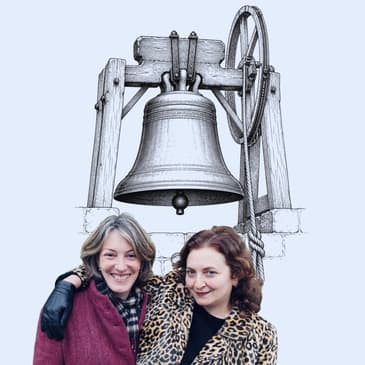
[00:00:18] Hello, this is Garlic and Pearls with me Muriel Zagha and my friend Suzanne Raine. On this podcast we discuss the Frenchness of the French and the Britishness of the British and today it's your turn Suzanne to talk about something quintessentially British. What is it? Muriel, I'm giving you a book. Oh, it's so exciting. Can I say what it is? You've already got the book. I'm not really giving it to you. It's a fake. We're pretending.
[00:00:48] We're pretending because actually I'm too much of an Anglophile not to know this book. This is The Nine Tailors, which is a novel by Dorothy L. Sayers. Dorothy L. Sayers is one of the queens of crime, isn't she? She's one of those really astonishing British women who wrote fantastic crime novels, which in her case are more than crime novels. I think they're really brilliant literature and romances, some of them as well. It's fantastic.
[00:01:13] And now The Nine Tailors happens to be the first Dorothy L. Sayers I ever read because I found it in someone's house. I didn't know what it was. But it would completely open me up to her. So why are you giving me this book? Are we going to talk about Dorothy?
[00:01:28] Well, only in passing, actually, because we should contextualise her a little bit. But what we're actually going to talk about is the fence and bell ringing. Because the tailors in the title are not Savile Row. No. Tailors. No. No.
[00:01:50] No, they're not. I mean, you know, we know it all. This is a tricky thing on this one because I realise that by talking about a murder mystery book, which we want to encourage everybody to read because it's glorious, we've slightly hamstrung ourselves because there will have to be a bit where we don't talk about the ending. I know. Well, I'll leave it up to you. I'll try not to spoil the ending. So there is an amazing denouement.
[00:02:20] Twist, really, somehow. Realisation. Yeah. Well, so difficult. But it's essentially a book about two very, very British things, but actually, and I'm sorry to do this, but very English things, which are the fence and bell ringing. So this is a particularly English podcast, actually, in this event. But I'm going to tell you a little bit about the book and then I'm going to make you read from the first page.
[00:02:48] So it's written in 1934 by Dorothy L. Sayers, and it's her ninth book featuring Lord Peter Whimsey, who is her kind of heroic special detective. And the romance by then has sort of happened in a way because the development of his romance with Harriet Vane happens in earlier books that she wrote.
[00:03:13] And those of you who haven't read it, it is glorious. And yeah, as you said, there's so much texture, I think. Is that what literary criticism people say? Yes, I think they would agree with us. But although ostensibly the plot of this book is about the theft of some emeralds, and in parentheses, I think any plot that involves thieving emeralds is always a winner. Ah, definitely.
[00:03:36] It's about the theft of emeralds, but it's actually about the mystical, liminal, watery landscape of the Fenlands and a place with wide skies and mists where sound carries very long distances. And it's also the strange, very haunting world of ancient bell ringing. So it revolves around a group of bell ringers at the local parish church.
[00:04:06] And it has been described as her finest literary achievements, although apparently, and who am I to judge? The answer is I'm not the person to judge. It isn't always completely technically correct on some of the aspects of campanology. So good. Apparently, Dorothy spent a lot of time trying to understand campanology. And I feel like I understand the effort that she must have gone to in order to get even a cursory amount of understanding of campanology.
[00:04:36] So it opens the first chapter on New Year's Eve, where Lord Peter Wimsey and his valet, Bunter, are driving across the Fens. And I'm going to make you read a little passage. I love Bunter, by the way, the valet. In my house, when we tidy up our wardrobe, you know, to change of season or something, we call that buntering. Because that's what Bunter does for his employer. He sort of sells his clothes.
[00:05:03] So, OK, so I'm just starting with the text itself. This is the first chapter. That's torn it, said Lord Peter Wimsey. The car lay helpless and ridiculous, her nose deep in the ditch, her back wheels cocked absurdly up on the bank, as though she were doing her best to bolt to earth and was scrapping herself a burrow beneath the drifted snow.
[00:05:28] Peering through a flurry of driving flakes, Wimsey saw how the accident had come about. The narrow, humbucked bridge, blind as an eyeless beggar, spanned the dark drain at right angles, dropping plumb down upon the narrow road that crested the dike.
[00:05:45] Coming a trifle too fast across the bridge, blinded by the bitter easterly snowstorm, he had overshot the road and plunged down the side of the dike into the deep ditch beyond, where the black spikes of the thorn hedge stood bleak and unwelcoming in the glare of the headlights. Right and left, before and behind, the fen lay shrouded. It was past four o'clock and New Year's Eve.
[00:06:14] The snow that had fallen all day gave back a glimmering greyness to the sky like lead. We're going to skip a little bit and I'm going to make you read a tiny bit more. They wrapped their coats about them and turned their faces to the wind and snow. To the left of them, the drain ran straight as a rule could make it, black and sullen, with a steep bank shelving down to its slow, unforgiving waters.
[00:06:41] To their right was the broken line of the sunk hedge, with here and there a group of poplars or willows. They tramped on in silence, the snow beating on their eyelids. At the end of a solitary mile, the gaunt shape of a windmill loomed up upon the farther bank of the drain, but no bridge led to it and no light showed. That's beautiful. Thank you very much.
[00:07:07] Do you remember, Muriel, when we were walking through some fields in the fence where we had some drains? And we got completely sort of cut off because that's what they do. They're so, they're man-made and they block your ability to traverse a piece of ground quite dramatically. And I remember being down in one of the drains and a Lancaster bomber flew over, which was disconcerting.
[00:07:33] It was a sort of out of time moment, really, where we thought, are we in a Bell Pressburger film? What's going on? Yeah. I mean, I just think it's a fabulous beginning to book because those of us who've driven through the fens, especially in the wintertime, that flatness, the way that the wind comes in straight off the North Sea from the East with this extreme cold chill.
[00:07:57] And poor Peter Whimsey and Bunter, who've crashed into the ditch and have got to try and find respite or something. And they end up, of course, in the village of Fenchurch St. Paul, which is a rural community with a disproportionately high church tower. And they hear bells ringing and it introduces Mr. Venables, who is the welcoming parish rector, who you're a fan of.
[00:08:24] I love his voice because a lot of it is done through dialogue or monologue in the case of the rector, I think, where he just talks and the pacing of his speech. And of course, Dorothy was herself the daughter of the vicar, wasn't she? She was exactly. So she knew exactly what she was writing about, I think. All the analysis says a lot of the book is based on her childhood. She lived in the fens. There's some confusion exactly because, of course, it's fiction.
[00:08:53] So is it the Norfolk fens? Is it the Cambridgeshire fens? Is it the Lincolnshire fens? I don't think it matters because it's the East of England fens. So shall we do the plot now? Yes. Very briefly. So 20 years before the events of the novel, the family of Sir Henry Thorpe, who is the local squire, were the victims of a robbery.
[00:09:20] So they'd had a wedding and one of their guests had had this amazing emerald necklace that was stolen. And that was called the Wilbraham Emeralds. And the family's butler was a man called Geoffrey Deacon and his accomplice, Nobby Cranton, were convicted and imprisoned, but they never found the emeralds. And then in 1918, Deacon, the butler, escaped from prison and vanished.
[00:09:49] And his wife didn't know where he'd gone. And they found a man's body in prison clothes a few years later. Mary was declared a widow. And she married a man called William Thode, I think we pronounce it, who was one of the village bell ringers. So that's the sort of backstory.
[00:10:12] Peter Whimsey turns up and he gets to the village and he finds that they're ringing an all-night peal on the church bells. And he ends up having to stand in for William Thode. And he rings all night. He ends up ringing the bells for nine hours the whole night. So that's a long time to ring bells for Muriel.
[00:10:40] I'm just wondering whether if you had crashed the car into a ditch in the fence, walked to the local village, made friends with the local vicar and been asked if you could stand in in the church bell ringing because one of the bell ringers who's the second husband of a woman whose husband stole the emeralds. Would you be up to say, yes, I'm very happy to do nine hours of bell ringing all night? I don't think I could. I think I could offer maybe 20 minutes. But in the case of Peter Whimsey, it's noblesse oblige, isn't it?
[00:11:10] That, of course, he will say yes. So I was thinking, actually, because there's something about bell ringing over a period of time that it requires constant concentration, constantly having to use your muscle and your wit and being part of this team with other people in this performance, which is quite meditative.
[00:11:32] And it makes me think maybe you remember the queue to go and see the coffin of Queen Elizabeth II, which was, I mean, even I think in your case, an even mightier travail. 14 hours in the queue. I think I really, I don't know what I did really, but it felt like a thing. It felt like a significant thing. So Peter Whimsey does it. He stands in for nine hours of bell ringing, huge physical exertion.
[00:12:02] Sir Henry, the squire, dies. They, trying to bury Sir Henry, they open up his wife's grave and they find somebody else in it. It's unbelievable. And the dead man is wearing French made underclothes. Oh, how suspicious is that? I was hoping you'd be able to tell me how suspicious you think that is.
[00:12:29] Well, I think it's often suspicious in detective novels of that era that someone who's wearing Italian or French, especially underclothes, my goodness, you know, you know that he's come from the continent. He's probably up to no good. I mean, there is a suggestion of that. I don't know how they would, I mean, I suppose their label, that's how you'd know, because essentially we all wore the same kinds of underclothes, I should imagine, especially men. French made, I think you could tell.
[00:13:27] Okay. the events 20 years earlier. And there's a very long sequence in the trenches in 1918, because there obviously is this sort of story where Peter Whimsey was in the war and was wounded in the First World War. This plot has an element that the thieves ended up in France in some way. Bunter goes and gets an uncollected letter from the post office, come from France, and the writer
[00:13:56] is the French wife of a British soldier who had deserted in 1918, who says he knows where the emeralds are hidden. So this is all just a bit confusing. And they find a document in the bell chamber of the church, which is written on the same paper as the letter from France. So I'm telling you this because it's a French element. Yes. And it's about the war. I mean, that bit is about
[00:14:24] the war and how many people of that generation has spent time in France. I'm like doing time, but... And not particularly nice times in France, very, very hard times. I'm going to talk a lot about bell ringing later on. Okay. But just so I can situate bell ringing for you as a thing.
[00:14:45] There's a difference between striking a bell in a church tower, so Big Ben chimes, and ringing a bell. Okay. And we have this thing called change ringing, which is used on bells which are hung for full circle ringing. So I'm going to try and explain this to you. Yes, please.
[00:15:10] I'm obviously not an expert. If you think of the science of it, if you let a bell ring from side to side, it will act like a pendulum. So it will swing constantly backwards and forwards. And you're not really controlling that. It's a pendulum action. Okay. And it happens regardless of how softly or hard you pull the rope. So it's no good if you
[00:15:39] want to control the timing of each bell to fit a melodic sequence. Yeah. So what they worked out how to do is that if they mount it on an axle, so that it's theoretically possible for the bell to kind of go all the way up and over and come back again, then it's possible to pull the bell such that it goes right up to the top and pauses right at the top of the swing upside down. Ah, d'accord.
[00:16:07] So you then pull it. You decide when it chimes because you pull it and it swings back down, chimes, and then it goes back up to the top and pauses again. So that's the way that you can work with a peel of bells and control the timing that each bell rings in order to create the melody. And that's why this requires great skill. So say I'd never thought about that.
[00:16:34] This is English full circle ringing, which gives rise to a ring of bells or a peel of bells or change ringing, which are terms that we use when we're describing bell ringing of English churches in particular. And the stats on this are extraordinary. So there's a book called Dove's Guide for Church Bell Ringers, which was first published in 1950 by Ronald Hamilton
[00:17:01] Dove under the title, A Bell Ringer's Guide to Church Bells of Britain and Ringing Peals of the World. And he basically, as all these things, he found them all, categorized them. And he produced between 1950 and 1994, eight editions of the guide. He visited and rang at nearly all the ringable towers
[00:17:24] himself. And then in 1994, he handed over responsibility for producing the guide to the central council of church bell ringers, about which more later, again, I just little hooks for you there. But Dove's Guide counted them all. And as of January 2021, there were 5,756 ringable rings of
[00:17:50] bells in England, over 5,500 individual rings of bells, so the church towers with bells in. 182 in Wales, 37 in Ireland, 22 in Scotland, 10 in the Channel Islands, 2 in the Isle of Man, and only a further 142 towers worldwide with bells hung full circle ringing. Right. So this is an English thing.
[00:18:19] It is. Just completely. And that's why this book is so brilliant, because this is about bell ringing in England. And you can see on the front of my edition, it has a church on a rise of... It's got a church, but it's sort of hiding behind this lure, this sort of fishing lure. Oh.
[00:18:43] She does say it's an English thing, doesn't she? It really is important. There's a foreword in my edition. Do you have the foreword? The foreword says, from time to time, complaints are made about the ringing of church bells. In fact, that is still true today, isn't it? Then she says, it seems strange that the generation which tolerates the uproar of the internal combustion engine and
[00:19:08] the wailing of the jazz band should be so sensitive to the one loud noise that is made to the glory of God. England, alone in the world, has perfected the art of change ringing and the true ringing of bells by rope and wheel and will not lightly surrender her unique heritage. So that is essentially what you've just said. It is a distinctly English thing that has been lovingly maintained and passed
[00:19:38] down. Yeah. So we're going to focus now for a little bit on the spirit and meaning of the bell ringing aspect of it. And I'm going to veer away from trying to explain in any more detail the quite complicated plot about who stole the emeralds. But I think, and I'm sure you'll agree, bell ringing is the voice of an English village. It is the sound of a wedding or a coronation. The happy
[00:20:03] peals are like summer rain, she says poetically. And they bind a village together unless there's a new person moved into the vicarage and they want to shut it all down because they can't bear it. But often, both the bells and the church are hundreds of years old and they've maybe accumulated new bells over the years, but some of the bells date back centuries as well. And they've stood at the centre village and
[00:20:29] they've marked occasions in parish life for generations. And I should note actually as well, because this is about the Fens, the church bells in Lincolnshire, which this may or may not have been set in, although everyone says it's Norfolk or Cambridgeshire, were a critical element in the Lincolnshire Rising or the Pilgrimage of Grace, which, as you know, started on the 1st of October
[00:20:56] 1536 when the vicar of Lowth preached a sermon about the closure of the religious houses because all the way along the River Wytham there were monastic houses which Henry VIII wanted to close down. And he did this sermon, it sparked panic. And then St James' Church in Lowth, which had a very high spire, maybe even the highest medieval spire in Britain. I don't know if someone will tell me
[00:21:19] that's wrong. The next day, they told the bell to call people together. And then what started was, again, because you've got the Fens, because sound carriers, particularly in those days where you haven't got jazz and combustion engines, they then rang the bells in all the local churches. And it became this sort of passing of a message of a call to revolution. And it is believed that the church
[00:21:48] bells were run backwards, or what's in what's called back round. So obviously, we can't recreate it, but that was a signal that the uprising was beginning. So now the Lincolnshire Rising is commemorated by what they ring, what's called a court appeal. And I'm going to explain a little bit about, this is all about mathematics, really. St James' Church. So they ring that to celebrate Lincolnshire
[00:22:12] Day in memory of the role of the ringing of the church bells as the summoning of the revolution. So I'm going to tell you now the history of bell ringing. Oh, good, good, good, good. Brace yourself. Yeah. Change ringing, as we now know it in England, emerged in the 17th century. And it's possible
[00:22:38] to trace back the earliest ringing society, you really love a society, to, for example, the Lincoln Cathedral Guild, which claims to date from about 1612. But actually, when I was talking just now about the Lincolnshire Rising, you know, you sort of think, well, what would that have sounded like? How were they doing it? And actually, it does say in the papers at the time,
[00:23:05] that these wonderful letters and papers, Foreign Domestic of Henry VIII, which states that during the Lincolnshire Rising of 1936, the people rung bells backwards. And there are also papers, state papers, Domestic of Elizabeth I, from 1569, also saying that, for example, the Earl of Northumberland took Topcliffe Bridge and rang the bells backwards. So this makes you think,
[00:23:33] historically detective working, that there must have been a usual order for bells to have been rung in, in order for them to be rung backwards. So when people are saying it started in the beginning of the 17th century, actually, and that there's now a little debate, into which I am tentatively tipping my toes, that, in fact, they were already probably doing some sort of ringing in rounds in Henry VIII
[00:23:59] and Elizabeth's times. I should also say, I mean, some of these bells are completely marvellous. So I went to a now, sadly, very parlous state church in Saltflipie, which is right on the salt marshes of the Lincolnshire coast. And it's standing there, you know, surrounded by
[00:24:25] watery, muddy marsh, not being looked after, not being attended, all the tragic. And on the floor, there was two huge bells chained up, so I suppose they couldn't be stolen, but otherwise just covered in bat poo. And on one of them, it said, God save the king. And the date was 1650. Goodness.
[00:24:51] And if you remember, that's what had just happened to our king in 1650. Yeah, exactly. Lost his head. Just lost his head. So there's just sitting on a floor in an old Fenland church on the salt marshes, there's a bell which says, simply God save the king, that was, what's the word for making a bell? Came from the foundry. Yes, the foundry.
[00:25:18] The year afterwards. So somebody, I think, possibly taking an enormous risk at that time, making a bell that says God save the king at a time of civil war and anti-royalist behavior. Just lying around. They're all just lying around as part of our history out there that possibly we don't care enough about. Anyway, change ringing. What the hell is it?
[00:25:45] What is it? I have no idea. I can sort of imagine that. So it's several people bell ringing together, but in a very precise order of rotation or alternation, is it roughly? But of course, I can't define it better than that. I have no idea how it works. Maybe. And it's not impossible. Some of our listeners will be campanologists.
[00:26:10] And therefore, what I'm about to say will be quite maddening for them. And I'd like to apologize in advance, but I'd say that in my defense or as a counter argument, simply by talking about it, I might stimulate new interest and get you some new recruits who want to know how it's properly done and what the exact mathematics and physics are of it.
[00:26:32] So this is my attempt from my research. As I explained already, you have to swing them in a massive arc in order to be able to control the strike interval. And that's about physics. And if you can control the strike interval, then you can stand in a circle and you can ring
[00:26:58] independently and change the speeds of your bell by how much you're pulling. And so that gives you the possibility of ringing in different mathematical permutations. So you can ring your bells at different speeds in different orders, like a rotor. So it creates a form of music, which is not
[00:27:23] written on a musical score. It's written in terms of a sequence of numbers, which we know from the book. From the book, yeah. And those are known as changes. So it's a sequence known as a change. And so it's not a conventional melody. It's hard to reproduce it because it's a sort of a clanging noise, isn't it? Yeah. Yeah. Let's talk about the bells. You can have a smaller number of bells. So six bells or eight
[00:27:52] bells is quite common. Some towers have as many as 16 bells that can be rung together. And they have different tones. So the highest pitch is the treble and the lowest is the tenor. And you can have a bell that is bigger than a tenor, which is called a bordon. And so those bells are then given numbers. So the treble is number one, and then you measure them according to their pitch,
[00:28:21] going down sequentially. And they are tuned to what is called, don't ask me, a diatonic major scale. Love it. And the tenor bell is the tonic or the keynote of the scale. Does that mean anything to you? Not really. No, I'm going with it. Then how do you make it work so that you can ring them in the circle? So they're mounted on a bell frame, which can be steel or wood. And then they're suspended from, these are all words,
[00:28:50] which I'm going to give you just because they're words. They're just suspended from a headstock, which is fitted on trunnions, which are bearings, which are mounted onto the bell-free framework so that the entire assembly of bells can rotate. Extraordinary. Don't really understand it, frankly. And the bells then, they hang stationary in the down position. Yeah.
[00:29:16] Where essentially the bell and everything is below the trunnion and the clapper is hanging there. So the whole thing is pendulous. And the dynamic of it all then is controlled by the rope. So the rope wraps and unwraps on the rim of the wheel. And this is so mathematical, I can't really... It's so technical, yeah.
[00:29:41] And the bell rotates backwards and forwards. So they are not fixed. So the chiming bells are sort of fixed, but these bells are mobile. And the clapper can be steel or wrought iron and it has a large bell. So to raise the bell, you have to pull on the rope. So below the bell chamber, you then might have a couple of sound chambers where the sound passes through,
[00:30:10] which might maybe have a clock mechanism as well just to make everything more mechanical. And then the rope passes through then before it gets into the ringing chamber or the room. You often see photographs of groups of bell ringers standing around bells in their ringing chamber. And the rope's length is long enough so that it falls to the floor in the ringing chamber.
[00:30:34] And about five foot from the floor, five foot high from the floor, that's one and a half meters in your language, there's a woolly bit on the ropes, which again you'll recognize from the pictures. And that's called the sally. And that's the bit that the ringer holds. So to raise the bell, to get it into its up position, the ringer pulls on the rope and starts the bell swinging.
[00:31:01] And then every time the bell swings, the ringer pulls it a bit more to get a bit more energy into it. Just like imagine pushing a child's swing. Yes. Is what you're doing. And eventually there's enough energy for the bell to swing right up and go up beyond the balance point. So then it stays ready to be rung. So the bell ringers then stand in a circle and they pull the bells in sequence.
[00:31:30] So is there quite a lot of silent communication through eye contact? Oh, good. Like in a sort of choir orchestra where you're ringing, you're looking at the person. Super question. Yeah. Super question. Wondering about that. So there's two different ways of doing it. There's call change ringing or method ringing. And call change ringing is where the conductor calls the change of the ringing. And method ringing is where you give a word of command to start.
[00:32:00] And then the changes are rung from memory by the ringers. But what are the changes? This is the bit where I am going to attempt to explain this. And it's just going to be a taster. And people of real interest can go and learn more about it. But change ringing is where the order in which the bells are struck is constantly being altered. Every time you ring them, you're changing the order in which you're ringing the bells.
[00:32:30] You have to time your swing so precisely that your bell isn't ringing. It's ringing in the right place. So it requires a huge amount of precision. It's also worth saying, one of the things that makes this so physical and what makes Lord Peter Whimsey's bell ringing ordeal so noteworthy is that even the smallest bell in a tower is much, much heavier than the person who's ringing it.
[00:32:56] So you at the bottom are pulling the rope trying to make this bell swing in this vast arc. So, for example, the heaviest bell, and this really is a non-representative sample, but the heaviest bell, which is hung for full circle ringing, is in Liverpool Cathedral and weighs 9,195 pounds or 4,171 kilograms. That's enormous.
[00:33:26] I mean, I have no idea because I can't do weights and measures, but it sounds super heavy. Is 1,000 kilos a tonne? I don't know. I don't know. I've just told you. It's a very heavy bell. We can leave it at that. It's not as heavy as Big Ben, but nobody's trying to ring Big Ben by hand with a rope that requires you to swing it backwards and forwards. What did you learn from the book about the numbers? Oh, no.
[00:33:54] I mean, about bell ringing and the numbers, almost nothing because it's just so complex. When I started reading the book and I realized that it wasn't about Savile Row, you know, the 19th. That it was in fact set in the countryside and that it was going to be about campanology. So first of all, I had to understand what was meant by that. It was new to me that there was a science of bell ringing. And then I thought, shall I try and make notes or understand what the changes are and how it works?
[00:34:24] Or should I just go with the story? And I went with the story because that's what I always do with detective stories. You want to know where the emeralds are? Yeah. And I want to follow the story and I want to be led down the garden path. But it's good that you're topping up my knowledge. So please explain because actually I don't understand it. In call change ringing, you have a different sequence of bells and that's called a row. So you would say you've got six bells. This is an easy thing. So you'd run, you'd ring one, two, three, four, five, six. Yeah.
[00:34:52] And then the next time you would say one, three, two, four, five, six. Yeah. And then the next time you'd say one, three, two, five, four, six. And those changes would be called by your conductor who would instruct the other ringers on how to change the place of their bell in the row from one row to another. So that's essentially how it works.
[00:35:18] Then you also have the method ringing, which is continuously changing the row. And it comes from the method. This is so complicated. I mean, this is the whole thing. This is so, it's an insane extra bit of the world that only happens in England. So it's the method that they use to generate the changes, which what makes it called method ringing. And so you'd start doing repetitive rounds.
[00:35:48] And then when they give a command, the ringers will then vary the order in which you're ringing the bells, which produces a series of sequences, which are known as the rows or the changes. So that's the same. And this method is committed to memory by each one of the ringers so that you only need to have a very small number of commands from the conductor. So there are thousands of different methods. Gosh.
[00:36:15] And for some people, the ultimate goal of this system is to ring all of the permutations that you can get from the sequence of bells that you could ring. Does that make sense? Yes. So for example, you know that thing in maths where you have a number with an exclamation mark after it, which means like 10 to the power of 10 or something. Oh, I've forgotten about all that. But yes. Maybe. Yes. So it's about permutations.
[00:36:44] So if you have six bells, one, two, three, four, five, six. Yeah. And then like I was saying, you then swap them around and have one, three, two, four, five, six, and then blah, blah, blah. There are 720 different ways that you could order that sequence of bells. If you have eight bells, there are 40,320 permutations.
[00:37:08] If you have 10 bells, there are 3,628,800 permutations. And if you have 12 bells, there are 479,1600 permutations. It's what they call an extent. So if you estimate two seconds for each change, two seconds between each bell on six bells,
[00:37:34] so that's ringing all the permutations of six bells, you can do it in half an hour. So that's not bad. An extent on eight bells takes 22 and a half hours. Ah. An extent on 12 bells, which is 479,1600, would take 30 years. 30 years? 30 years. So that's not really possible.
[00:38:03] So often then ringers do shorter performances. So they start and they end on rounds, but they can't repeat a row. It's quite interesting because the terms here are truth and false. So a true ringing must not have a repeated row. Otherwise it would be false. Gosh. An appeal is an extended performance. So it must comprise at least 5,000 changes.
[00:38:33] A full extent on seven bells is 5,040. So you can do that. So then you can do a performance of 1,250 changes, which is a court appeal of something. I was just listening intently, but honestly, I can't really follow.
[00:39:02] For me, it's too many numbers. But I understand the complexity of it. And I'm full of admiration for the people who master this. So let's just finish with a little bit on the people who master this, because I think that it is worth us having them in mind. And they are so important. There are ancient societies, well, you know, quite ancient societies. There's two, actually.
[00:39:30] The Ancient Society of College Youths or the Noble Society of College Youths. And there is also the Royal Cumberland Youths. And the first, the Ancient Society of College Youths, was founded on the 5th of November 1637, an auspicious date, because that was the date of the gunpowder plot. Ah. You should do that one day. Yes. Although it may have already existed.
[00:39:57] And the first ringing of the Ancient Society of College Youths was recorded in 1642, when it managed to plane six score on five bells, which I know you now know what that is. There is an amazing man who is the kind of Ur writer on this topic called Fabian Stedman, who was a Cambridge printer.
[00:40:19] And he wrote the Tintinologia, or the Art of Ringing, in 1668, which was dedicated to the Noble Society of College Youths. And there isn't an original copy, but there is a 19th century reprint. And he was Master of the Society for the year 1662.
[00:40:39] And among the valued documents that they still hold is a list of masters for every year from 1637 to 1986, except from 1755 to 1802, when the keepers of the name book didn't record the names of the masters. So that's a bit rubbish off then.
[00:41:02] In 1891, the end of Victorian period where everyone set things up, the Central Council of Church Bellringers was founded. And that is dedicated to representing change ringers around the world. It has existed since then. And I think I would like to devote the final segment of this before maybe coming back to Dorothy L. Sayers, which is a little bit that I want to read.
[00:41:30] Go on their website, everybody. They represent the interests of bell ringers and ensure a sustainable future for the traditional art of bell ringing. They represent 65 affiliated societies, which cover all parts of the British Isles, as well as centres of ringing in Australia, New Zealand, Canada, the USA, South Africa and Italy.
[00:41:51] The object of the Central Council is to advance the practice, heritage and appreciation of bell ringings and enjoyable mental and physical exercise and unique performing art for the public benefit of both church and community. Their mission is to be the strategic leader and public voice of the ringing community, the arbiter of standards. Brilliant. And to promote an environment where ringing can flourish. And their vision, they've done the whole thing. They've had a strategy away day.
[00:42:22] Is a vibrant community of ringers with bell ringing widely valued as an enjoyable mental and physical exercise and a unique performing art which enhances the life of both community and church. So I think that is noteworthy because what that shows is an organisation founded in 1891 that has had a strategy away day that now has a major strategy called ringing 2030.
[00:42:52] Oh, I like the sound of that. What do you think is the aim of ringing 2030? 30 changes. 20 in 2030 on the year's eve. Hmm. No, it's not. You should have been on the council. Oh. You could have suggested that. Well, I think it's a brilliant idea. It's not too late.
[00:43:14] What they're saying is we want to work in collaboration with ringing organisations to put in place a growth pipeline, creating a steady and sustainable recruitment stream. They've got a strategy thing. Yeah. They want 10,000 more active ringers by 2030. Half of them under the age of 30. Sorry, I should have read this bit first. Why are we doing it?
[00:43:41] They're up front about the boiling frog. If you roll forward the current demographic profile of ringing 20 years, keeping recruitment as it is, there won't be that many active ringers. Many ringers now are over 60 and too few are under 25. So they're aiming for, by 2030, half of the new ringers are under the age of 30.
[00:44:08] 30,000 people under the age of 20 have heard about or had a go at bell ringing. They want, and this is something to be aspired to, retention rate of at least 50% of new recruits and double the number of teachers and trainers of ringing. That's huge. That's tremendous. I love the ambition.
[00:44:32] Well, what they're saying is there are pockets of great progress so far, but there are many towers, district branches and associations who are struggling with numbers and they're not seeing the young ringers coming through. And then they say, it's not as though we didn't see this coming. We've been ignoring trends for years and now the demographic time bomb of ringing is ticking loudly.
[00:44:56] The current ringing population came from a base of young ringers that was probably five times what we have now. The pipeline needs strengthening. So that's their thing. They've done what they admit is a back of the envelope calculation. But they're saying that by 2030, more than half of the ringing population could be people we are yet to teach.
[00:45:21] They had a campaign called Ring for the King, which showed that it's not enough just doing a recruitment campaign and expecting the numbers to double. It's quite difficult because churches are closing. Churches, you know, like the one in Salt Fleetby, the bells are on the floor. They haven't got the ringing teachers. They haven't got skilled steeple keepers. And there might be fewer and fewer towers with bells, which is, as they say, a multifaceted problem.
[00:45:49] It's all running on a shoestring. The Central Council cannot do it alone, which is, I think, where garlic and pearls step in. Yes. So they've got a three pillar approach. I can't believe this. Three pillar approach. Pillar one, publicity and marketing. Raise awareness of the art of bell ringing. That's what we're doing. That's what we're doing. Promote it as a social and voluntary activity. Pillar two, recruitment and development.
[00:46:18] Encourage the development of local regional structures to recruit new ringers and attract lapsed ringers. Yes, of course. Shame on them, lapsed ringers. Although, I mean, obviously great if they choose to come back. And then through pillar three, quality environment. Good teachers, good structures, good bell installations, good ringing environments, safeguarding. Tea and sandwiches and cake. Tea from those things. Oh, the good thing.
[00:46:47] And then it says, all three of these efforts underpinned by a young person work group to ensure their voices are heard and new digital projects to tie them together. Very good. So, be part of the change. And then I was going to finish. You know, we talked a lot about world records on the Guinness Book of World Records. Oh, yes.
[00:47:10] I thought, given this sort of thing, this longest peel, Peter Whimsey ringing until he can't stand, what are the world records for ringing? And I have to say, the Guinness Book of World Records let me down quite a lot. Because I think partly because it's really complicated because it depends on how many bells you've got and which type of change ringing you're doing. So, here's some world records that I found.
[00:47:40] In October 2015, according to the BBC, bell ringing world record that stood for 50 years was broken by bell ringers in a church in Somerset. What do you think that was? I can't even begin to think. I have no idea. So, they had, I mean, poor them, they've got the full 12 bells. So, they're facing the 30-year thing. Oh! Which is why they didn't do it. No.
[00:48:04] So, they attempted to ring 21,216 changes on their 12 bells. They did this at South Petherton Church near Yeovil and it took them 14 hours and 26 minutes to complete. Wow. 14 hours. Also, of having to remember all of that to get it all in the right order because one false thing, one wrong move. It's all ruined. It's a huge amount of concentration. But that beat the previous record.
[00:48:34] So, that was 2015. The previous record was from 1965 from Birmingham Cathedral. And organiser David Purnell said, despite each ringer having to ring their own bell for the whole time with no break, they'd done an excellent job. That is so impressive. Well, they'd had to give up the previous October because they had to call it off after four hours when two of the ringers suffered mental fatigue and made mistakes.
[00:49:03] So, he'd said, Mr. Purnell said, at the point they'd failed at last year, there was a bit of hesitation and a bit of unevenness. But once they got over that, it was fine. And they rang from 7 a.m. British summertime on Saturday through to around 9.30 p.m. And the church had a video link of the ringers in the tower.
[00:49:22] And the tenor ringer, who's pulling this one and a half ton bell, he had a gadget, he said, a bit like a hospital drip with a tube which he'd put in his mouth and he could ring the bell one-handed. But he said, we were all on the end of a rope for 14 hours. So, luckily, nobody needed a wee. Yes, don't drink anything before you launch into such a performance. I mean, that's, I think, quite extraordinary. Yeah.
[00:49:50] What I'd like to stop with now is the little bit of the very first bit of the first chapter in The Nine Tailors, which is a quote from a book called On Change Ringing. And this is it. The coil of rope, which it is necessary to hold in the hand before and whilst raising a bell, always puzzles a learner. It gets into his face and perhaps round his neck, in which case he may be hanged!
[00:50:21] Exclamation mark. Ooh, I know. It's so good. It's so good. It's bringing everything together. Oh, Suzanne, how tremendous. I'm so thrilled. I've been hoping, since we started doing this podcast, I've been hoping that Dorothy L. Sayers was going to come in through the door or through the window or through the chimney or in some way. And you brought her in, in the most amazing way possible. So thank you. So good.
[00:50:48] I really encourage everyone to ring this, to really encourage everyone to read this book, to read all of her books, and to take perhaps a closer interest in bell ringing wherever they live, you know, in cities, in the countryside. And if you want to join in, join in, I couldn't do it. I'm just such a weakling. But there are a lot of listeners out there who are strong. You could do it. They could do it. You could do it. You could sign up.
[00:51:14] Although, unfortunately for us, we do not fall into the desired demographic. No. We fall into the about-to-die-off-soon demographic. Yes, that's the thing. They're not trying to recruit us. They're not. But young listeners or parents of young listeners. Parents of young listeners. Encourage your infarctione. In fact, Muriel, I just noticed that you could indeed, you could have an effect on this. I could. Terrible problem. I could potentially make inquiries in my immediate entourage. Thank you, Suzanne.
[00:51:44] This is brilliant. Listeners, if you enjoyed this ringing, vibrant episode of the podcast, then tell your friends, leave us a review, subscribe to the podcast, and we look forward to seeing you next time for something else. Thank you, Suzanne. Goodbye. Au revoir, Muriel.