
Garlic & Pearls (Ad-free)
Suzanne and Muriel examine a series of very different things – from a film to a kitchen utensil, a model train to a bar of soap – that define British or French attitudes, each explaining her cultural background to the other and trying to get to the essence of what makes the British British and the French French.
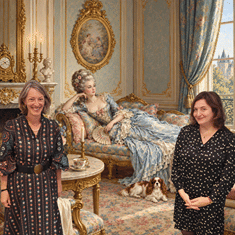
The boudoir: sulking room, private retreat, haven of frolics?
In this Garlic and Pearls episode, Muriel Zager and Suzanne Rain explore the French boudoir, a small private room whose meaning and use evolved from private retreat to a symbol of Frenchness. They trace its etymology, design features, and shifting social roles, comparing French and British ideas of
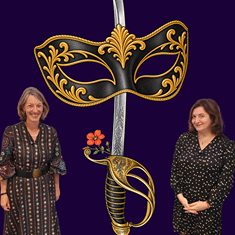
The Scarlet Pimpernel: The very first and quintessentially British masked superhero.
They seek him here; they seek him there... Suzanne gives Muriel a riveting rendering of The Scarlet Pimpernel, Hungarian émigrée Baroness Orczy's colourful and melodramatic 1905 historical novel set during the French Revolution, in which a gallant mild-mannered fop and his associates stick it to Mad...
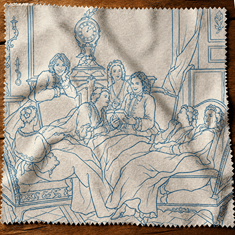
Toile de Jouy: A Tale of Printed Fabric, Savoir-Faire and Storytelling
Muriel tells Suzanne the story of the printed cotton or linen known as toile de Jouy, generally printed in a single colour on a neutral background and created in the late 18th century by an enterprising German émigré, the engraving and colour specialist Christophe-Philippe Oberkampf, at his thriving...
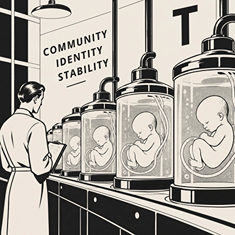
Literary Dystopia: A Very British Response to Social Change
Suzanne explores dystopia, one of the most significant sub-genres of the British novel, where trouble often starts with the breakdown of the monarchy and aristocracy (which sounds a bit like France). It begins with Jonathan's Swift's Gulliver's Travels, then Mary Shelley comes along, then HG Wells's...
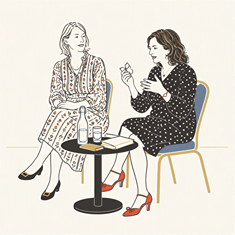
Garlic & Pearls at the Lansdowne Club: Entente Cordiale, a clever Marquess and G&P's findings so far!
In the effervescent atmosphere of Anglo-French friendship created by the arrival of the Bayeux Tapestry at the British Museum, Muriel and Suzanne appeared at the Lansdowne Club in Mayfair to salute the memory of Henry Charles Keith Petty-Fitzmaurice, Fifth Marquess of Lansdowne, a diplomat bilingual...
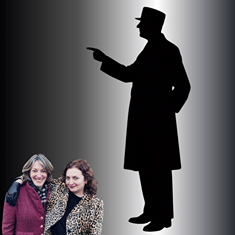
De Gaulle: Resistance: How good is the French blockbuster about De Gaulle's time in London during the war?
Muriel and Suzanne discuss a new French film set during the years 1940-41, a pivotal time in the history of France and Britain, as General de Gaulle, powered by 'a certain idea of France' and refusing to accept Pétain's new collaborationist regime, relocated to London to seek support from the Britis...
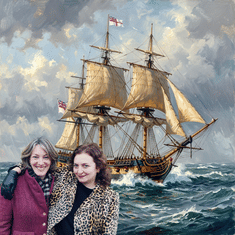
The Beaufort Scale: The Poetic British Way of Measuring What Happens at Sea
Suzanne enlightens Muriel about the Beaufort Scale and explores the remarkable story of its creator, hydrographer Francis Beaufort, who went to sea as a boy, was shipwrecked in the Far East, took part in Napoleonic sea battles against the French and in 1805 devised a brilliant empirical scale full o...

Camus’s L’Etranger: literature, murder and Absurdism in a French colony
Camus’s terse 1942 novel about an enigmatic killing won the Nobel prize for Literature in 1957. It is entrenched as a French literary classic and as a gateway to Philosophy in French schools. But what, asks Muriel, do the book and its recent film adaptation by François Ozon tell us about morality, j...

