
Hosted on Acast. See acast.com/privacy for more information.
[00:00:21] Hello, this is Garlic and Pearls, a podcast that explores what makes the French so French and the British so British, with Muriel Zagha, who's French, and me, Suzanne Raine, who's British, and today with someone else as well, who is kind of both. I know! So today's a red-litter day. Today we have a special guest. Welcome, Debora Robertson. Debora, we are thrilled to have you on Garlic and Pearls. I'm thrilled to be here.
[00:00:52] This is so exciting. So you are being beamed from the south of France, from the southwest. Debora, you are a distinguished food writer. You write for a lot of national papers and magazines. You have written a cookbook and memoir called Notes from a Small Kitchen Island, which you wrote, I think, mostly during lockdown from your then London house. I did.
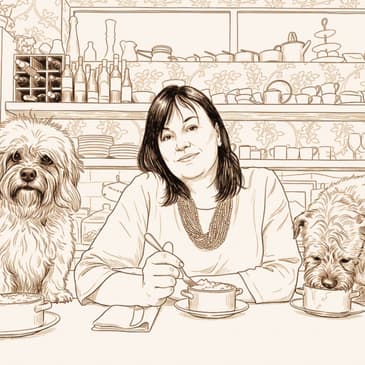
[00:01:16] Debora, you've also written, excitingly, and Suzanne is going to be so thrilled, cookery books about how to feed your dog and how to feed your cat properly. And this could not be more relevant to me and Suzanne because we have recently acquired, respectively, Suzanne a puppy and I a kitten. So the books are going in the Christmas stockings. This is very exciting. It's really exciting. And you also have, Debora, a fantastic sub-stack called Licked Spoon. Thank you.
[00:01:44] Which is about your life as an expat because you are British. You grew up in the northeast. I think as Jane Gregson did. She did. She also grew up near me. Also grew up near you. But I think my mother never cooked. I think Jane Gregson's mother cooked. She did. But there is something in the water, clearly, in the northeast. I think so.
[00:02:09] And some women who grew up there go on to be really great food writers. And now you live in France in the southwest where you've taken on a big project. You're renovating a house in a village and you now cook in a French kitchen. A very small, very colourful French kitchen. What colour? What colour is your kitchen? It's every single colour. Whoever built this house in 1900, it was a man.
[00:02:36] And he was a wine merchant. And I think he also took his job very seriously and drank quite a lot. My kitchen has four different kinds and patterns of tiles in it. And it's slightly mad, but it's so wonderful. And it was slightly the tiled kitchen that made me buy that house. And I just wrote about it in my subset this week. So I put lots of pictures on there.
[00:03:00] And it's all crazy tiles with shells on and tulips and all kinds of things. Every surface has a different tile. And one of my very smart friends, when she came to visit the first time, she looked at it and she said, What are you going to do with all this? And I just said, nothing. I love it. I might wash it, but that's it. So now, Deborah, you've been in France for years. Yes.
[00:03:27] And one of the things you've mentioned on your Substack and elsewhere, in some of the columns you've written for The Telegraph, for example, is all those cliches about the French, all those tropes about the French that you come across. That's to say, people say to you, Oh, you live in France, where the French, of course, do X, Y, Z. And you've found a lot of those things to be completely untrue.
[00:03:52] So we're going to talk about your British expat experience in France and more generally about those misconceptions we have about each other's country and your best place to debunk some of them. Maybe we should start with food as a general area of interest, because, of course, that is your speciality and what you write about. I'm just going to pluck something out of your Substack and we'll start with that.
[00:04:17] People have this idea that the French eat croissants and pain au chocolat and all these things every day of their life. No. And, of course, they are available every day, aren't they? They are. And I live dangerously close to a bakery, literally two minutes from my gate. It's an excellent bakery. When you come on holiday here, you do eat croissants every day. It's part of your little holiday ritual.
[00:04:40] But then, when you live here, you realize that you cannot do that, otherwise you would never get through the gate. So, and I think my observation is that French people don't eat them every day either. Most of my French friends, adult friends, don't eat breakfast for a start. No. And croissants and that sort of thing, they're really something you would have on the weekends or on a special day.
[00:05:11] And for breakfast, if you're having breakfast, you might have a bit of last night's baguette toasted with some butter and some apricot jam or some sort of fruity jam. Or one of the endless yogurts French people eat. There is no nation more obsessed with yoghurt. You eat more yoghurt than the Greeks. And I think that's just showing off. That's amazing.
[00:05:36] I am always struck when I go home and I go to a supermarket by those massive aisles with all kinds of yoghurts. And that is possibly one of the things I miss in Britain. And I don't know why it is that the British are not as focused on yoghurt. Is it a Mediterranean habit, maybe? I think it might be. Because you mentioned the Greeks. I think the Turks also eat. In Turkish families, they buy these big vats of yoghurt. Yeah. I used to, when I lived in London, I lived in a part of London where there was a big Turkish community.
[00:06:05] And we used to buy these enormous tubs of yoghurt. And also, if we went out to a local restaurant, there would be yoghurt somewhere in every single meal. It's like this miraculous ingredient. It is. It's also, I think, a default pudding in France. Yes. Fruit or yoghurt tends to be what you have for pudding. Whereas it's not the case here. So that's maybe, that will change, but it hasn't. So, okay. So the French don't eat croissants every day.
[00:06:34] They do eat bread. Baguette is still, because that is the other image that people have. The baguette, you know, people on a bike having, you know, bought their fresh baguette. That is true that the baguette is still a staple. The baguette is still sacred. Though I think people are eating less baguettes than they used to, because now there are more widely available other sorts of bread. You know, breads with grains in them.
[00:07:01] Our bakery does what she calls a Norwegian bread. And I said, why is it Norwegian? And she said, I don't know. But there are, you know, 10 years ago, there would be maybe four or five different kinds of bread. But now there might be 10 different kinds of bread. So I still set my clock every day when I open the shutters and look out on the little square in front of my house.
[00:07:26] There's a man who carries his baguette down the port every day at eight o'clock in the morning. Yeah. So if he's not carrying that baguette, it's like the ravens leaving the tower. If he's not there at eight with his baguette, I'll be very worried. That is a nice way to keep, you know, an eye on your neighbours. It's like milk bottles used to be, you know, people didn't collect their milk, you'd know that something was wrong.
[00:07:48] So would you say that broadly, this is broad brush, but actually, this is the topic we've touched on on the podcast on a number of occasions, that the French are more focused on food, on cooking, on food than the British generally. Definitely. Because I think sometimes, certainly the way I grew up, food was sort of something to get out of the way until you got on with something else. And here, everybody I know will talk to you about food.
[00:08:17] You can't get in a taxi, you can't walk down the street, you can't go to the market without somebody giving you a recipe for something. And maybe it is a cliche, but I think it's still true, that mealtimes are very important. And people do keep regular mealtimes. I had some English friends staying with me last week, and we have builders, we always have builders, we have builders here at the moment.
[00:08:45] And the young guy who was the painter, he's maybe 18 or 19, you know, he stopped for lunch, and he got out a really good piece of cheese and some really good bread and a really lovely looking saucisson. And he sat down and had his lunch for an hour. And my friends were saying, well, I didn't really think that still happened, but it does still happen. And he's so young. Definitely, it still happens.
[00:09:11] And there are certain, you know, Sunday lunch is really sacred here. And people go out a lot to the restaurants, there are lots of restaurants in our village. And there will be, you know, three generations of the same family all sitting down. And what I love to see is, you know, all the children will be sitting at the end, and the older children, boys and girls, will be helping the little children eat their food.
[00:09:38] And they'll all be talking, and because we live on the Aton de Tour, which is a big saltwater lagoon, there's lots of shellfish here. There's oyster farming and mussel farming in the Aton. And to see some teenage boy helping a little three-year-old to eat her mussels is just one of the joys of my life.
[00:10:03] And, you know, tiny little children eating their oysters like, you know, proper citizens. It's a wonderful thing. It is a wonderful thing. And I wondered actually whether that had been perhaps exaggerated, this difference, that there have been books published about this, you know, how French children don't throw food was one of those books, which is about the sort of food education in France being so different.
[00:10:28] And we did an episode where we talked about French canteens and how in schools, you know, school, home, work hand in hand, you start training the taste buds, les papilles, at a very young age. And I sometimes wonder if that's been overblown, if perhaps that's being lost now, but actually apparently not. I don't think so. I don't think so. One of the joys of my life every month is to look on the internet at the menu of our local primary school for the month.
[00:10:58] And they, you know, it's very simple, but it's very varied. And they have three course lunches every day. And that might be a little salad and then a hot main course and then probably a yogurt, let's face it, or a piece of cheese. And they all sit down together because it's not just about the food. It's also about sitting together and talking together and helping each other.
[00:11:22] And in our market every year, they have a special Tuesday once a year where the children run a section of the market. And it's just adorable. They have their little aprons on. They have all sorts of things. And then you buy these tokens and you buy the food from the children. And that's about food, eating well and learning about fruit and vegetables.
[00:11:48] But it's also about learning about being in a community where food is really central to that community. The market is really central to our community. And historically, French markets have always been, haven't they, about more than just food. It's where you see your friends once a week and where you chat and gossip and find out what's going on. Well, they are literally on the public square, aren't they? Yeah. Actually, it is the public square.
[00:12:15] And I suppose also, French markets are for everybody. Exactly. They're not posh. No. They're not markets for people who have money and who care about food more than other people. Suzanne? Well, I'm only thinking that British markets, we have markets in town squares as well across the country. And in a way, we were probably much more similar 100 years ago than we are now. I agree.
[00:12:44] You know, where I live, which is not in London, there's thriving local fruit and veg markets, which are as they used to be. Not artisanal farmers markets where bread costs eight pounds fifty and you can't possibly afford a planet of strawberries. And so they are still there.
[00:13:05] But it's almost, I don't know, it's something to do with the mass food production and food distribution, which in Britain seems to have broken the local system. Whereas in France, you have that, you have the big supermarkets, but it hasn't destroyed to the same extent the local foods production and distribution networks. I think it's possibly because it is this thing where it's about life, not just about feeding yourself.
[00:13:36] So it's almost like a sacred thing. Everybody goes to the market on Tuesday here. I mean, absolutely everybody. And I'm from a small market town in the northeast where when I was growing up in the 70s and 80s, there was a really big market there twice a week that filled the market square. That doesn't exist anymore. Yeah.
[00:13:56] And then when I moved to London, I lived in Stoke Newington, which had the country's first organic biodynamic farmers market because of course it did. And that was wonderful. But it was, you know, there was a certain kind of person who shopped there. And when I go to my market here, everybody goes there.
[00:14:19] This fits, feeds into a misconception that the French have about the British, which is, or a cliche, which is that the British have terrible food. I mean, that is, that is a cliche you find in France all the time. People will say, well, it rains all the time and the food is terrible. The food is great. It doesn't taste of anything. It's horrible, you know. And I, I came to live in Britain, not, not exactly with those ideas, but I suppose I was slightly wary about the food aspect of everyday life.
[00:14:47] And what I discovered instead is exactly as you say, Deborah, in France, food is sacred. It's part of your internal life, your interactions, everything. In Britain, it's not like that. But instead, what I found is people in Britain have the same kind of passion and preoccupation for their garden. Hmm. Gardening. Hmm.
[00:15:11] Not to say that the French don't garden, but the people I meet who have gardens, even tiny little bits of garden in Britain, are in a gentle, continuous way, preoccupied with their garden in the way that I'm preoccupied with what I'm going to cook tonight and tomorrow and what I had last week. You know, they're thinking about plants and I don't know quite how that works, but I think if there's a big passion, I don't know. Is that, is that wrong? I mean, you, you ladies probably each have a garden.
[00:15:42] I do think food in the UK has changed a lot in the last 20 years. And usually people, when they say, oh, British food isn't very good, it's because they haven't been to Britain for a long time and they haven't seen some of the incredible. I think it has improved enormously. So in my French butcher, they do have a cut of meat on the counter, which is called le roast beef de boeuf, which is a roasting joint.
[00:16:09] So, and I do find French people, like French friends, they love particularly English puddings. They're absolutely wild for them. Anything like a trifle, a crumble, all of those things. I mean, they adore them. And there are two sisters who live about an hour from here. They're South African. They've lived here a long time.
[00:16:32] And they're tremendous bakers and they go around lots of the markets and fairs and they sell English baking, including mince pies. And their French customers are wild for their mince pies, so much so that they sell them all year round because French people don't know it's just something that we eat at Christmas. And hot cross, all of those things, they love them. Yeah. Because they're superior. But of course.
[00:17:03] And exotic. Superior, delicious, but wildly exotic. When we first moved here, we'd only been here a couple of months and it was our first Christmas. And because I'm pathetically needy and wanting to be liked. I made these mince pies and I gave mince pies to some of the people who helped us settle in, including our estate agent, because estate agents deserve love too.
[00:17:30] And I came back from England in January and he came racing after me down the street and he said, thank you so much for the mincey pies. So, you know, I think I've established them in our village as a treat. Well, I think that's wonderful. So, perhaps let's move on to something less pleasant than food, which is the French administration. So, that is something that you flag up in your list of misconceptions.
[00:17:56] You say there is this idea that the French are obsessed with bureaucracy, red tape, you know, to a ridiculous degree. And you are more nuanced than that in your assessment. Well, what I think is, Nurel, I mean, I'm sure you can understand this because you've moved to another country. I think moving to any other country is complicated. And I think British people move to different countries and say, well, this is very hard. Well, maybe try being a foreign person trying to move to the UK.
[00:18:26] You have to jump through 95,000 hoops. So, it is complicated, but it's very logical. You have to jump through. You just have to jump through. You can't resist. You just have to jump through all the hoops. And remind yourself they're not doing it to you. It's just how it is. They're not trying to ruin your life. They're just doing their job. The one thing that does drive me crazy, though, is all the paper. My God.
[00:18:55] I had to buy a new printer when I came here because I was constantly, I had to print out 95,000 things. But in England, I would simply email to somebody. Yeah. It's the paper trail. Well, exactly. Everything has to be in triplicate as well. Totally. It's not just one time. So, my experience of the other side of this, because I grew up with this all-powerful, well, to me, French administration having to fill in forms and deliver them and triplicate them and so on.
[00:19:23] And the kind of sacredness of the French administration, which is the Republic, you know, as it interacts with you. When I first came to work in Britain, the poll tax was introduced that year or around that time. And I was working as a very junior, in a very junior teaching capacity in Cambridge, in the University town.
[00:19:43] I and the other French people, young students who were teaching in that capacity, we were being asked to pay the poll tax at a rate that was completely out of kilter with what we were being paid. So, one of us found out there was this thing called the Citizens Advice Bureau, which doesn't exist in France, I don't think. No, I agree with that. So, we went to the Citizens Advice Bureau in a little delegation.
[00:20:06] We explained our situation and we had a sort of checkbook thing that we were supposed to use to pay our poll tax with the amount already printed on it and all our details printed on it. And the lady at the Citizens Advice Bureau said, she listened and she said, you're right, it doesn't seem quite fair. I think what you should do is cross out the amount that's printed in the booklet, write what you think is, you know, in keeping proportionate with what you're being paid and then pay that.
[00:20:36] And we all stood there going, this is an official document that comes from the government, the state, and you're saying that we can cross it out. I think in France, you'd be jailed for doing that. I think it is actually a crime. Without question, you would be in jail. It's defacing an official document. And we did do it and it was fine. And I thought, this is a civilized country. My goodness, you know. It's anarchy. That's what it is. It's civilized and also anarchy.
[00:21:06] It's what you're describing. Or empirical suppleness. You adjust better to individual cases. Suzanne, what do you think? Well, this is one of the themes that has been pretty consistent all the way through, which is this absolute requirement somehow in the French mind for things to be orderly and regulated and controlled.
[00:21:34] And weirdly, not always controlled centrally. So which is probably why you need three copies of it because you've got the central and then you've got the local. Whereas in the UK, there's something much more organic about how we organize ourselves. And that's not to say that we don't also have massive amounts of pointless bureaucracy and people doing local planning who seem to have far more powers than they should. You know, we have all of that as well.
[00:22:03] But at the heart of it, I mean, it's the thing about having a written constitution or one that isn't written. I mean, the idea that you can be a country which doesn't have a document which says how you're going to govern yourselves is one that we're very happy with, but which seems odd to most other nation states, I think. I think this is a little bit like what you were saying about gardening, Meryl.
[00:22:26] One of the things that told me more about the French psyche than almost anything else in the first year we lived here, we live on a corner that's quite a busy corner. It's the main avenue from the village to the port. So everybody walks past. And our garden when we moved in was 12 foot bamboo, no path. It was chaos. And so I started to make this garden and then I made some paths and I said, what am I going to put on these paths?
[00:22:53] And I thought, I'm going to make an oyster shell path because oysters, there are millions. I went to my favorite oyster restaurant and I said, what do you do with your shells? Can I have them? Yes, you can. So I made this oyster shell path. And as I was proudly planting my roses and gardening and all of this, especially all the old ladies who rule the school in this village, would walk past and we'd have a little chat over the fence. And I thought, this is me integrating into village life.
[00:23:19] And they would say to me, is that an oyster shell path? And I said, yes, it is. And they would, more than one occasion, they said to me, oh, c'est original, ça. It's original. Now, as a British person, telling somebody that something they're doing is original, that's the highest compliment because we value that. We think that's wonderful. You know, look at our fashion, look at Vivian West.
[00:23:48] We love all of that. But it took me a little while to realize what they were really saying was, are you out of your mind? It's a crazy woman with the oyster path. But I think that's it. I was just doing my own thing, but not within the rules of taste. You know, though, I have to say, and maybe this is the British thing, because in my garden, I had a sort of area that was often very boggy and I didn't know what to do with it.
[00:24:16] But I also had a bag of mussel shells that I have. It was just a long story. And so I just threw them all out and it was just wonderful. And that's my mussel shell area. And they gradually disintegrated into the bog. But so there's something that's, I think, again, it comes back to it's our response to land and nature is somehow perhaps more organic. And Deborah, you said something about the boundaries of taste.
[00:24:44] So let's just talk about style generally, because I think you're right that, for example, eccentricity being très original is not a compliment in France. Not at all. At all. We are a lot more conformist, the French, I think, than the British are. And so, for example, two aspects I found about this stuff in your writing, Deborah. One is to do with the way French women present themselves.
[00:25:11] So, you know, there is this received idea that French women are, well, they don't get fat, do they? And they're incredibly stylish. And they all wear red lipstick and they dress in black and they're pencil thin, all of that. Have you found that to be the case? Well, I live in a village in the Southwest where summer clothing might be a Johnny Alliday T-shirt. And winter clothing might be a fleece with a wolf on it. So that's unfair.
[00:25:40] There are some very chic women in our village. But also, you know, rural France is very different from urban France. If I went to Montpellier, I'd see, which is about an hour from us, I would see, and lots of young people, I see much cooler looking people. And I was recently in Aix-en-Provence and I was just stunned by how beautiful all the young girls were.
[00:26:06] And that terrible cliche of effortlessly chic, just with a little boot and a jean and a sweater tucked in a little bit and long hair. I mean, and a touch of lip gloss, you know. So it does exist that French woman chic that we have in our British imagination are in our sort of slightly inadequate style sense of grooming, maybe.
[00:26:35] Because I think British women are incredibly stylish. But I don't think we pay as much attention to groom. My village has 8,000 people in it. We've probably got a hairdresser per 100 people. I don't know, you know. That is interesting. And I love going to the hairdresser because it's just gossip central. But, you know, yeah, I think grooming is really important even here. But fashion isn't so important. Fashion isn't so important. That's interesting.
[00:27:04] Johnny Halliday, by the way, for those of our listeners who don't know, is the French Elvis. And we have an episode all about him that you can find in the catalogue. He's fascinating. Do you know Johnny Halliday's final wife is from my village? There you go. And Johnny Halliday's grandmother-in-law still lives in my village. She's a local celebrity. This is stunning celebrity info and the real scoop that I think no other podcast will ever have. Move over TMZ.
[00:27:33] But I'm also thinking if he's now quite dead and his grandmother-in-law is still alive, then his final wife must have been younger than him. Tiny bit. I think she was 19 when they met. Because her father ran a nightclub in Miami, which Johnny went to. I don't think Johnny was well into his 50s then. Very well into his 50s. Fantastic.
[00:28:03] Another aspect of style, because on this podcast, we don't shy away from the realities, you know, the more visceral realities of life is bathrooms. So the context for this is, and you say this in your post, Instagram is awash with all these accounts about French style and French decoration. And, you know, the French house style or the country house style in France. And it's all immaculate. It's all fair and bold colors.
[00:28:29] By the way, a British company, which is very popular in France, really much admired. But it's not to say that all French houses are beautifully decorated. So you say, for example, when you bought your house that you found an avocado sweet in the bathroom. Such a treat. And that bathroom led directly off the kitchen. And it had a bath and the whole thing. So that was one of the first things that went into a skip.
[00:28:59] Probably some hipster would have given me money for it. But there you are. Well, it's probably in Hackney now. Probably. By way of eating. We've done a cultural exchange. So that's interesting, though, that there's a lot of naff. Well, what some people would think is naff. Some of our listeners probably have avocado sweets, so we should be a little bit careful. God bless you. But some people would say, well, that's not what I expected. I expected the French to have immaculate interiors.
[00:29:27] But actually, the French are like everywhere else. There's a mixture of tastes. I think they live in their houses. You know, I think it's maybe less curated, to use that terrible word. Though there is, you know, when I was looking for a house, there were an awful lot of really glossy, lacquered red kitchens, which seem a bit like, you know, a criminal offense to me. But there you are.
[00:29:53] There's nothing between what the kids call granny chic and a trolley dash around Ikea. You know, there's... But I sort of like the lack of obsession with that, especially down here, you know. Yeah. Because I live in a small place.
[00:30:16] And I mean, it works out very well for me because there are constant vigreniers where people sell stuff from their granny's attic. So half my house is that. I think some French people look at me like, why are you hauling that back to your house? You couldn't give it away. But I'm cherishing it, you know. Well, it's perfect. It's a perfect ecosystem, really. I'm just going to pull up a little sidebar about bidets.
[00:30:46] Oh. The bidet. Okay. Because when I was growing up in the 70s, everybody had a bidet. Everybody. I think 95% of French bathrooms had one. It's gone down. And so you do say that's when... Yeah. I think there is this idea that the French, of course, will have a bidet and then everyone has a good snicker about it. My lovely builder went... Because we were putting a new bathroom in upstairs. Rest in peace, the avocado bathroom suite.
[00:31:12] He said to me, I haven't put a bidet in for at least 10 years. So it's not something... So I was slightly horrified because one of my indulgences living here is an immigrant. I still get World of Interiors delivered to me. And the front of World of Interiors this month has a bathroom with a bidet on it, on the cover. I didn't notice that. I was quite scandalised by that. But, you know, good for them. But no, I haven't seen a bidet... In the wild.
[00:31:42] For many times. No. Suzanne. But, well, you were having a conversation with the man who was fitting your bathroom about bidets. So I'd like to know how that came up. Have you got one? No. What I said, am I supposed to have a bidet? Like my carte vitale and, you know, all the other things you have to have when you move to France. Am I really in France if I don't have a bidet in my bathroom? And he said, no, I think you'll be fine. You don't need a bidet.
[00:32:11] You can use that space for something else. So the French health inspectors are looking to be battering down your door and demanding to see... The Mary will be round. Yeah. Well, that's very reassuring. Do you think that happened at the same time that the French started actually using toilets? Sorry, maybe you can cut that out. But from my school trips to France, which is, again, a long time ago, that was one of the horrifying things.
[00:32:41] Was that they didn't seem to use loos and, you know, it's a European thing. A hole in the ground. What do you mean? You mean the hole in the ground? Not so many now. Yeah. So exactly. So that's changed as well. We've moved on. There are loos in service stations and places, but there seems to be a great lack of loos seats anywhere in service stations. In fact, the plumber... More of my boring house renovations. Yes, please.
[00:33:08] He was very apologetic because when he delivered the loo and he fitted the loo and he took all this trouble and he said, Oh, désolé, madame. The seat has not arrived yet. And I said, well, you know, most loos in France don't have seats. And he looked absolutely horrified and he said, not in the home. So, you know, it's a service station thing, the no loos seats. It's a bit aggressive that I think to go to a public lou and be greeted with no seat. I think it makes you feel very unwelcome. I know.
[00:33:38] It's not very polite. And, Miriam, I don't think you can dodge this though. I mean, that is the English person's or the British person's experience of France is often a little bit challenging in the sanitary department. Department, yes. Yeah, so there is a difference there because actually I noticed in brackets the same absence of loos seats in Italy.
[00:33:59] So it's obviously a kind of Latin thing as opposed to maybe the more Nordic Protestant countries are a bit more focused on, you know, hygiene and things being nice and comfortable in the bathroom. The other thing, even in private houses, if they have a loo, a separate loo, as it often is, often there isn't a wash hand basin in the loo. So you have to go out of the loo and into the bathroom to wash your hands, touching every handle. Every surface, yes.
[00:34:28] And my germaphobe heart hurts. No, you're right, you're right. This is something we're flagging up as an area where the French need to do some work. Since we're on things that are not necessarily very pleasant or can be challenging, can we talk about perceived or real rudeness in France? Are the French rude in your experience, Deborah? No.
[00:34:53] I think British people and Americans too, possibly, we may think that French people are rude because they tend to be very direct. And, you know, sometimes that can come across as being quite abrupt. And I also think there are invisible rules that lots of foreigners don't really understand.
[00:35:16] So, you know, you can walk into a shop and you can be your best smiley face and you could say, please, could you help me and all of that? But if you haven't said bonjour, madame, before, God help you. You're just going to get that flat pan face. Whereas in Britain, you know, if you walk in and you're friendly and the rest of it, the bonjour is implicit. So I don't think they're rude at all.
[00:35:45] But I think they're less flowery than us. I have a neighbor who is a delightful woman and she's incredibly helpful to me. And I'm always saying, you know, I'm effusive with my thanks. And she just looks at me and shrugs and says, c'est normal. It's normal. You stupid woman. You know, I'm just a civilized person helping you. So I don't think it's rudeness. I think it's directness.
[00:36:12] What about the sort of displays of affection? So, you know, kissing hello, for example. It drives me crazy, especially here in the Southwest, because it's three kisses. It's not even two kisses. And it takes you about 45 minutes to arrive at a party and then leave a party because you have to greet everyone. And they even call it, don't they? Feel it along there.
[00:36:41] Boy, you just slip away without saying goodbye. And I just so want to do that. And I can't because, you know, it'd be incredibly rude. So the greetings, the myriad greetings, it's like a full-time job in the party season, isn't it, really? Well, I did work. I did a summer job when I was a student. I worked in a bank in Paris for a few weeks. And I learned early on that I had to, in the morning, you had to go into the office and shake hands. It wasn't kissing. It was a bit more formal.
[00:37:09] You had to shake hands with absolutely everybody. And one day I missed out one person. And then he didn't speak to me for a week. And I said to someone else, what's the problem with Jean-Michel or whatever his name was? And he said, well, you didn't shake hands with him a week ago. So you have to, I had to go back. You know, this is not something I would imagine would happen in Britain. I don't think anybody would give it a... Would you ever think if somebody missed out a handshake? No, but I did.
[00:37:37] This is this thing where, you know, is it a French thing? Is it a British thing? I would... I lived for a while in Germany. And there you would go into the room and shake hands with everybody before you sat down. So maybe it's wider than just France. But I was thinking as you were speaking that there's kind of opposites in this. Because on the one hand, you're saying in the actual conversation, expect the French to be more abrupt. They don't dance around things. They don't apologize in the same way that we do.
[00:38:07] But then in the sort of routine around the conversation, the hello, goodbye, that bit is a performance. And that's the bit that we don't do, but which is absolutely necessary. So all that courtesy, it's like the courtesy is in a different place. Oh, that's such a good point. So the courtesy is what you do to get to the nitty gritty of things. And then you can be quite straight with people.
[00:38:36] And that explains the point that Muriel is always making to me, which is that French dinner parties usually involve quite violent arguments. Such big arguments. Honestly. And it can be about nothing. But it's because people like you. I mean, it could be about Macron, but it could be about, you know, how you worn that jacket. It's perfectly easy.
[00:39:04] It's true, but I think it's not, I mean, there's a lot to be said about aggression, passive aggression, aggressive aggression, you know, between Britain and France. We talk about this often. And Suzanne, you think, I think that passive aggression, small doses of passive aggression are what binds British society together. That's the glue. Whereas in France, I think we're more explosive. But it doesn't mean to say that people are being mean. They, in a way, I mean, you know, you've been adopted when people shout at you because of your... That's so true. You know, then that's...
[00:39:33] And it doesn't mean, and it doesn't mean the friendship is at an end, or it's just part of the ecosystem. It's like in England, if we give you a nickname, even a terrible nickname, it's because we love you. Stinky, for example. Yeah, okay. I don't love anybody more than I love Stinky, you know. And to the outside, it would seem like a terrible thing. I know Americans find it absolutely shocking. But, so maybe that's the same thing.
[00:40:01] So in France, if somebody's going to really have a proper argument with you, that means that they trust you, they accept you, and you're in then. How do you respond? Because that, obviously, this is at the heart of quite a lot of, probably, misunderstandings through the centuries. Because if I have an angry French person shouting at me, how do I respond? Do I shout back?
[00:40:29] Or do I say, oh, I see that I must interpret this as love? And... I mean, I think if we could have had a conversation about this before the whole Battle of Waterloo thing, maybe it could have settled a bit more amicably. But, I mean, what is the response when things get heated? Well, Deborah, what do you think? I think you just have to stand up for yourself a bit and go toe-to-toe a little bit.
[00:40:58] And I think as a British person, that can feel very uncomfortable. But then you realise it's just a sport, it's just a game. It doesn't feel so bad then. You have to think it's not personal, but it is really personal because what they're really saying is, I really like you, even though it's really loud. It's slightly terrifying. So that's all very good advice, I think,
[00:41:26] for people who are considering doing what you've done, Deborah, which is to go and live among the French, fearlessly immerse yourself in our climate. It's very flattering to me and my people that you are still there and that you obviously enjoy it. I love it. And I didn't leave England because I was tired of living in England. I lived in London for 30 years. I absolutely loved it.
[00:41:51] But I just thought, I was in my early 50s sort of then, and I thought I can have one big adventure. Because I think sometimes when they move, when people move abroad, they leave it too late. They retire abroad. And then it becomes much more difficult to establish yourself and learn a language and all of those things. So I love it here. And I view it very much as my home.
[00:42:21] And I think for other people who might be considering it, I think you just have to take your time and let it in. You can't force it to bend to your will, is what I know. And you just have to let it, you have to take your time with it. I think some people rush at it. But certainly kind of join in things. Go to town dinners. Go to the concerts. Go to all of those things.
[00:42:51] Because that matters to people that you attempt. But don't be too pushy. Because nobody wants a pushy person. You have to just be patient. Especially in rural France where people, you know, the family is everything. And people are friends with the same people they were at school with. And all of that sort of thing. People are incredibly kind and welcoming. But you do need to just ease your way in a little bit. So in French we say,
[00:43:20] il faut laisser le temps au temps. You have to give time, some time. Yeah. That's fantastic. Well, very encouraging. Suzanne, are you tempted? Are you going to be joining Deborah? Move to France? Learn French properly? Yeah. I mean, I'm... I was... I'm not starting an argument. I'm just asking a question. I mean, I think there are things that are just so wonderful
[00:43:50] that you have in France that you don't have in Britain. And you immediately think of the food, actually. And so there's something about just that joy of the beautiful tasting tomato. Or the, you know, it's just so lovely. I'm not sure that I'm temperamentally set. I can't basically... I can't work in kilograms. I'm just the whole thing.
[00:44:18] I find it incredibly difficult and constraining. I think that require for regulation in a sort of broadest sense, not, you know, just everything to be regular. I think I would find that quite difficult over time. You're free-born Britain. Yeah. I don't want to stereotype it in any way, which I just massively laugh. You just keep scattering your muscle shells on the ground in a free way. I know. More oyster shells, more muscle shells.
[00:44:46] But I think also the thing that is glorious in my head about France, which is different to how it is here because of geography, is that there's still a lot of wild space. And we haven't got really wild space anymore because it's... We have a much more densely populated island. And so I think there is paradoxically, again, because there's so many paradoxes in all of this,
[00:45:13] but there's a sense of freedom in the French countryside that you can't get in the British countryside. And we did actually... We did an episode on hedgerows, for example. And I think, if I were to say, I think despite our kind of anarchist tendencies, I think we massively constrain our own freedom to roam here. And it seems that that's the sort of thing in France,
[00:45:40] which is somehow much more free and wonderfully so. But you can tell me I'm wrong. No, I think that, you know, in the United Kingdom, lots of those wild spaces are private. They're privately owned spaces. So we can't access them. Whereas I think, you know, France is roughly twice as big as the UK and with about the same population. So there are more open spaces.
[00:46:09] You can get away and be in the middle of nowhere and see nobody for miles and miles and miles in a way that's more difficult. And you don't have people telling you off all the time because you're on their land and you shouldn't be there. Well, you might. You might. You might. There are... Yes, you might have that. So is that the sort of flip side of the revolution? You know, there's... I mean, it's really difficult because what we're basically saying on the one hand
[00:46:38] is the revolution made everything super controlled and the rest... I mean, I think the British, the sort of class system, the property ownership system is so entrenched and extreme because of the parceling out of land that it is fixed in a way which has all of us kind of stuck in our little... Well, this is good because we're going to end on a note of sort of simmering revolutionary feeling there, I think, Suzanne.
[00:47:05] I think you're edging towards some kind of movement. It's also the puppy's woken up. And the puppy's woken up. So let's leave it here. Deborah, that was so fascinating. It's so interesting because, you know, we are mirror images of each other. I came to live in Britain years and years ago because I was attracted to the language, the culture, the landscape, the architecture, all the things that you were attracted to in France.
[00:47:34] And it's so nice to hear the other side of the story. For our listeners who are interested in Deborah's experience and are not yet aware of her substack, it's absolutely brilliant, fascinating, full of really granular detail about interactions with people and also full of food and ideas for good things to eat, which is, after all, the fabric of happiness. It's what it's all about.
[00:48:03] Thank you, Deborah, for visiting us on Garlic and Pearls. Thank you for asking me. It's a delight. It is such a thrill to have had you on the show. And we look forward to seeing everyone next time. Suzanne, see you next time for something completely different. Au revoir to both of you. Au revoir to both of you. Au revoir. Bye. Bye. Bye. Bye. Bye.